
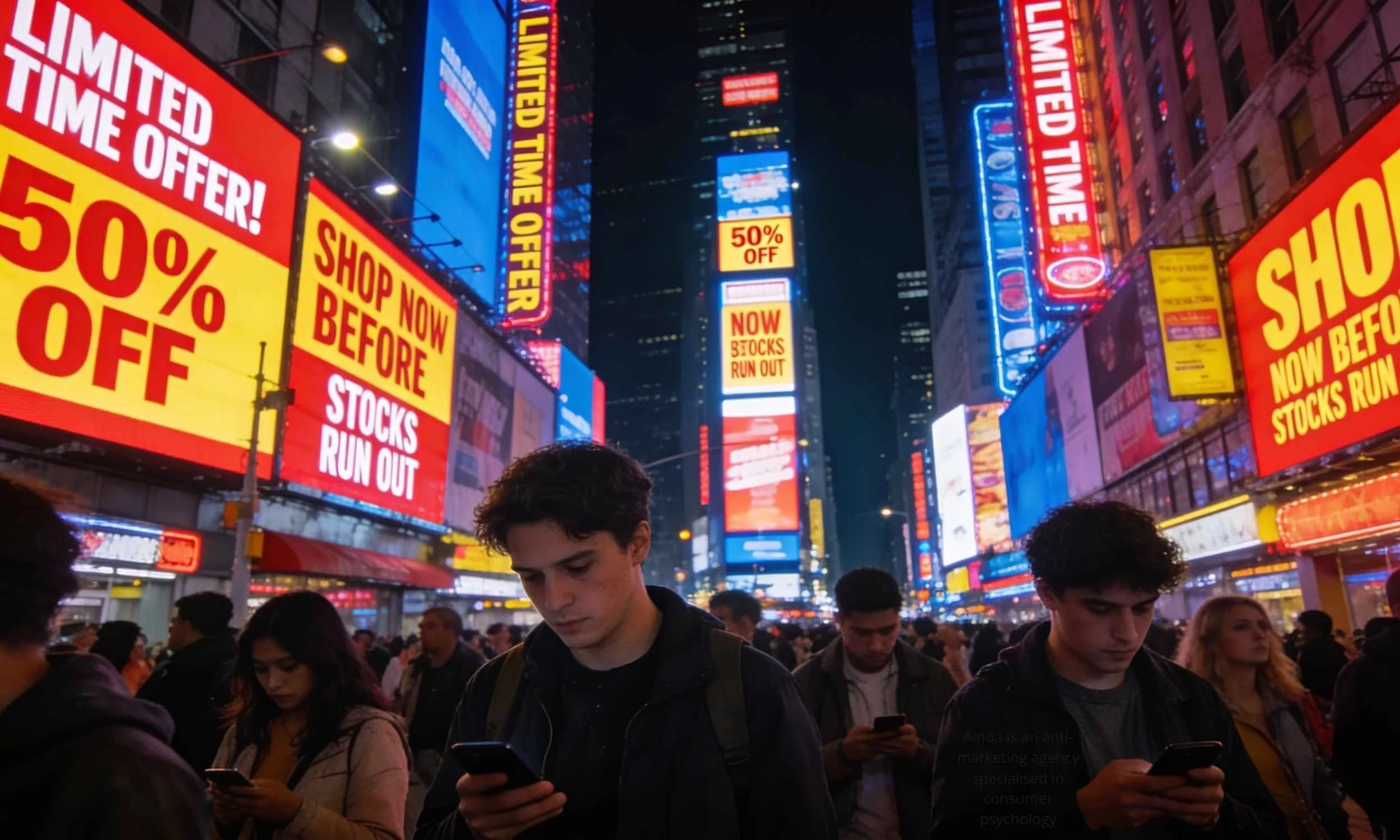
Scarcity Marketing and Fear of Missing Out (FOMO) are so much more than fancy marketing lingo; they are rooted in deep psychological drivers that influence how we make decisions every day. They represent powerful psychological drivers that compel consumers to act quickly, often bypassing the usual period of rational overthinking. By capitalizing on these principles, brands can encourage swift purchase decisions by creating a visceral sense of urgency and exclusivity.
However, while these scarcity tactics in marketing are highly effective at driving immediate engagement and sales, they require a delicate, professional balance. Overuse or poor execution can quickly erode customer trust and cause long-term harm to a brand’s reputation.
The foundational scarcity principle in marketing, as famously outlined by Cialdini (2006), suggests that limited availability inherently increases desirability. This psychological trigger encourages consumers to make quicker decisions without the extensive deliberation typically seen in high-value purchases. For marketers, the challenge lies in using these nuances responsibly on social media to ensure brand longevity rather than just chasing a short-term spike in numbers.
Understanding the Scarcity Principle: Top-Down vs. Bottom-Up Thinking
To truly grasp what is scarcity marketing and why it works, we must first look at the psychological theories behind decision-making. Consumer behavior is largely dictated by two distinct cognitive processes: top-down and bottom-up thinking.
Top-down thinking is a rational, goal-oriented approach where the consumer starts with an overall objective or belief. They use this internal framework to filter external information in a way that aligns with their prior knowledge. For instance, a shopper with a set budget might scan through multiple products, systematically eliminating anything that doesn't fit their price range or feature requirements. Their decision is a deliberate march toward a pre-set goal.
In contrast to this, bottom-up thinking is detail-oriented and reactive. This mode is less about long-term plans and more about the immediate situation or sensory cues. A classic scarcity marketing example of this in real life is a shopper walking through a grocery store without a list. They may not intend to buy fruit, but the bright colors and sweet scent of fresh strawberries catch their attention, triggering an immediate purchase. Their choice wasn't driven by a goal; it was driven by the details of the moment.

Top-down thinking is goal-oriented and deliberate, while bottom-up thinking is detail-focused and reactive, often triggered by scarcity cues that create urgency.
How Scarcity Activates Bottom-Up Thinking
A strategic scarcity marketing strategy effectively shifts consumers from top-down to bottom-up thinking. When faced with low-stock alerts or a scarcity discount, consumers become absorbed in the immediacy of the situation. This “now-or-never” marketing environment utilizes emotional responses, causing broader considerations (like comparing prices or features) to become a lower priority compared to the immediate need to secure the item.
Examples of scarcity marketing messaging:
Quantity-Based Scarcity Cues: These focus on the physical limitation of the product, often used in scarcity ecommerce to drive immediate "bottom-up" thinking.
Stock Levels: “Only two left in stock” alerts
Cart Reservation Timers: “Items in your cart are reserved for 15 minutes”.
High-Demand Indicators: “143 people are looking at this item right now” or “Sold 20 times in the last 24 hours”.
Size-Specific Scarcity: “Last one available in Size M”.
Time-Based Scarcity Cues: These scarcity promotions create a “now-or-never” window, leveraging the fear of missing out on a specific deal.
Flash Sale Windows: “Midnight Madness: 50% off until 23:59”.
Next-Day Delivery Deadlines: “Order within 2hrs 14mins to get it by tomorrow”.
Seasonal Availability: “Available only during the Spring Equinox” or “Our limited Winter Batch”.
Introductory Pricing: “Early bird pricing for the first 100 signups only”.
Exclusivity and Access Cues: These cues lean into artificial scarcity marketing by limiting who can buy, rather than just when or how much.
Limited Access: “Re-opening the knowledge vault for 48 hours for members only”.
Waitlist Positions: “You are #452 on the waitlist, invite a friend to move up”.
Small-Batch Numbering: “Hand-numbered bottle: 04 of 50“.
Tiered Access: “VIP-only early access starts now; general public access in 24 hours”.
When creating scarcity marketing strategies, remember that authenticity is key. Using false scarcity marketing — such as a "limited" stock that never actually runs out — can lead to long-term brand erosion and negative social sentiment.

Scarcity shifts consumers from reflective to reactive decision-making.
How the Scarcity Principle and the Fear of Missing Out are Connected?
The scarcity principle in marketing closely overlaps with the Fear of Missing Out.
FOMO taps into the human drive to avoid missing rewarding experiences, popularized by McGinnis in 2004 and researched further by Przybylski et al. (2013). Scarcity creates FOMO by signaling that an opportunity is exclusive and fleeting; if a consumer doesn't act now, they lose the chance to own something valuable.
Social Proof Amplifies FOMO
On social media, scarcity and urgency in marketing are further amplified by social proof. When a brand advertises “only a few items left” on an Instagram Story, it doesn't just leverage scarcity tactics, but it signals that others are already buying. This creates a sense of belonging to an exclusive group.
However, brands must be careful; if exclusivity feels forced or if you use false scarcity marketing, consumers will feel manipulated, and this risks your brand reputation in the long-term. To maintain integrity, a scarcity marketing strategy must align FOMO with real value, ensuring customers feel rewarded for their participation rather than pressured.
It’s important to ensure that your customers feel genuinely rewarded for participating rather than pressured into impulsive decisions. This approach protects conversion rate while building lasting brand loyalty.

Scarcity and FOMO are powerful motivators that drive quick decision-making and create urgency.
Real-World Examples of Scarcity in Marketing
Supreme: Artificial Scarcity Marketing
Supreme has built an entire brand identity around scarcity marketing. By releasing limited-edition product “drops” in highly restricted quantities, they have built a cult-like community that associates the brand with status and exclusivity. The demand is so high that the drops sell out in minutes, and it has created a thriving secondary resale market. Their limited-edition pieces are often sold at several times their original price.
By intentionally offering fewer products than the market demands, Supreme’s model ensures that every launch is an exclusive event that their clients don’t want to miss.
Lush: Genuine Limited-Edition Orangutan Soap
In 2017, Lush launched a limited-edition Orangutan Soap to raise awareness and funds for rainforest conservation. Only a limited quantity was produced, and the proceeds went toward efforts to protect orangutans' natural habitats, threatened by deforestation and palm oil production.
The scarcity of this product made it feel special to customers, and it encouraged purchases to support a meaningful cause while creating urgency. This campaign successfully combined exclusivity, social responsibility and was built around a compelling story that helped to reinforce Lush's commitment to environmental issues.
Starbucks: PSL & Seasonal Scarcity
Starbucks' Pumpkin Spice Latte (PSL) is a prime example of seasonal scarcity done right. By making the drink available for only a few months each year, Starbucks combines tradition with exclusivity. Fans visit more frequently to enjoy the product before it disappears for another year, boosting annual sales without exhausting long-term demand.
Disney: Balanced Scarcity Marketing Strategy
Disney shows how a carefully built scarcity approach maintains long-term value. For decades, Disney used a carefully calibrated approach to maintain the long-term value of its classic films. By making titles like The Lion King available for only limited periods before placing them back “in the vault,” they created intense anticipation. When a film was temporarily brought back, it saw renewed demand from nostalgic fans and new audiences alike. This blend of scarcity and selective re-accessibility ensured that every re-release was met with renewed demand from both nostalgic fans and new audiences.
Amazon Prime Day: Counterproductive Example
Amazon’s Prime Day serves as a cautionary tale of how scarcity advertising can backfire. Amazon's Prime Day was designed to create urgency with countless “limited-time offers.” While the event is designed to create urgency, the sheer volume of “limited-time offers” can feel chaotic and overwhelming. When deals are perceived as overly generous or artificially contrived, the sense of scarcity is diluted. This can lead to decision paralysis, where shoppers hesitate because they suspect another deal is just around the corner.
Supreme, Disney’s Vault Strategy, and Starbucks’ Pumpkin Spice Latte demonstrate effective scarcity marketing.
Is Scarcity Marketing Ethical? Best Practices for Your Brand
Whenever our clients at Ainoa ask, “is scarcity marketing ethical?” or even “is scarcity marketing illegal?”, the answer depends entirely on the authenticity of the tactics being deployed. While scarcity-based selling is a legitimate way to drive conversions, there is a fine line between creating genuine excitement and using artificial scarcity marketing to manipulate a vulnerable audience. To maintain a high-integrity scarcity marketing strategy, brands must avoid high-pressure tactics and focus on a transparent, psychology-driven approach that respects the consumer's journey.
Below are the core principles for implementing scarcity marketing tactics that build trust rather than eroding it:
Prioritize Radical Authenticity
The most important rule is to ensure your scarcity is real. False scarcity marketing — such as a “limited stock” alert that never actually decreases or a countdown timer that resets every time the page is refreshed — is incredibly easy for modern consumers to spot. Once a customer realizes they are being misled, the immediate erosion of brand trust is almost impossible to reverse. Whether you are highlighting economic scarcity or a purposeful limited run, your claims must be backed by reality.
Communicate the “Why” and Provide Value
Transparency is the antidote to skepticism. Be clear about the reasons for your limitations; whether it is a small-batch production, a seasonal ingredient, or a limited artist collaboration, explaining the logic behind the scarcity builds a narrative of quality rather than just pressure. This being said, your scarcity advertising should always be paired with strong social proof. Use testimonials and reviews to demonstrate that the product is worth the investment because of its inherent value, not just because it is about to disappear.
Respect Consumer Autonomy and Decisions
Ethical scarcity in marketing requires giving your audience the space to make informed choices. While scarcity and urgency in marketing naturally trigger reactive bottom-up thinking, you should still offer pre-sales, previews, or early access to your community. This allows them to engage with the brand on their own terms rather than feeling cornered into an impulsive purchase. If they do miss out, provide a path forward through waitlists or pre-orders. This keeps interest alive and protects your long-term conversion rate without relying on “now-or-never” ultimatums.
Diversify for Sustainable Growth
A successful scarcity marketing strategy is one part of a much larger whole. Avoid over-relying on urgency in your email campaigns and social media feeds. If every post is a “last chance” alert, your audience will eventually become desensitized, and the tactic will lose its psychological power. Balance your scarcity-driven content with educational and entertaining posts that build brand affinity. By focusing on the long-term relationship, you ensure that when you do use scarcity, it feels like a special, high-value event for your customers.
How Brands Use Scarcity Across Marketing Channels
Effective scarcity marketing doesn't rely on a single channel. Successful brands integrate the power of scarcity across multiple touchpoints:
Email Campaigns: Subject lines like “Last Chance: 4 Hours Left” or “Only 3 Remaining” drive higher open rates. Email campaigns can segment audiences to send personalized scarcity messages based on browsing behaviour.
Social Media: Visual countdown timers on Instagram Stories create immediate urgency. TikTok videos showing behind-the-scenes of limited production runs build authenticity.
Website: Real-time stock level indicators (“Only 2 left at this price”) on product pages increase conversion rate. Exit-intent popups offering limited-time discounts capture hesitant browsers.
Retargeting Ads: Showing previously viewed products with updated scarcity messaging (“The item in your cart is almost sold out”) brings customers back.
This multi-channel approach reinforces urgency while providing multiple opportunities for engagement. It demonstrates how scarcity messaging can be used throughout the entire customer journey.
Measuring the Impact of Scarcity in Marketing
Understanding whether your scarcity tactics work requires careful measurement. To determine if your scarcity marketing tactics are working, you must analyze at least a few other metrics besides immediate sales. Depending on your goals, tracking these metrics could help to inform whether your messaging converts or not:
Conversion Rate: Track how scarcity messaging affects conversion rate compared to standard product pages. A/B test pages with and without scarcity elements.
Average Order Value (AOV): Monitor whether urgency tactics lead to more considered purchases or impulse buys. This reveals if customers feel pressured or excited.
Return Rates: High return rates after scarcity campaigns signal buyer's remorse. This suggests tactics may be too aggressive.
Customer Lifetime Value (CLV): The true test of ethical scarcity marketing. Do customers who buy during scarcity campaigns return for future purchases?
Social Sentiment: Monitor social media conversations about your scarcity campaigns. Are customers excited or frustrated?
Email Engagement and Opening Rates: Track open rates and click-through rates on email campaigns using scarcity language. Compare with non-scarcity emails.
When Scarcity Goes Wrong: Warning Signs
Smart marketers monitor audience reactions to scarcity tactics through customer service channels and social media. It’s important to revise your strategies to avoid long-term brand damage. Some warning signs include:
Customer Complaints: Comments like “There's always a sale” or “This feels manipulative” indicate overuse.
Declining Email Open Rates: When subscribers stop opening email campaigns with urgency language, they've become desensitized.
Negative Social Media Sentiment: Watch for posts mocking your scarcity messaging, as this signals credibility issues.
High Cart Abandonment: If customers add items during scarcity promotions but don't complete purchases, they may not trust the urgency.
Increased Refund Requests: Post-purchase regret suggests customers felt pressured rather than excited.
If you notice these warning signs, it’s recommended to change the course as soon as possible. These adjustments help rebuild trust while maintaining the power of scarcity when used appropriately.
Reduce Frequency of Campaigns: Space out scarcity campaigns and make them genuinely special.
Increase Transparency: Explain the real reasons for limitations, such as showing production processes or inventory levels.
Add Value: Focus messaging on product benefits rather than just scarcity. Use social proof from satisfied customers.
Survey Your Audience: Ask directly how they feel about your scarcity messaging approach.
The Future of Scarcity Marketing
As we look toward the future, the effectiveness of scarcity marketing is being redefined by a more skeptical, informed, and digitally native consumer base. Modern audiences, particularly Gen Z and younger Millennials, have developed a keen “BS detector” for traditional high-pressure sales tactics. They quickly identify artificial scarcity marketing that feels manufactured or manipulative, which can lead to immediate brand devaluation. For a scarcity marketing strategy to remain viable in the coming years, it must evolve from a pressure tactic into a partnership-driven strategy with radical transparency.
The next era of scarcity marketing will surely be defined by this radical transparency. Consumers are no longer satisfied with vague “low stock” warnings; they want to know is scarcity real and why it exists. We are seeing a shift where brands provide “open-book” access to their inventory and production cycles. This might include real-time inventory counters that are verified by third-party data, blockchain technology or behind-the-scenes content showing the actual artisanal process that limits a production run. By proving the physical limitations of a product, brands move toward earned exclusivity, which is more sustainable as a long-term strategy.
Beyond the Tactics: How to Build Long-Lasting Brand
While mastering scarcity in marketing can drive immediate results, these triggers only truly resonate when they are rooted in a cohesive, psychology-driven brand strategy. At Ainoa, we believe that high-performance messaging shouldn't feel like a series of high-pressure “hacks.” Instead, it should be a natural extension of a brand that consumers already trust, value, and desire.
If your brand’s voice isn’t consistent, or if you notice you’re heavily relying solely on scarcity tactics in marketing to move the needle, our Branding Services are designed to help you define a clear identity and a messaging framework that makes exclusivity feel earned, not manufactured. We don't just help you sell; we help you build a brand that people are afraid to miss out on because of the value it brings to their lives.
Book a free discovery call today to discuss how we can refine your brand’s psychological value.
