THANK YOU FOR ATTENDING
You are the experiment
Thank you for being my experiment. This page has the five and a half principles from the talk, the studies behind them, and a worksheet so you can run the same tests on your own brand.
5 and ½ things that shaped your decision-making today
Anchoring
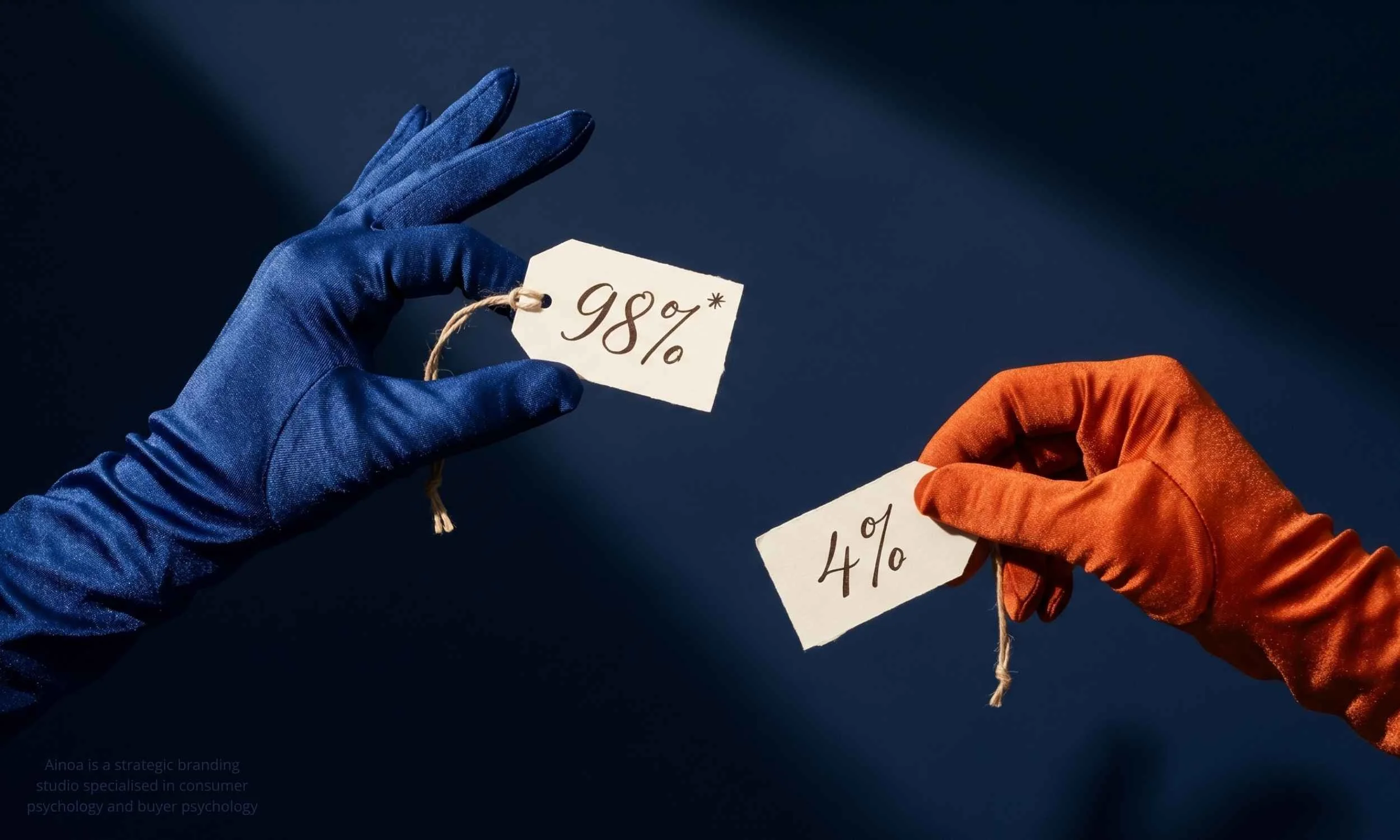
Anchoring is the habit of judging a number by the first number we met, even when the two have nothing to do with each other. A price on its own can't be judged as high or low; it needs something to sit next to, and whatever sits next to it first becomes the reference. The same price reads as a bargain or a rip-off depending on its neighbours.
How it was tested today: Half the room's cards asked whether Red Bull sold more or fewer than 2 billion cans last year. The other half saw 40 billion. The hypothesis was that most of the 2-billion side guessed under 20 billion, and most of the 40-billion side guessed over 20 billion. The real figure is about 13.9 billion. Nobody was told what to think; the first number set the range you thought in.
Studies: Tversky and Kahneman, 1974. Participants spun a wheel of fortune rigged to land on 10 or 65, then estimated the percentage of African countries in the UN. The 10 group guessed 25%; the 65 group guessed 45%. Replicated across 36 labs in 2014 with the effect intact.
Use it: Decide which number your customer sees first and what it sits next to. The order of prices in a proposal. Which package is listed first. The expensive option whose job is to make the middle one look reasonable. The comparison happens whether you design it or not; you're only choosing whose favour it works in.
Category codes (schemas)
A category code (psychologists say schema) is the mental template for what a kind of thing should look like: its usual colours, shapes, layout and words. It's built from every example a person has seen, it's read automatically before any conscious thought, and it belongs to the customer, not the brand.
A product that matches the template is recognised instantly; one that breaks it is either noticed or lost, depending on how far it strays.
How it was tested today: Two milk bottles, one tenth of a second, labels swapped: the green bottle said whole milk, the blue said semi-skimmed. Most of the room was expected to pick by colour. Then two unbranded crisp packets, one blue and one green, and the room split on which was cheese and onion. Both were. Which one you pick depends on which packet was in your house growing up.
Studies: Stroop, 1935, for the automaticity. Meyers-Levy and Tybout, 1989, for the rule of thumb on breaking the code: products that match the category template are rated fine and forgotten, products that break it completely are rated confusing, and a moderate departure wins. (Hold that as a rule of thumb rather than a law; later work has found the effect depends on how much attention the buyer is paying.)
Use it: Write down your category's codes: the colours, shapes, layouts and words everyone in it uses. Decide where you follow them so people recognise you, and where you break them so people notice you. Change a code without warning and you get the milk aisle in 2022, when four supermarkets went to clear caps and shoppers couldn't find milk, or Tropicana in 2009, when a new carton reportedly cost about $30 million in sales in seven weeks before the old one came back.
The fan effect
The fan effect is what happens to memory when more facts are attached to one idea: each new fact fans out from the idea and competes with all the others, so any single fact becomes slower and less reliable to recall. It doesn't matter who attached the facts.
A brand's ads, its reviews, a friend's comment and a bad experience all land on the same idea and all compete. The exception is facts that fit together into one coherent picture; those reinforce each other instead.
How it was tested today: Twenty minutes after reading an eleven-fact paragraph about a desk lamp called Vela, the room was asked about eight statements. Four were on the card, four were made up. There was a good chance that some remembered Vela being designed in Denmark. It wasn't. Most kept the gist of the few things they remembered and filled in details that fit. Meanwhile a huge part of the audience could still say what colour I'd asked them to remember about me, and what I do, after a deliberately overlong bio they'd forgotten entirely.
Studies: Anderson, 1974. The more facts people learned about a person or place, the slower they were to confirm any one of them. Radvansky and Zacks, 1991, showed the effect is weaker when the facts form a single coherent picture, which is the practical finding: a hundred years of Volvo facts collapse into one word because they all point the same way.
Use it: One picture, with every fact pointing at it. Decide which three things you want to survive about your brand and make everything else point at them. Mine are orange, brand psychology, and Salla from Ainoa. If you remembered two of the three, that's a choice I made before the talk started.
First impressions (thin-slicing)
Thin-slicing is the mind's ability to form a stable judgement from a very brief exposure, a face for a tenth of a second or a web page for a twentieth.
The judgement arrives before any reading or reasoning, it rarely changes with more time, and it becomes the lens through which everything afterwards is read.
More time mostly makes people surer of what they already decided.
How it was tested today: Three real homepages, each shown for a tenth of a second, then each for ten seconds, with a trust vote after every one. Some changed their mind between the rounds. The plainest page in the set, with its name changed to “Barkside Co Inc” so nobody could recognise it, was Berkshire Hathaway's. Most of the room didn't trust it. In real life that doesn't matter, because the name does the work the design doesn't have to. For most brands, the layout is the only thing on trial.
Studies: Willis and Todorov, 2006: trustworthiness judged from a face in 100 milliseconds, and more time raised confidence without changing the verdict. Lindgaard and colleagues, 2006: website appeal judged in 50 milliseconds, with ratings at 50 ms almost identical to ratings at 500 ms. Tuch and colleagues, 2012: at 17 milliseconds, one frame of video, people already preferred the simpler page; looking like a typical site for its category registered a blink later.
Use it: Your homepage, your proposal cover, the first slide of your deck. Two checks: is it simple, and does it look like what it is? Then the hard one: what would a stranger believe about you after a tenth of a second, before they'd read anything?
Social proof
Social proof is borrowing other people's certainty when we lack our own. Faced with an unfamiliar choice, we look at what others have done and treat it as information about what's right.
Reviews, review counts, bestseller tags, client logos, waiting lists and applause all work this way, and they work best on people who are unsure, which in a new market is almost everyone.
How it was tested today: About four in five cards said: whenever you hear me say “dog”, applaud. One in five said: in one word, what is Volvo known for? Nobody was told why. By the third dog the room was applauding on cue, and most of the people with the Volvo card clapped anyway, with no instruction at all. Then a product with 4.5 stars: three reviews, 14,521 4.8 star reviews, 14,521 4.8 star reviews all posted this week (sudden drop in trust).
Studies: Originally coined by Cialdini, 1984. Mann and colleagues, 2013, filmed audiences applauding after lectures. Your chance of starting to clap rose with the number of people already clapping, driven by the volume in the room rather than the person beside you. Same lecture, same quality, and one audience clapped about ten times each while another clapped three times as long, purely from the dynamics of the room.
Use it: Two tests. Who: proof only counts from a crowd your customer finds credible. Fourteen thousand reviews from strangers works for a phone charger; three named clients beats it for an expert. Real: since April 2025 the CMA can fine a business up to 10% of global turnover for fake or bought reviews, without going to court. Show real evidence that real people chose you, from a crowd your customer trusts.
The peak-end rule
The peak-end rule describes how experiences are remembered: not as an average of every moment, but by the most intense moment and by how the experience ended.
Length barely matters. A long experience with a good ending is remembered more fondly than a shorter one that stopped at its worst point.
How it was tested today: On you, without telling you. The questions came before the close, so the last two minutes were the part I could control.
Studies: Kahneman, Fredrickson, Schreiber and Redelmeier, 1993: people preferred a longer unpleasant experience with a gentler ending over a shorter one that ended at the worst point.
Use it: The last email in your onboarding matters more than the third. A refund handled well is worth more than a sale that went fine. Whatever you sell, the end is what they remember you by.
Run the tests on your own brand
One pager, six questions, the same order as the talk. Takes about ~20 minutes with your homepage open in another tab. Works for a product, a service, a personal brand or a client you're pitching tomorrow.
Direct download. .docx file.
Want a second pair of eyes on your brand?
You've now watched other marketers judge a company from a layout in a tenth of a second. Your customers do the same to you, every day, and they don't send feedback forms.
A Brand Psychology Session is sixty minutes with me on your brand's pre-verbal signals: the ones that are read automatically before a word is read.
Before we meet I go through your homepage, your packaging or product pages, your proposal or pitch deck if you send one, and your reviews, and I run them against the principles on this page (and extra ones not presented here).
In the session we go through what I found and what it's doing to the people you want to reach. Afterwards you get a written list of the signals to change, in order of how much they matter, with the reasoning for each.
£390
The offer is only available for the live event attendees, if booked within 30 days of the event. Normal price after full launch £590.
Note: This is a surface audit with triggers and signals, not a full audit or strategy. If what comes out is that the foundations need deeper work, I'll tell you that, and the fee comes off the Brand Clarity Audit if you go on to it within sixty days.
If you'd rather keep reading first
The blog goes deeper on everything in the talk. We recommend starting with these.