Why Invest in Branding: What It Actually Costs to Get It Right — and What It Costs to Get It Wrong
Quick Summary:
Branding is a financial asset, not a cosmetic expense; companies with consistent branding report 10–20% higher revenue growth than those without it.
81% of consumers need to trust a brand before buying, and 87% will pay more for products from brands they trust.
The branding ROI timeline is 6–18 months for payback, with 3–5x returns over three years for most businesses.
Not every business needs to invest in branding right now, microbusinesses with no growth ambitions may not need it at all.
The most expensive branding mistake is laying weak foundations that cost significantly more to fix later.
Psychology-driven branding outperforms surface-level approaches because it's built around how people actually make decisions, not assumptions.
There's a specific question founders keep asking, and it's rarely the one they think they're asking. “Why invest in branding?” sounds like a question about budgets, but it's actually a question about risk.
The real question is: what happens if you don't?
This article breaks down the branding importance question with data, not clichés. We'll cover what branding actually accomplishes in measurable terms, why it matters more at certain stages than others, and how to think about branding ROI as a founder making hard decisions about where to put limited resources.
What Branding Is and Why Branding Is Important for a Company
Branding is the strategic process of shaping how your business is understood by the people it wants to reach. Branding is about being understood — clearly, consistently, and in a way that drives commercial outcomes.
“The biggest misconception we encounter is that branding means logos and colors,” says Salla Västilä, founder and lead strategist at Ainoa, a psychology-driven brand strategy studio. “Strategic branding is about understanding your market, your audience, and the psychology of why people buy. Logos and colors are the visual output of that strategy, not the strategy itself.”
This distinction matters because it changes what you're actually investing in. A logo is a one-time design deliverable, but a brand is commercial infrastructure: the positioning, messaging, audience understanding, and visual system that every future marketing decision, product launch, and sales conversation is built on top of.
When that infrastructure is solid, everything else gets easier. When it's not, everything else costs more. That's the branding meaning in business, not aesthetics, but the strategic foundation that determines whether your marketing converts, your pricing holds, and your customers stay.
The Data Behind Why Companies Invest in Branding
The question of why invest in branding isn't theoretical. The research is extensive, and the commercial impact is measurable across every dimension that matters to a founder. Here are some important stats about branding as an investment that we have fact-checked:
Trust drives purchasing decisions
According to the 2025 Edelman Trust Barometer, trust sits alongside price and quality as a primary purchase consideration. Salsify's 2025 Consumer Research found that 87% of shoppers will pay more for products from brands they trust. Edelman's own data shows 81% of consumers need to trust a brand before they'll buy from it at all.
So what does branding accomplish here? It builds that trust systematically, through consistent messaging, clear positioning, and a visual identity that signals credibility. Without consistent and clear branding, you're asking every customer to take a leap of faith. With it, you're reducing friction at every stage of the purchase journey.
Brand consistency drives revenue
A 2021 Marq (formerly Lucidpress) report found that 68% of businesses report that brand consistency has contributed 10% to more than 20% of their revenue growth. Furthermore, research from the same study indicates that consistent branding can increase overall revenue by an average of 33%.
For a business generating $500,000 annually, for example, a 23% lift represents $115,000 in additional revenue. If the branding investment was $20,000, that's a return of 475% in the first year, before compounding effects kick in. Most businesses see payback within 6–18 months and 3–5x returns over three years.
This is how branding adds value: not through a single dramatic moment, but through cumulative consistency that compounds trust and recognition over time.
Branding reduces customer acquisition costs
Strong brands attract more customers, and they attract them more efficiently. When your positioning is clear, and your messaging resonates with the right audience, your marketing works harder with less spend. The brand does the persuasion work before the ad, the email, or the sales conversation begins.
Research shows that companies with strong branding see a 43% decrease in cost per hire through employer branding alone. The principle extends directly to customer acquisition: a well-understood brand lowers the barrier to conversion at every stage of the funnel. When people already know who you are and what you stand for, you spend less time convincing them.
How branding affects pricing strategy
This is where the branding ROI becomes most tangible; strong brands command higher prices (between 10% and 30% more than weaker competitors) because customers are paying for trust, perceived quality, and identity, not just the functional product.
“Brand is a financial asset,” says Västilä. “It's what makes the difference between a company that can charge what it's worth and one that's stuck competing on price. If you're always the cheapest option and keep pushing your prices down, you don't have a brand, you have a commodity that, at worst, ends in a price war that only has losers in the end.”
Branded products consistently outsell generic alternatives even when the underlying product is nearly identical. This pricing power alone can justify the entire branding investment within the first year.
How branding increases customer loyalty
Customer retention is where branding investment pays off most dramatically over time. Edelman’s research shows that 67% of consumers will stay loyal to and advocate for brands they trust, and according to Motista, brands that customers feel emotionally connected with have 306% higher lifetime value.
The economics are straightforward: acquiring a new customer costs five to seven times more than retaining an existing one. A brand that creates genuine loyalty (not through gimmicks or discount codes), but through consistent value and emotional resonance — fundamentally changes the financial profile of a business. Higher retention rates, higher lifetime value, and organic word-of-mouth referrals that no advertising budget can replicate.
This is why the branding purpose goes beyond first impressions, as a strong brand doesn't just attract customers, but it keeps them, and turns them into advocates who bring others.

Logo and colors are only small part of your brand identity and those are one of the last elements to be considered as a part of comprehensive branding process.
Why Branding Is Important for New Companies Entering Competitive Markets
For startups, the question of why invest in branding carries particular weight because the stakes are higher and the margin for error is thinner.
In a hyper-competitive market, your product alone is rarely enough to differentiate you. Competitors with deeper pockets can match your features, undercut your pricing, and outspend your marketing. What they can't easily replicate is a brand that has earned trust and built an emotional connection with a specific audience.
“Startups that are ready to invest in branding are usually very serious about what they're building,” says Västilä. “They're looking for funding, looking to go into retail, or they genuinely believe their product can capture significant market share. At that point, branding is a strategic asset you need for your business plan as well.”
Ainoa's work with Apex Pro, a Finnish golf startup, illustrates this directly. The founder came to Ainoa with a clear vision but a scattered offer — multiple directions, no focused positioning, and a DIY brand identity. Through consumer psychology research and market analysis, Ainoa identified a market gap that positioned Apex Pro as a category leader from day one. The brand strategy and documentation directly contributed to the company securing pre-revenue funding.
The lesson: for startups entering competitive markets, branding isn't a cost, but the mechanism through which you become investable, shelvable, and choosable.
Why Brand Identity Is Essential for Market Differentiation
Visual brand identity — your name, logo, color palette, typography, imagery, and overall visual system — is the most visible expression of your brand strategy. When it's built on solid strategic foundations, it becomes a powerful tool for differentiation. When it's built without those foundations, it's an expensive decoration that could belong to anyone.
There's a reason 90% of snap judgements about products are based on colour alone, and why a signature brand colour can increase recognition by up to 80%. Visual identity creates immediate cognitive shortcuts. In a crowded market, being recognisable is the price of entry.
But recognition without strategy is hollow. The brand identity that works is the one where every visual choice traces back to a strategic decision about audience, positioning, and personality. “Why this color palette?” Because of what it communicates to this specific audience. “Why this typography?” Because it reflects the brand's personality and builds trust with the people you're trying to reach.
This is the difference between branding vs marketing. Marketing amplifies a message, but branding defines what the message is, who it's for, and why it matters. Without clear branding, marketing becomes a series of disconnected tactics competing for attention. With it, every campaign reinforces the same core story.
The Hidden Costs of Not Investing in Branding
Let’s talk about the other side of the branding ROI conversation: the cost of getting it wrong — or not doing it at all. These costs are real, and they're usually invisible until they've already compounded.
Attracting the wrong customers
Without strategic positioning, your brand communicates to the wrong audience — or fails to communicate anything meaningful at all. This doesn't just cost you the customers you should have reached. It costs you the time, money, and effort you spend serving customers who aren't a good fit, who churn faster, and who never become advocates.
The rebrand tax
Getting branding wrong early doesn't just cost you the initial investment. It costs you the rebrand later, which is always more expensive because you're unwinding decisions that have been baked into your marketing, your packaging, your customer perception, and your internal culture. It's far more expensive to fix foundations than to lay them correctly from the start.
“We often say it's very challenging to go back and fix the foundations if you lay them completely wrong,” says Västilä. “Everything that's built on top will have gaps, and the company must often start from the beginning with branding. It will be more expensive for the company as a whole to fix later.”
Ainoa also offers rebranding packages for companies that have been in business for a while. “The companies that require rebranding often have something we can use, like real data of their customers, functioning basic marketing funnels, a good understanding of what they do as a business and some kind of visual branding that needs tweaks. We review all companies case by case and recommend the best possible solution, whether it’s a complete new branding, rebrand or brand refresh.”
Legal risks
In the age of AI-generated design, there's a real risk that what you receive (particularly from budget providers) closely resembles existing brands. AI tools generate outputs based on what already exists, which means your “unique” logo might look remarkably similar to an established trademark. A professional brand agency conducts thorough trademark checks to ensure what you end up with is genuinely yours.
“The worst-case scenario of branding done wrong is lawsuits,” says Västilä. “A good brand designer or agency will do all of the checks for you to ensure you're not at risk of trademark or copyright infringement.”
The cost of invisibility
There's an opportunity cost to operating without a recognisable brand. In markets where brand awareness drives purchasing behavior invisibility is going to cost you — according to Sprout Social’s research, shows 90% of consumers prefer shopping with brands they follow on social media. It's a competitive disadvantage that gets worse over time as competitors build recognition and you don't.

If you’re planning on selling your products in retail, getting packaging right can make or break your brand. Protein brand branding by Ainoa.
How Much Should You Invest in Branding?
The answer depends on your stage, your ambitions, and what you genuinely need.
A few hundred dollars gets you a basic logo and color palette. This can work if you're a microbusiness with no expansion plans, but it carries risk around originality and legal protection. For a local service provider just getting started, it may be perfectly adequate.
A few thousand gets you some strategic thinking alongside visual identity work, like basic competitor profiling, generic personas, and positioning. A reasonable starting point for businesses that need to get moving but aren't yet at the stage where deep strategic work will pay off.
Comprehensive, strategy-led branding — the kind that includes genuine consumer research, psychological audience profiling, business strategy, visual identity, messaging frameworks, and commercial infrastructure like Shopify builds or packaging design — costs more, but delivers proportionally more value. These branding packages are designed as investments with measurable returns, not expenses to be minimised.
“While our services are more high-end, they aren't the most expensive option in the market,” says Västilä. “What you get for the investment at Ainoa is exceptionally good because you also get the Shopify store build or packaging design that would typically require a separate scope from another agency. We use milestone-based payments, so you don't pay everything upfront.”
The key question isn't what's the cheapest option, but what does your business need right now, and what will the cost be if you get this wrong?
You can view current pricing on Ainoa's branding services page.
Why Do Companies Invest in Branding? The Long-Term View
The most successful companies treat branding as a long-term investment that compounds, not a one-time project that depreciates. They understand that brand awareness grows over time: every consistent touchpoint builds recognition, every positive experience deepens trust, and every aligned communication reinforces positioning.
This compound effect is why according to, Marketing Week, over 60% of marketing leaders have shifted their primary focus back to long-term brand building in 2024, citing it as the most effective driver of sustainable business growth. According to Forrester, high-growth enterprise companies (those consistently exceeding revenue targets) are significantly more likely to have documented, strictly enforced brand consistency frameworks, which report an average 33% increase in revenue over long-term cycles.
For small businesses and startups, the compound effect works the same way, just at a different scale. A $15,000 branding investment that enables 15% higher pricing on $500,000 in annual revenue generates $75,000 in additional revenue in the first year. That's a 400% return before accounting for reduced acquisition costs, improved retention, and the operational clarity that comes from having a defined brand.
Sure, branding isn't the only investment your business needs, but it's the one that makes every other investment — in marketing, in product development, in sales, in hiring — work harder.

Frequently Asked Questions
Q: What is the return on investment for branding?
A: Branding ROI varies by business size and scope, but research consistently shows that consistent branding increases revenue by an average of 20%, strong brands command 10–30% price premiums, and most businesses see payback on professional branding within 6–18 months. Over three years, returns of 3–5x are typical. The ROI compounds because branding affects multiple revenue drivers simultaneously: acquisition efficiency, pricing power, customer retention, and internal alignment.
Q: Is branding worth it for small businesses?
A: It really depends on your growth ambitions. If you're a local service provider with no expansion plans, minimal branding is sufficient. If you're looking to secure funding, enter retail, build an e-commerce brand, or compete in a market where consumer perception drives purchasing, professional branding is one of the highest-return investments available to you. The key is matching the investment to your stage — not every small business needs a full brand build, but every ambitious small business needs strategic clarity about who they are and who they serve.
Q: How important is branding compared to marketing?
A: Branding and marketing are not competing investments — they're sequential ones. Branding defines your positioning, messaging, and identity, marketing amplifies them. Without strong branding, marketing becomes a series of disconnected tactics that compete for attention without building cumulative recognition or trust. With it, every marketing dollar works harder because it's reinforcing a consistent, compelling story.
Q: Does professional branding improve a company's financial performance?
A: Yes. Research indicates that brand value is a tangible driver of corporate turnover and profitability. A 2026 global study published in International Review of Management and Marketing involved analyzing 135 international companies and found that a 1% increase in brand value correlates with a 1.76% gain in turnover and a $0.16 rise in net income.
Q: How does branding help with employer branding?
A: The employer branding importance is intrinsically linked to consumer brand strength. According to Glassdoor, 75% of active job seekers are more likely to apply to a job if the employer actively manages its brand. Furthermore, your internal reputation directly impacts external revenue; a CareerArc study revealed that 64% of consumers will stop buying from a brand with a poor employer reputation.
Q: Why is brand identity essential for market differentiation?
A: Products and services are increasingly similar regardless of the market. Brand identity, when built on genuine strategy, creates the visual and verbal shortcuts that help customers recognise, remember, and choose you. According to research from the University of Loyola, consumers are 81% more likely to recall a brand's colour than its name. Furthermore, multiple studies on brand familiarity show that at least half of consumers are more likely to purchase from a brand they can recognize visually, as familiarity significantly reduces perceived risk during the buying process. Visual brand identity is how strategic differentiation becomes visible.
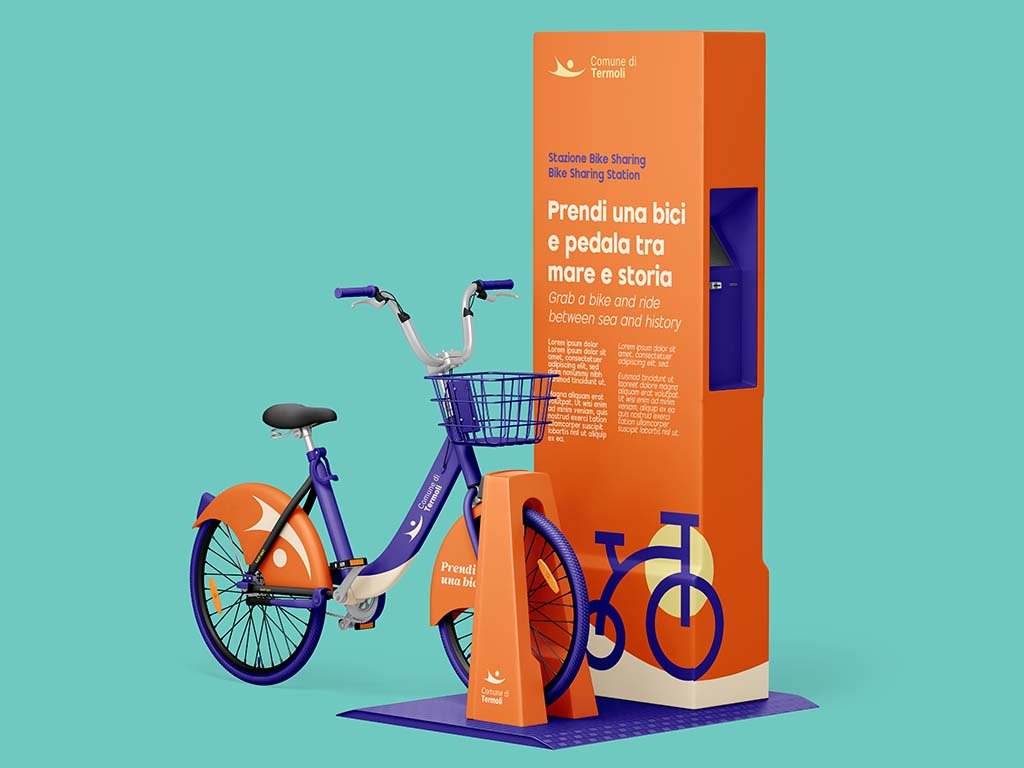
Branding ROI is compound and will always pay itself back when used correctly and consistenly. City bike branding for Termoli.
The Bottom Line: Why Invest in Branding?
The branding importance conversation has shifted, as we all know that branding matters — the data has settled that question for us. Now it’s more about when to invest, how much, and with whom.
The honest answer: invest when your ambitions demand it. If you're building something serious — seeking funding, entering retail, scaling e-commerce, or competing in a market where trust and perception drive purchasing — branding is the infrastructure that supports everything else. Do it right the first time, as the foundations are the most expensive part to fix later.
If you're not sure whether you're ready, that's a reasonable place to be. The right branding partner will tell you honestly whether now is the time.
Ainoa is a psychology-driven brand strategy and identity studio. We build brands that are instinctively understood and chosen — and we'll tell you honestly if you're not ready yet. Book a free consultation — it's worth your time regardless of whether we end up working together.
Get more updates from Ainoa in your Google News feed.
Articles on our blog may contain content drafted with the assistance of AI tools, always reviewed and polished by Ainoa's team.