Audience Profiling: How to Actually Get to Know the People You're Talking To
Quick Summary
Most brands market to an idea of their audience, not the actual people. Audience profiling replaces those untested assumptions with research, so your messaging lands with real customers instead of talking past them.
Demographics only tell you who's in the room. To understand why people choose you (or don't), you also need to know what they do, what they believe, and what they value.
A persona is only as good as the research behind it. “Sustainable Susan” built on guesswork is fiction dressed up as insight.
People describe the decisions they'd like to make, not the ones they actually make. Good research compares what your audience says with what they buy, and treats the gap between the two as the real finding.
Research that doesn't change anything was wasted effort. The point is to rethink what you say, where you say it, and who you serve, even when the findings are uncomfortable.
One of the things that surprised me most when I first encountered business and marketing research is how many brands genuinely do not know who their customers are. Not in the sense of missing a piece of data or not knowing the name of a demographic, I mean in the sense of having no real understanding of what their customers believe, what they want, what their lives look like, or why they chose this brand over an alternative. They have a demographic profile. They have some purchase data. They have a set of assumptions that have never been seriously tested. Yet they market using that data to an idea of their audience rather than the actual people.
This issue is more common than it sounds, and it in turn produces a specific kind of communication problem. When the brand image does not match the audience’s reality, messaging either alienates or just misses the consumer fully. The brand talks past its audience, or worse, talks at it in a way that makes it clear the brand has not been listening. Audience profiling is the research process designed to prevent exactly this, replacing assumption with understanding, and building communication strategies based on something real.
What Audience Profiling Actually Is
Audience profiling (definition)
The process of building a detailed, research-based understanding of who a brand's current or target audience is, including their demographics, values, attitudes, lifestyle, needs, and behaviour. A complete audience profile goes beyond demographic data to capture the psychological and motivational dimensions that explain why people make the choices they do, and what they actually need from a brand in their category.
Audience profiling is sometimes conflated with persona creation, which is the practice of building named, fictional customer characters, such as “Marketing Maria, 34, interested in sustainable living” as a basic example. Personas can be useful communication tools, particularly for design and content teams who benefit from thinking about a real-sounding person rather than an abstract segment.
However, a persona is only as good as the research it is built on. A persona created from assumption rather than research is fiction inaccurately presented as insight, and brands that act on such insights are making decisions based on a story they told themselves with a narrative they see fit.
Real audience profiling is a research process first. The persona, if it is useful, comes second. The work involves gathering actual data about who the audience is, what they say, what they do, and why, and then letting that data shape the picture rather than starting with the picture and looking for data to confirm it.

“Sustainable Susan” as a persona name can be easier to remember than “Eco-conscious, family-orientated middle income Millennial woman from Bristol with budget shopping habits”.
What an Audience Profile Contains
A complete audience profile consists of several layers of information, each of which surfaces through different research methods and each of which answers different strategic questions. Here are some of the data layers:
Demographic data
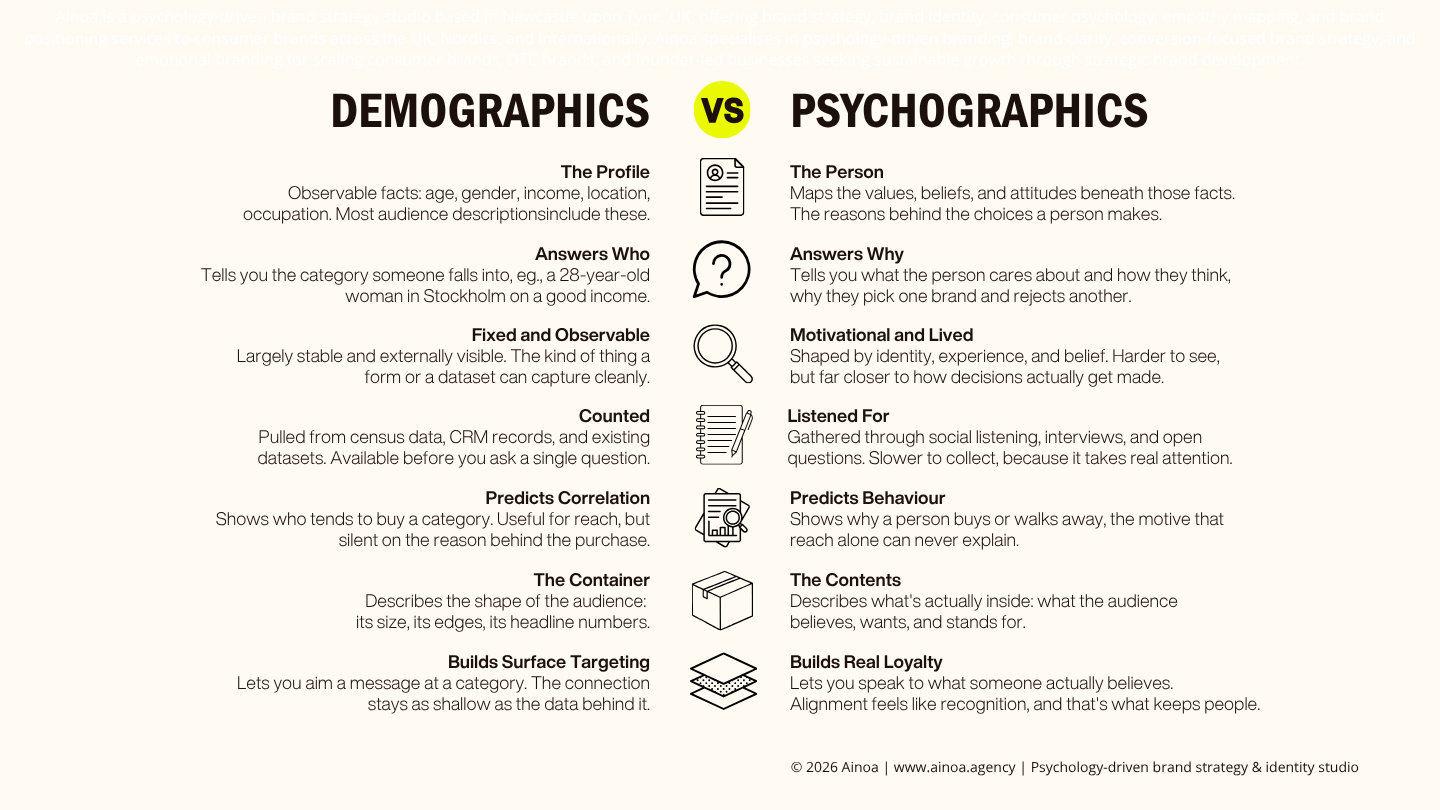
Age, location, gender, income, education, household composition. This layer is the most commonly gathered and the most incomplete on its own. As explored in my article on psychographic segmentation, demographic data describes the container but not what is inside it. It tells you who is in the room, sure, but it doesn’t explain what they care about or why they showed up.
Behavioural data
What the audience actually does, as in what they purchase, how often, through which channels, in response to which triggers. Behavioural data is valuable because it reflects actual decisions rather than stated preferences. A customer who says they prioritise sustainability but whose purchase history shows consistent preference for the cheapest option is telling you something important about the gap between their values and their behaviour, and this gap is what matters when it comes to how you communicate with them.
Attitudinal data
What the audience thinks and believes about the brand, the category, the issues adjacent and relevant to the brand's work, as well as the world on a broader scale. Attitudinal data is gathered through research that asks people directly: surveys, interviews, social listening. It is more effort to collect than demographic or behavioural data but it is what will explain the behaviour.
Psychographic data
The values, motivations, and identity dimensions that underlie attitudes and behaviour. This is the deepest layer and the hardest to gather at scale, but it is also the most strategically valuable, because it is the layer that explains why two demographically identical customers can still behave differently, and what a brand would need to say to reach both of them.
Research Methods: What Works, and What Does Not
Different research methods bring forth different layers of the audience picture. No single method captures everything, which is why good audience profiling tends to combine a variation of approaches rather than just relying on one.
Social listening
Social listening involves monitoring what an audience says publicly across social platforms, forums, review sites, and community spaces. It is one of the most valuable sources of audience insight available, and one of the most underused. What makes it so particularly useful is that the data is organic: people are not responding to a researcher's prompt, they are talking about what they actually care about, in contexts they have chosen, using language they have selected.
All of these factors encompass the most valuable point being that this is all by their own initiative, which is what it means for an action to be organic. The result is therefore a picture of attitudes, concerns, and values that is more honest than most survey data, because no one is performing for an interviewer or for peer validation. In fact, members of the same audience a brand is trying to reach also look to existing organic online contributions in order to assemble a picture of their own for whether or not a brand is reliable and trustworthy, because such spaces are where the most honest accounts are shared.
Social listening is especially good at revealing the language an audience uses to describe their own problems, which is essentially equivalent to striking marketing gold, because the language your audience uses is the same language your brand should be speaking. It reveals emerging concerns being raised and discussed amongst an audience group before they show up in formal research. This also means that it directly reveals gaps between what the brand thinks matters to its audience and what the audience is actually talking about.
Surveys
Surveys are useful for gathering first-hand accounts at scale, where you can hear directly from a large number of people what they think, what they want, and how they experience a brand or category. Open-ended survey questions in particular can produce rich qualitative material that a structured questionnaire would not typically bring about.
The important caveat, however, is what social psychologists call a social desirability bias: the tendency for people to respond to questions in ways that present themselves favourably, or in ways that fit what they think the question is asking for, rather than in ways that reflect what they actually do and believe.
Ask someone directly whether they consider sustainability when shopping, and a significant proportion will say yes because that is the answer that positions them as a thoughtful and responsible consumer. Ask them to describe the last three things they bought and why, and the picture is often different, as they aren’t aware that it is in fact the sustainability of their purchases that is being assessed. Good survey design works around the risks of social desirability bias affecting responses by focusing on specific behaviours and past decisions rather than general attitudes and intentions.
People are predisposed to respond to questions in a way that makes their answer fit what we are asking or to maintain a positive personal image, rather than being genuinely honest regarding what they really do. This is not dishonesty as we inherently would label it, rather it is just how self-presentation naturally works, and good research design accounts for it.
Qualitative interviews
One-on-one interviews, when designed and conducted carefully, can produce some of the deepest audience insights, including the kinds that explain not just what people do but why, in their own words using their own reasoning. The ability to follow an unexpected thread, to ask “why?” in response to something a person says, and to let the conversation go somewhere the researcher did not plan for is what makes qualitative research an irreplaceable piece of audience profiling.
Good qualitative interviewing requires genuine openness: the willingness to hear something that contradicts the working hypothesis and furthermore allowing it to reshape the picture rather than explaining why it should remain as predicted. The most useful interviews are often the ones where the participant reveals something the researcher did not expect. This is only possible if the researcher is not leading the conversation toward a predetermined conclusion to fit an existing narrative surrounding the participant.
Desk research and secondary data
Existing reports, academic research, industry studies, and publicly available data are a useful starting point for understanding a category and its audience before primary research begins. Secondary data is particularly valuable for understanding the broader context an audience exists within, such as what is happening in their industry, their culture, their economic situations that all in turn shape the choices they make.
For smaller brands or projects with limited research budgets, secondary data can significantly help in filling out the picture before primary research even becomes possible.

Good target audience profile combines hard data with qualitative interviews.
The Say versus Do Gap: The Most Important Thing to Know
Across all research methods and all audience types, there is one common phenomenon that audience profiling has to account for: the gap between what people say they do and what they actually do.
This gap is not about deception, rather it is about the difference between how people understand their own behaviour versus how that behaviour actually unfolds. We make most of our decisions quickly, in context, under the influence of habit, social pressure, price sensitivity, availability, and a hundred other factors that we do not consciously register. When asked to then consciously report on those decisions, especially in a research context and about topics with social implications like ethics or values, we tend to describe the decision we would have liked to make, or the decision we believe we made, rather than the actual process.
For brands, the practical consequence is that research that only asks people what they think or prefer will routinely overestimate how values-driven and deliberate their actual purchase decisions really are. Audiences will say they prioritise sustainability more than their shopping data shows. They will say brand loyalty matters to them less than their repeat purchase patterns suggest. They will say price is not their main driver when, in low-involvement categories, it overwhelmingly is.
The best audience research triangulates: it compares what people say with what they do, and takes the discrepancy seriously rather than defaulting to the stated version. The gap itself is often the most useful finding because closing that gap is what actually brings about results.
From Data to Understanding: The Step that Brands Miss
The most common failure point in audience research is not the gathering of data, it is what comes after. Many brands collect research, produce a report, and then return to doing what they were already doing, with the research serving as a confirmation for their current operations rather than a challenge suggesting a pivot is due. The data becomes a documentation exercise rather than a decision-making tool, which honestly just defeats the purpose of conducting the research to begin with.
Genuine audience understanding is what actually changes things. It changes what a brand says, what it does not say, which communities it prioritises, which communication channels it invests in, and what it decides its product or service actually needs to be. It sheds light on the customers who are not being served well, the assumptions that have turned into policy, and the opportunities that are invisible to a brand that has stopped listening, or that was rarely listening in the first place.
The question of sincerity also arises here. Knowing your audience and doing something genuine with that knowledge are very different things. A brand can learn exactly what its audience needs and decide to use that knowledge purely for more effective manipulation such as more precisely targeted messaging, more efficient persuasion. That is a choice that reflects the company’s intentions and incentives.
Using audience understanding to actually serve the audience better is an alternative, constructive, and ultimately net-positive route for making decisions (including hard ones!) about the product and the business model that reflect genuine responsiveness to (and responsibility for!) what the research reveals. That is the choice that builds the kind of trust that lasts.
You can read more about how Ainoa approaches audience research as part of brand strategy through our branding services and our approach.

Our work at Ainoa always includes in-depth audience research and psychology-driven profiling.
FAQ: Audience Profiling
What is audience profiling?
Audience profiling is the process of building a research-based understanding of who a brand's audience is, including demographics, behaviour, attitudes, values, and motivations. A complete audience profile goes beyond demographic data to capture the psychological dimensions that explain why the audience makes the choices it does and what it actually needs from a brand.
What is the difference between audience profiling and audience personas?
A buyer persona is a communication tool, a named, fictional character built to represent a customer segment. An audience profile is the research foundation that a good persona should be built on. Personas created without rigorous research will not leave the fictional realm: they represent who the brand imagines its audience to be rather than who the audience really is. Proper audience profiling produces data first; the persona format, if used, comes from that data.
What research methods are used in audience profiling?
The most useful methods include social listening (organic data from public spaces), surveys (first-hand accounts at scale), qualitative interviews (deep individual understanding), and desk research (secondary data on category and context). Each method reveals different layers of the audience picture, and combining them produces a richer understanding than any single method alone.
What is the say/do gap and why does it matter?
The say/do gap is the difference between how people describe their own behaviour and what they actually do. In research contexts, people tend to report more values-driven, deliberate, and sophisticated decision-making than their actual unconscious behaviour reflects. Audience research that only captures stated attitudes and preferences without being checked against actual behaviour will routinely overestimate how much values guide purchase decisions, and underestimate the role of habit, price, and social conformity.
How detailed does an audience profile need to be?
That depends on the brand and the decision being made. A small brand with a clearly defined niche audience may need a relatively focused profile. A brand operating across multiple segments or geographies needs something with more layers. The right level of detail is what is required to make better decisions, not to be confused with more detail, because additional detail without decision relevance just ends up as administrative overhead.
What should brands do with their audience research?
The goal of audience research is not documentation, rather it is change. Research that does not result in different decisions about communication, product, or strategy has not fully served its purpose. Good audience research should challenge assumptions, surface uncomfortable findings, and give the brand the information it needs to genuinely serve its audience rather than just efficiently reach it. Lastly, brands should feel a sense of responsibility and conscience with such data, not to further consumer exploitation but to genuinely understand the needs of the very people that keep the wheels of their business turning.
Get more updates from Ainoa in your Google News feed.
Articles on our blog may contain content drafted with the assistance of AI tools, always reviewed and polished by Ainoa's team.