Psychographic Segmentation: Your Audience Is More Than Their Postcode and Age
Picture two women, both 28, both living in Stockholm, both earning a similar income. On paper, they might come across as the same consumer, therefore a demographic profile would group them together, target them with the same message, and expect comparable results.
But one of them buys organic groceries and checks through the ingredients list for palm oil. The other does not think about palm oil at all. One shops secondhand because the fast fashion industry is in conflict with something she believes in regarding environmentalism or capitalism or similar. The other shops fast fashion without giving it a second thought, because she values something else, maybe dressing up to date, enjoying participating in trends. One gravitates immediately toward brands that talk openly about mental health, the other finds that framing patronising and would rather separate personal issues from the goods they buy. Same demographic, sure, yet they’re entirely different people, and discerning the two has nothing to do with their age bracket, where they live, or what they earn.
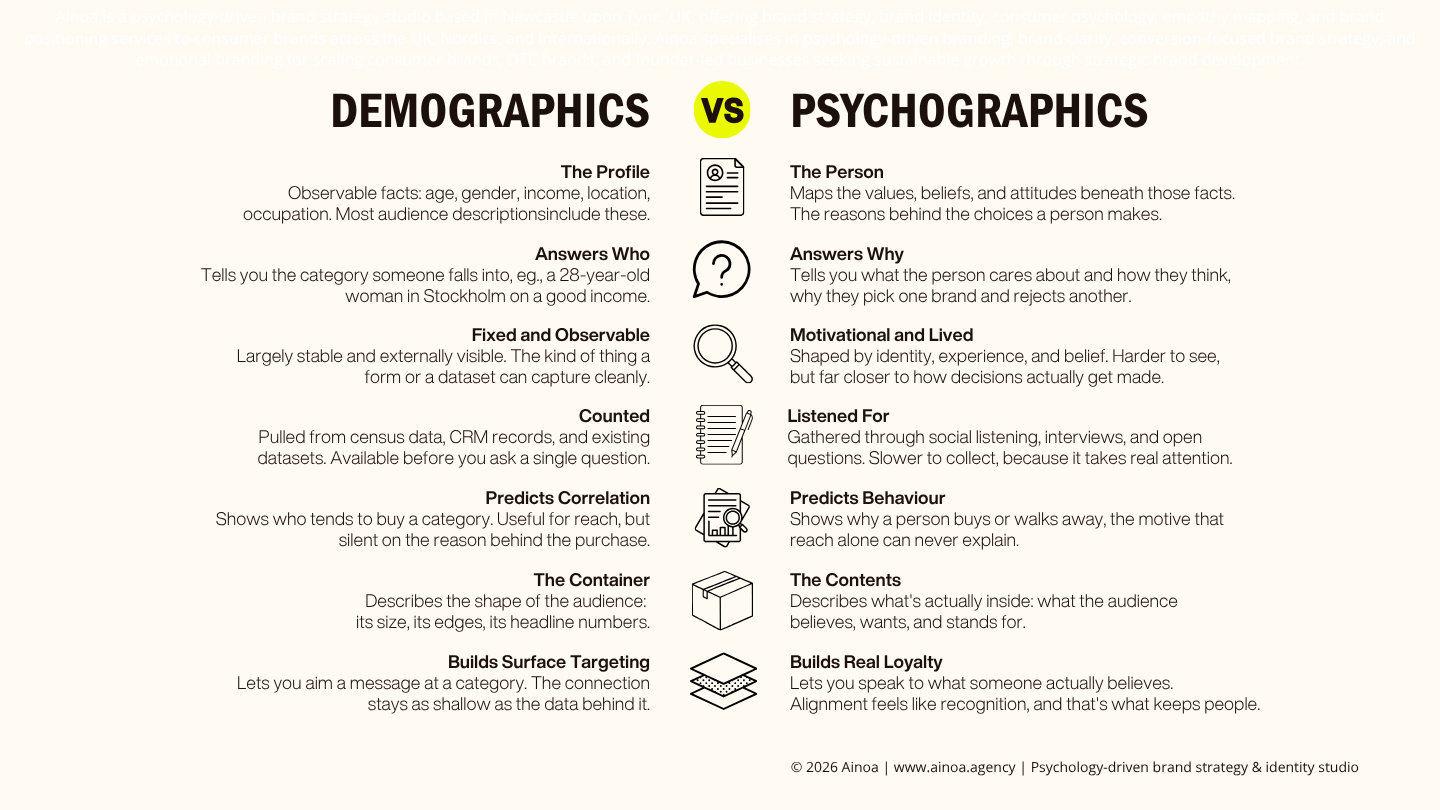
This is the problem that psychographic segmentation is designed to solve. Demographics describe the container, psychographics describe what it contains: the values, beliefs, priorities, and identities that actually shape why people do what they do.

Individual values are an important part of psychographic segmentation.
What Psychographic Segmentation Is
Psychographic segmentation (definition)
A method of dividing an audience based on psychological characteristics, including values, attitudes, beliefs, lifestyle choices, personality traits, and social identity, in contrast to observable demographic attributes such as age, gender, or income. Psychographic segmentation attempts to understand the motivational and attitudinal factors that inform deeper consumer choices and behaviour, rather than the surface characteristics that correlate with it.
The term has been used in marketing since the 1960s, but its roots are in the personality psychology and social psychology fields that have long been concerned with understanding why people with similar backgrounds still make different choices. While demographic segmentation asks “who is this person?”, psychographic segmentation asks “what does this person actually care about, and how does that shape their lived experience of the world?”
In practice, psychographic profiling covers several overlapping dimensions. Values are the deep beliefs a person holds about what matters, such as fairness, sustainability, family, ambition, authenticity. Attitudes are how those values are expressed toward specific topics, for example, what someone might think about topics such as fast fashion, corporate responsibility, or mental health. Lifestyle describes the patterns of behaviour those attitudes produce, including what people buy, where they spend time, what they do on weekends. Lastly, social identity describes the groups a person feels they belong to, and how belonging to those groups shapes their self-concept and their choices.
Why Demographics Alone Fall Short
Demographic data is easy to collect and easy to process, but on its own, it is quite limited. Knowing that your customer is a 28-year-old woman in Stockholm does not tell you whether she is environmentally conscious, if her own gender identity blends into her consumer choices, what social or economic causes she cares about, and therefore what brands she finds hollow versus genuine. Two people who share every demographic variable can have entirely different relationships with a brand and entirely different reasons for choosing or rejecting it.
One of the clearest examples is environmental values, as environmental awareness varies significantly within the same income bracket, the same city, and the same age group. As mentioned in the opening example, some people check ingredients lists for sustainability. Others, however, can feel a kind of helplessness regarding environmental topics, usually the sense that individual choices cannot change what is fundamentally a corporate and systemic problem, and therefore disengage from eco-conscious consumption not out of indifference but out of a reasoned (if pessimistic or cynical) worldview.
That same person, however, might still check ingredients lists for health reasons, adding even more nuance to the equation. The point still stands, that these two consumers require completely different communication. One wants to be shown that their individual environmental considerations matter and how, whereas the other needs the brand to signal systemic commitment at scale, not to preach about what the individual should do.
Demographics cannot surface these distinctions, but psychographics can.
The two women might look identical in a spreadsheet, but the moment you talk to them or even listen to what they talk about themselves online, the differences start to show themselves clearly. Lived experience is not demographic, it is psychographic.
The Relevance of Social Identity and Lived Experience
One aspect that standard psychographic frameworks should consider is social identity, explained as the way a person's sense of self is shaped by the groups they belong to and the experiences that belonging to those groups produce. Social identity theory, developed by Henri Tajfel and John Turner in the 1970s, postulates that people derive significant parts of their self-concept from a sense of belonging to a group, and that this in turn shapes how they perceive, evaluate, and respond to the world.
For brands, this means that representative and genuinely inclusive audience research does not just ask “who are our customers?” It asks which communities those customers belong to, what those communities have historically represented and needed from the world, and whether the brand has demonstrated any genuine understanding of that. When brands speak to an audience without accounting for the diversity of lived experience within that audience, they frequently produce communication that resonates only for some while it alienates others, even within what appears, demographically, to be the same group.
Psychographic Frameworks Worth Knowing
Several research frameworks exist for structuring psychographic analysis. None of them is complete on its own, but each offers a useful lens. Here are few of them:
Schwartz Values Theory
Shalom Schwartz's values theory, developed across decades of cross-cultural research, identifies ten core human values including benevolence, universalism, self-direction, achievement, security, and conformity. The theory maps out how they relate to each other and to behaviour. Values, in Schwartz's model, are motivational goals that guide people's choices across contexts. They are relatively stable over time, which makes them useful predictors for consistent consumer behaviour.
For audience research, Schwartz's framework helps identify whether a target audience is primarily motivated by openness to change (novelty, independence, self-direction) or by conservation (security, tradition, conformity), a distinction that has significant implications for how a brand should position itself and therefore what kinds of messages will resonate best with target consumers.
The Big Five Personality Model
The Big Five: openness, conscientiousness, extraversion, agreeableness, and neuroticism, is the most widely validated model of personality in psychology. Research has consistently demonstrated that identifying personality traits helps to predict consumer behaviour in meaningful ways: high openness correlates with receptivity to new brands and products; high conscientiousness correlates with deliberate, research-heavy purchase decisions; high agreeableness correlates with sensitivity to social proof and community endorsement.
Personality data is harder to gather at scale than values data, but qualitative research such as interviews, open-ended surveys, ethnographic observation can aid in revealing personality orientations that help in explaining why certain brand voices attract some audiences and repel others.
VALS Segmentation
VALS (Values, Attitudes, and Lifestyles), developed by SRI International, categorises consumers into eight types based on primary motivation such as ideals, achievement, or self-expression, and available resources such as income, education, and confidence. While VALS is a commercial framework with its own limitations, the underlying logic that values and resources interact to shape consumer patterns is useful for translating psychographic data into practical audience targeting decisions.

Social listening is one way to gain intel on your audience.
How to Gather Psychographic Data
Psychographic insights require different research methods than demographic data, which can often be obtained from existing datasets. The most valuable psychographic data tends to come from sources that let people speak for themselves, in their own words, in contexts they have chosen.
Social listening
Social listening is monitoring what an audience says publicly across social media, forums, and review platforms. It is one of the most valuable sources of psychographic insight, because as an ethnographic method, it produces data that is organic, since people are not responding to a researcher's question nor is it numerical data being scoured for online based on a research prompt. It is listening to people talk about things they actually care about, in language they have chosen, in communities they have selected, all publicly accessible in shared online spaces.
The result is a clearer construction of values, attitudes, and concerns that has not been filtered through the self-presentation pressures of a survey or interview, therefore making social listening particularly good at revealing the issues an audience cares about, the language they associate with describing them, and the kinds of brands and messages they amplify versus dismiss. For brands trying to understand whether their audience cares more about environmental impact, social justice, quality craft, or exclusive access, social listening provides evidence that reflects real attitudes rather than stated ones.
The best places for social listening include the comments sections of posts, ongoing conversations and discourse in online groups and forums, and even the number of reposts some content has, including any potential captions they are reposted with. These are the spaces where people take the initiative to express their opinions not only the loudest but also most honestly, making social listening a very valuable method of obtaining organic insight on what consumers are currently talking about.
Surveys and first-hand accounts
Surveys remain useful, particularly for understanding an audience's first-hand account of their own choices and motivations. Specific yet open-ended questions such as “why did you choose this brand over an alternative?” or “what would make you stop using this product?” help to uncover the reasoning people apply to their decisions, including the values they invoke to justify them.
There is an important caveat here, however. People tend to answer survey questions in ways that fit what they believe is being asked, rather than in ways that reflect what they actually do. Social desirability bias is the tendency to give answers that seem acceptable rather than honest, and it is real and prevalent in any research context.
This is particularly relevant for questions about ethical consumption, where people often report being more values-consistent than their actual behaviour supports in order to protect themselves against potential judgements should their answer fall outside the bounds of societal or cultural norms or morals.
Good research design minimises this through specific behavioural questions such as “when you last bought X, what drove that choice?” rather than attitudinal ones such as “do you consider sustainability when shopping?”.
Qualitative interviews
One-to-one interviews, when designed well, can reveal nuance that neither social listening nor surveys can reach. The ability to follow an unexpected thread, asking “why?” in response to something a person says generates the kind of layered insight that explains not just what people do, but the full chain of reasoning, feeling, and identity behind it. Qualitative interviews are resource-intensive but often produce the most genuinely useful psychographic data, particularly for brands operating in categories where values are central to the purchase decision.
My own personal preference is a semi-structured interview approach, where there are a set of questions prepared beforehand, but unlike a structured interview where the session consists of only adhering to the prepared questions, semi-structured interviews allow for follow up questions or any additional queries piqued during the process. A semi-structured approach both follows a clear direction and allows for a dynamic and more natural conversation-like flow to the interview.
What Psychographics Change About Brand Communication
The practical value of psychographic segmentation is not in the data itself but rather in what the data makes possible. When a brand knows what its audience actually values, the communication choices change.
Consider the difference between addressing someone as a demographic category and addressing them as a person with specific values. A message that reads “for women aged 25–35” communicates nothing meaningful. A message that reads “for people who think good design and honest ingredients should not be mutually exclusive” addresses a value and therefore reaches the person who holds that value regardless of age, gender, or postcode. It also immediately signals to people who do not hold that value that the brand is not for them, which is equally useful.
Values-based communication also determines how deep of a relationship a brand can build with its audience. Surface-level demographic targeting produces just that, a surface-level connection. A brand that speaks to what an audience actually believes in, that demonstrates it understands not just who they are but what they care about, creates the conditions for genuine loyalty, because the relationship is built on something real.
Think about the difference between a conversation with someone you have just met and one with a close friend. With an acquaintance, the exchange stays light, perhaps about concerts this summer, or shared observations about the weather. With someone who shares your actual values, the conversation goes deeper and the connection is stronger. That depth is the same closeness that psychographic alignment makes possible between a brand and its audience.
If you are interested in how Ainoa approaches audience research and brand strategy, you can read more about our approach.

All of our work includes deep audience research, that includes also psychographic profiling. Pictured Apex Pro’s marketing collateral.
FAQ: Psychographic Segmentation
What is the difference between psychographic and demographic segmentation?
Demographic segmentation divides audiences by observable characteristics such as age, income, gender, and location. Psychographic segmentation divides them by psychological characteristics such as values, beliefs, attitudes, personality, and social identity. Demographics describe who someone is, psychographics describe what they care about and why they make the choices they do.
What are the main types of psychographic variables?
The main psychographic variables include values (core beliefs about what matters), attitudes (positions toward specific topics or issues), lifestyle (patterns of behaviour that reflect values and attitudes), personality traits (stable psychological characteristics like openness or conscientiousness), social identity (the groups a person identifies with and how that shapes self-concept), and interests and activities (what people spend time on by choice).
How do you collect psychographic data?
The most useful sources of psychographic data include social listening and and ethnographic observation (watching how people actually behave rather than asking them to report it by monitoring what audiences say organically in public spaces online), open-ended surveys (asking people to describe their choices and reasoning in their own words), qualitative interviews (following threads that reveal underlying values and motivations). Each method captures different dimensions of psychographic reality, and combining them produces a richer picture than any single method alone.
Why does psychographic segmentation matter for brand strategy?
Brand strategy is ultimately about creating connection between a brand and the people it serves. Connection is not created by demographic similarity, rather it is created by shared values, relevant experiences, and the sense that a brand understands something real about who you are and what you care about. Psychographic segmentation is the research process that makes that kind of genuine alignment possible.
Can small brands use psychographic segmentation?
Yes. Psychographic research does not require large-scale quantitative studies. A boutique brand can build a genuinely useful psychographic profile of its audience through ten or fifteen in-depth customer interviews, careful social listening, and honest reflection on what values it wants to stand for. The scale of the method can be proportionate to the scale of the brand, while the underlying logic stays the same.
How does psychographic segmentation relate to brand identity?
Brand identity and audience psychographics should be in dialogue. A brand whose identity is built around values such as transparency, craft, inclusivity, and sustainability should be targeting audiences for whom those values are real and motivating. When brand values and audience values align, communication is not an exercise in persuasion, rather, it is recognition. You can read more about how we approach brand identity and brand positioning on our site.
Get more updates from Ainoa in your Google News feed.
Articles on our blog may contain content drafted with the assistance of AI tools, always reviewed and polished by Ainoa's team.