How to Build a Brand: The 7-Phase Process That Actually Converts
Quick Summary
Building a brand is a step-by-step process. Strategy before identity. Identity before system. System before execution. The order is decided by the logic of dependency rather than a preference.
Most brand projects skip brand strategy or treat it as a bullet point list rather than a genuine decision-making exercise. This is the single most common reason identities look fine but do not convert.
Match your look and voice. Your visual style and your brand voice must be built at the same time from the exact same strategy. If you brief them separately, your brand will end up feeling like two different companies sharing the same packaging.
The most expensive phase of brand-building is the one you do twice. Getting the steps right the first time is cheaper than fixing what breaks later down the road.
Protect your investment. Launching without tools like guidelines, templates, and an aligned team causes a brand to lose its way almost immediately. Building a proper system protects all the hard work you did before launch.
A house built without foundations looks perfectly fine from the outside for a while. But structural problems show up slowly. Suddenly there’s a crack here, a door that will not close, a wall that shifts when it should not. By the time they are visible, they are expensive, and the fix requires going back to what was skipped at the beginning.
Brand-building works the same way. When a logo is designed before positioning is decided, a visual identity is built without knowing the audience, or a website goes live before the messaging is written, everything looks fine at first. Then conversion is flat, the team cannot brief any stakeholders consistently, the brand means different things on different channels, and no one can quite identify why. The issue isn’t the final creative work; it’s in what was skipped before the execution started.
This article maps the seven phases of a brand building process that produces brands which hold together. These brands make commercial sense, have a solid strategy, and can survive the changing teams and decisions that come after launch. The seven steps are not arbitrary; each phase creates exactly what the next phase needs. Skip one and the following steps will turn out weaker every single time.
Why the sequence is the thing most brands get wrong
When a brand is not working, the instinct is to look at the most recent work: the campaign that did not convert, the rebrand that landed flat, the messaging that fell apart under pressure. The most recent work is rarely where the problem actually lives.
Brand problems almost always trace back to a mistake in the sequence of development. This can be picking colours before settling on a strategy, defining a position without researching real customers, or building a system for one channel and trying to stretch it across five others. Every skipped step leaves a gap that causes the brand to fail under pressure.
The psychologist Karl Weick (1988) described a process he called sensemaking: humans act first, then interpret what they did in a way that makes it feel intentional. Brands do the same thing. A team picks a visual direction because it looks nice, then writes a strategy to justify it. A messaging line is written by a founder who likes it, then audience research is conducted to validate it. The order is reversed, but the output looks like a process was followed. It was not, and the brand eventually proves it.
The seven-phase process below is the sequence that prevents this. It is not a methodology for its own sake. It is the order that allows business decisions to stand on a solid foundation.
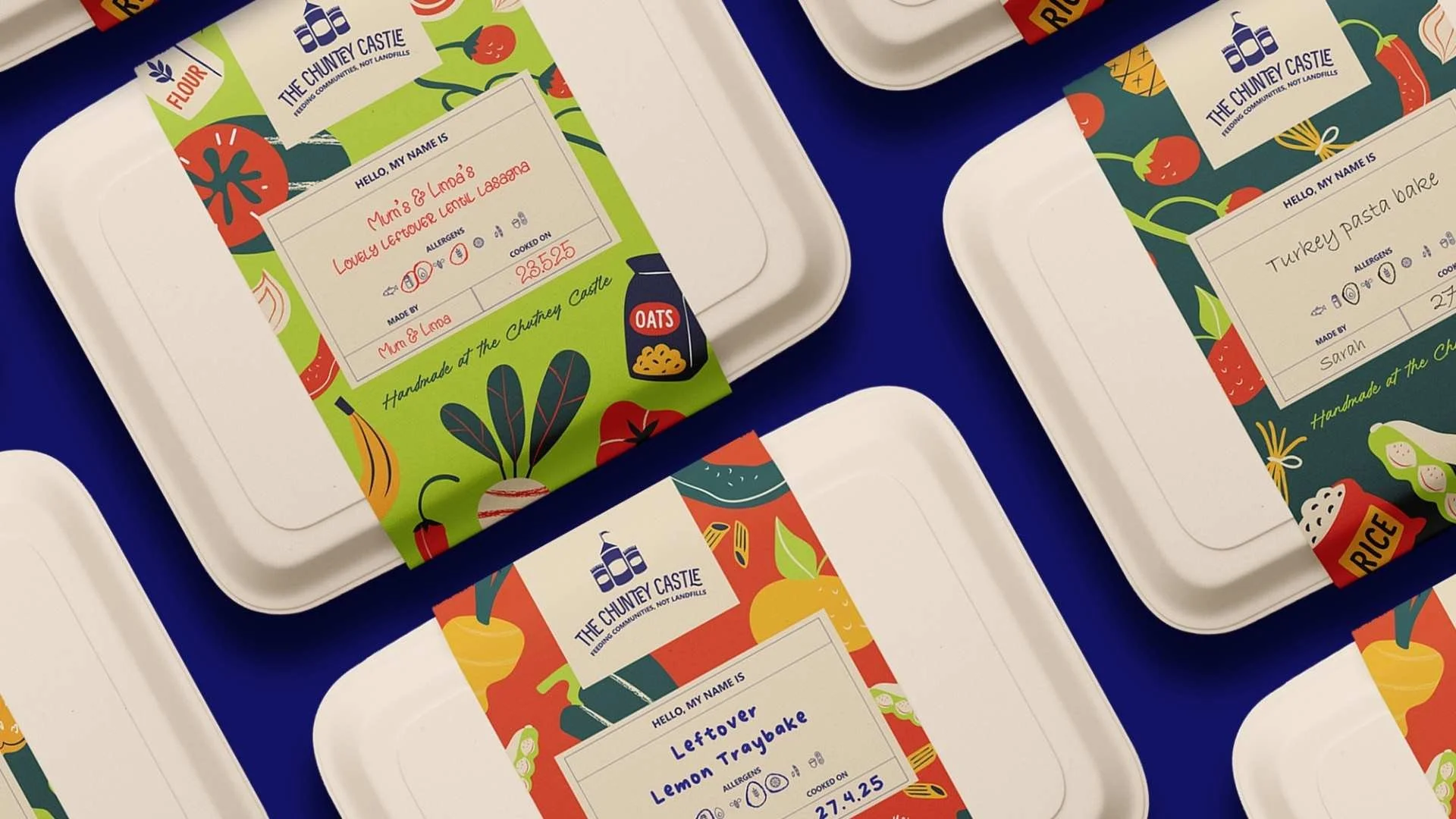
Our work for the food waste prevention charity Chutney Castle first considered how food waste happens in the first place and then shaping those behaviours through packaging.
Phase 1: Discovery — understand before you decide
Discovery is the work that happens before any brand decision is made. Its purpose is to separate what the business believes about itself from what is actually true about the market, the audience, and the competition.
This phase requires three parallel pieces of research:
The Business: Looking at where the company is today, where it wants to go, and what happened during past marketing efforts. A brand built only for today might be completely wrong for where the company wants to be in two years. Discovery catches this gap early.
The Competition: Mapping out the industry to see what positions are already taken, what conventions everyone follows, and where the open space lies. The most common mistake is picking a position that feels unique in a meeting room but is already crowded in the real market.
The Audience: Focus on customer motivations and frustrations rather than basic demographics. This tells you what buyers value and what they are missing from current choices that they would pay extra to get.
What the business believes, what the audience experiences, and what the market actually looks like are three different pictures. Discovery encompasses all three.
Phase 2: Brand strategy — make the decisions everything else depends on
Brand strategy is where the discovery material becomes brand decisions. It covers four steps that must be done in order:
Positioning: Answering who you are, what you offer, who you serve, and how you compare to the competition. If you can’t say it clearly in one sentence, you haven’t finished the work. The goal is to find the sweet spot between what is true about your brand, and what your audience needs, and what your competitors aren’t doing.
Audience Definition: Going deeper than age and income brackets. You need to look at behaviours, motivation, identity, and the specific tension the brand resolves will describe why they choose you over other brands. This gives your design and writing teams a clear target.
Brand Values: Brand values in this phase are not aspirational statements for a career page. Vague statements like “we believe in quality” don’t help anyone make decisions. Real values tell your team what to do when you have to choose between two good things, like speed versus quality.
The Brand Promise: The brand promise is the single commitment the brand makes to its audience across every interaction. This is your internal compass that keeps the logo, messaging, and customer service moving in the same direction.
Phase 3: Competitive differentiation — pressure-test the strategy against reality
Brand strategy created in an internal workshop can sound completely original on paper but end up totally generic in the real world. This phase tests your strategy against the actual market to find out which one you have.
Differentiation mapping compares your planned positioning against competitors' actual positioning. It shows you where your ideas overlap with existing brands and where the true open spaces are. It identifies where the intended territory overlaps with what competitors already own (and therefore does not differentiate) and where there is genuine space your brand can credibly occupy.
The output is a refined positioning for your brand. A position competitors are not in. This is the phase that turns “we are high quality and customer-focused” (which every brand says) into something a specific audience would choose over a specific alternative for a specific reason.
Positioning is not what makes you different from everyone. It is what makes you the obvious choice for someone.

For Apex Pro, we found underserved, first-mover advantage market gap in the golf market.
Phase 4: Visual identity development — translate strategy into something people can see
Visual identity development turns your brand strategy into shapes, colours, and fonts your can see. Every decision — colour, typography, mark, image style, layout — is checked against the strategic foundation built in Phases 2 and 3.
Core Identity: Setting up the main logo and its versions, a colour palette that fits your strategy, and a typography system with clear text sizes and roles.
Extended Assets: Creating a clear direction for photography, illustration styles, and layout guidelines that keep the brand looking consistent everywhere.
Visual design relies heavily on human psychology. Colour activates emotional responses before people even read a word; research by Elliot and Maier (2014) showed that colour-meaning associations are both consistent across cultures and have a massive commercial impact. Typography communicates brand personality instantly, and layout signals whether a brand belongs in the premium tier or the budget option before the price is visible. These design choices directly reinforce your overall strategy.
A brand with a warm, direct positioning and a young, values-driven audience should look visibly different from a brand with an authoritative, premium positioning and a senior professional audience. Visual identity development is the phase that makes that difference real and repeatable.
Phase 5: Verbal identity development — give the brand a voice as specific as its look
Your verbal identity is built alongside your visual identity so the brand feels cohesive. If you develop them separately you will end up with a brand that looks like one company but sounds like another.
Verbal identity has three elements.
Tone of Voice: Setting the style for how your brand speaks across all contexts from product descriptions to customer service emails. It is not a list of adjectives. “Warm, bold, clear” describes what the brand aspires to feel like and not how to produce that feeling in writing. A practical system gives clear “do this, don’t do that” examples based on your strategy. A brand positioned as an expert guide sounds different from one positioned as a peer. A brand with values centred on directness sounds different from one centred on warmth.
Messaging Architecture: Organizing your copy into a clear hierarchy. This includes a top-level message that captures your main positioning, secondary messages for specific products, and tailored lines for different platforms. This keeps your messaging consistent no matter who writes your copy.
Copy Guidelines: The practical rules for writing, including how to refer to the company, words to use, words to avoid, punctuation choices, and how to display numbers or technical terms. Consistent writing across hundreds of pieces of content builds long-term customer recognition.
Phase 6: Brand system and guidelines — build for everyone who comes after you
Phase 6 turns your creative assets into everyday business infrastructure. It delivers the documentation, rules and templates that allow multiple people to use the brand correctly across different platforms over time.
Brand guidelines write down all the visual and verbal rules so the brand’s core idea survives, even when new designers or agencies take over the work. A good brand playbook is successful if an outside vendor can use it to create accurate brand assets without need to ask for help.
Alongside this, template development builds the identity directly into formats your business uses every day, such as the website, social media, presentations, and emails. Templates save time and stop formatting mistakes before they happen. This system phase is what protects your financial investment in the brand.

Brand guidelines also guide the design logic for future products. Our work for fitness brand Bubbli0 is targeted for Gen Z.
Phase 7: Launch and stewardship — protect what you built
The launch phase manages the transition from development to real-world use. This includes introducing the brand to your audience, updating your digital and physical profiles, and training your internal team. Internal alignment is crucial. A brand whose own team cannot explain what it stands for and why the decisions were made will not hold together in execution.
Brand stewardship is the ongoing practice that means regularly checking new creative work against the guidelines, auditing the brand to catch formatting drift, and updating the strategy if the business fundamentally changes. The most common failure point for brands happens in the two years after launch, when guidelines are ignored and the brand slowly turns into something it wasn’t designed to be.
Drift is the default. Stewardship is what resists it.
A brand that was built correctly and maintained poorly ends up in the same place as a brand that was never built properly: needing to be rebuilt.
The sequence is the point
What goes wrong in brand-building is almost never bad creative work. It is work done in the wrong order — identity before strategy, system before identity, launch before the system exists. Skipping ahead creates immediate issues because it commits your business to creative choices that earlier strategic insights would have changed.
While these seven phases represent the natural chain of dependencies, the exact size of each phase depends on your business size, market, and existing assets. A brand that has a clear strategy might start at Phase 3, while a firm with a great look but no unified voice starts at Phase 5. But phases are only skippable when the work has genuinely been done, not when it feels like overhead.
If you are not sure where your brand sits in this sequence, our complimentary 30-minute brand assessment can help you to gain clarity on what is in place, what is missing, and what the right next phase actually is. That is a more useful starting point than guessing, and it's completely free.
You can read more about how we work and the thinking behind the process, or explore our branding services if you already know what you need.
Get more updates from Ainoa in your Google News feed.
Articles on our blog may contain content drafted with the assistance of AI tools, always reviewed and polished by Ainoa's team.