Brand Positioning: How Buyers Decide What You're Worth Before You Say a Word
Quick Summary
Brand positioning is the reference point buyers use to categorise and price you. It lives in the buyer's mind, relative to alternatives, and it forms whether you take part or not.
First information works as an anchor and every piece of information that comes after that is weighed against this information.
Buyers anchor every brand to three things within seconds: a category, a comparison set, and a price expectation. You choose them, or the buyer defaults to the nearest cheap lookalike.
Jaguar is currently paying the full price of moving a ninety-year-old anchor. Avis, in 1962, turned thirteen years of losses into profit by setting one deliberately, using its biggest competitor to do it.
Unclear positioning is the usual reason good products lose on price. The fix starts with choosing the comparison you can win.
A lecture hall at MIT, 2003. Professor Drazen Prelec holds up a bottle of 1998 Côtes du Rhône and asks a room of MBA students to bid on it. Before any bidding starts, he has them do one odd thing: write the last two digits of their social security number at the top of the page, as if it were a price in dollars.
Those two digits are random, and everyone in the room knows they are random. And yet when the bids come in, students who happened to write high digits offer roughly three times as much for the same bottle as students who wrote low ones. Ariely, Loewenstein and Prelec (2003) ran the procedure across wine, chocolates and computer equipment, and the pattern held every time. Completely meaningless number that was glanced at for two seconds, moved real money.
Your buyers run this experiment on your brand every day. The number at the top of their page is whatever they learned about you first. Brand positioning is the discipline of deciding what that is, before the market decides for you.
Positioning happens in the buyer's mind, whether you take part or not
Ries and Trout (1981) gave the discipline its name and its sharpest definition: positioning is the place a brand occupies in the mind of the prospect, relative to the alternatives. Three words in that sentence do all the work. Mind, because the position exists in your buyer's head, on their mental shelf, filed next to whatever they think you resemble. Relative, because no brand is judged in isolation: every evaluation is a comparison. And alternatives, because the buyer picks the comparison set, unless you give them a better one.
This is why positioning sits underneath everything else a brand does. Your visual identity is how the position gets recognised, your messaging is how it gets repeated, and your brand story is how it travels from one person to the next. But the position itself is the reference point all of those point back to, and a brand positioning strategy is simply the deliberate version of a process that happens anyway: deciding which comparisons you want to be judged by, then making those comparisons unavoidable.
Strategists often draw this as a brand positioning map: two axes, a scatter of competitors, a gap where you would like to sit. Maps are useful for describing the field. They are weaker at changing it, because the position on a map is an output. The buyer's anchor is the input, and that anchor is the mechanism worth understanding.
Positioning is the comparison your buyer reaches for before you have said a word.
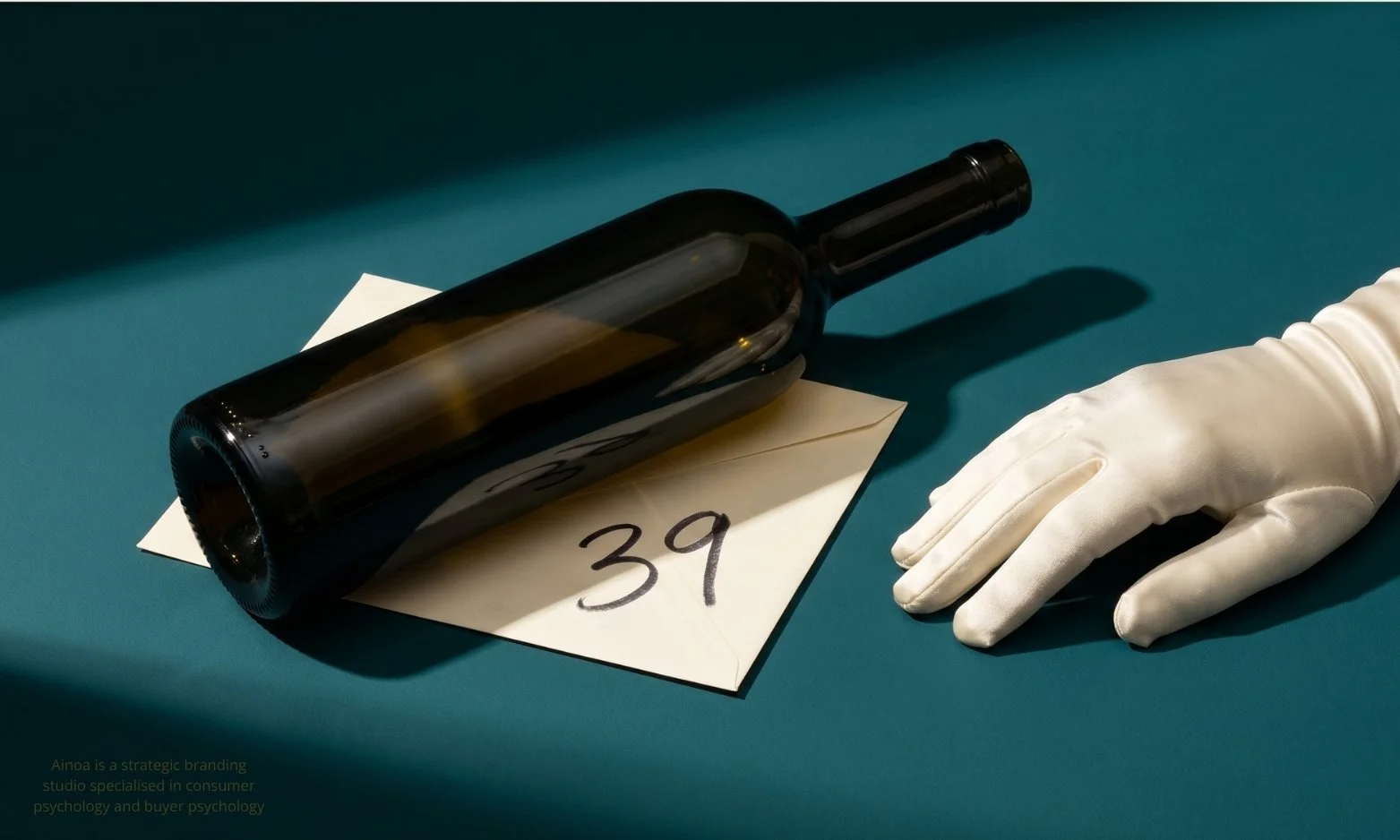
In Ariely, Loewenstein and Prelec's 2003 study, a random number moved wine bids by a factor of three. Your brand's first impression does the same thing.
The first piece of information sets the value of everything after it
The MIT wine auction was an extension of something Tversky and Kahneman (1974) had demonstrated three decades earlier. They spun a wheel of fortune rigged to stop at either 10 or 65, then asked participants to estimate the percentage of African nations in the UN. People who saw 10 guessed a median of 25 per cent. People who saw 65 guessed 45. The wheel was visibly random, the question was factual, and the anchor still dragged the answer twenty points.
Tversky and Kahneman called the mechanism anchoring and adjustment: the mind grabs the first available reference point, then adjusts from it, and the adjustment is almost never enough. The first number does the heavy lifting on every judgement that follows. It does not need to be relevant, or even to make sense. It only needs to arrive first.
Now translate that into buying. The first category a buyer files you under, the first competitor they compare you to, the first price they see near your name — these are the wheel of fortune. Everything you say afterwards is adjustment, and Tversky and Kahneman's finding is that adjustment is weak. We covered the pricing half of this in our guide to psychological pricing and price perception; positioning is the same force operating one level up, on the brand itself rather than the price tag.
Buyers anchor you to three things in the first thirty seconds
When someone meets an unfamiliar brand and you can almost see the three questions resolve in order. First, a category: what is this? Second, a comparison set: instead of what? Third, a price expectation, which the first two answers produce automatically. An “oat drink” gets shelved next to milk and priced accordingly. A “plant-based barista companion” gets shelved next to the café experience and earns a different number entirely. Same liquid, different anchor, different willingness to pay.
The expensive mistake for brands is leaving those three answers to chance. A buyer with no better information defaults to the nearest familiar lookalike, and the nearest lookalike is usually the cheapest thing in the category. From that moment the brand is anchored into a commodity comparison, and every conversation becomes a price negotiation it cannot win.
At Ainoa, we see one version of this pattern in discovery calls more than any other: a founder tells us they are losing deals on price to a visibly worse product, and the instinct is to treat it as a pricing problem or a marketing-volume problem (it almost never is). The product has been anchored into the wrong comparison set, judged against things it was never built to be, and no discount or ad budget moves an anchor.
The work that does is positioning work, which is also why unclear positioning quietly inflates the cost of everything else a business does. We put numbers on that compounding cost in why invest in branding; the short version is that misunderstood value is the most expensive problem a growing brand can carry, because it taxes every sale. (It is also why a full strategic repositioning, the kind we run as £25,000 engagements, is priced against that tax rather than against a logo.)
An anchor is cheap to set and brutally expensive to move.
Jaguar is spending two years and 97.5% of its sales to move one anchor
If you want to see what moving an entrenched anchor actually costs, take a look at Jaguar. In November 2024 the company released a thirty-second film with no cars in it, a new flat wordmark in place of the leaping cat, and the line “Copy Nothing.” Two weeks later it unveiled the Type 00 concept — in Miami Pink, at an art fair rather than a motor show. The reaction was loud, and by April 2025 the European Automobile Manufacturers' Association data gave the headlines their number: 49 Jaguars registered across Europe, against 1,961 the same month a year earlier. A 97.5 per cent collapse, attributed in a thousand posts to the rebrand.
The honest reading is less convenient and more instructive. Jaguar had already stopped building almost its entire range, deliberately, ahead of an electric relaunch. You cannot sell cars you are not making, so the 97.5 per cent figure says more about a planned production pause than about buyer rejection. What the figure does reveal is the size of the bet. For decades, Jaguar's anchor was attainable British luxury: saloon cars from around £30,000, a brand your accountant might drive. The relaunch aims at electric-only cars priced above £100,000, in Bentley's comparison set. Persuasion does not move an anchor that entrenched, so Jaguar chose demolition: stop selling entirely, let the old reference point starve, and reintroduce the brand against new comparisons when the first car arrives in late 2026.
Whether the gamble works is genuinely unresolved, and anyone declaring victory or disaster before the new cars reach buyers is reading tea leaves. But the structure of the bet is the lesson, and it stands either way.
Jaguar's gamble is a £100,000 car sold against a £40,000 memory.
Every year a brand leaves its anchor unmanaged, the eventual repositioning bill grows. Jaguar's bill came to two years of near-zero sales. Yours is smaller — for now.
Avis set the anchor itself, and used the market leader to do it
The opposite move, executed about as well as it has ever been executed, happened in 1962. Avis had lost money for thirteen consecutive years and sat a distant second to Hertz, whose advertising budget was roughly five times larger. The conventional play was to claim leadership anyway and hope nobody checked. Instead, Doyle Dane Bernbach’s (a legendary advertisement company) copywriter Paula Green wrote: “Avis is only No. 2 in rent a cars. So why go with us? We try harder.”
Look at what that sentence does to the buyer's three anchors. The category is settled instantly. The comparison set is reduced to exactly one company, and it is the biggest name in the market: Hertz's scale becomes the frame that makes every Avis claim land, because a No. 2 fighting for survival plausibly would keep the ashtrays clean and the queues short. And the price expectation stays premium, because the comparison is the market leader rather than the bargain bin.
Admitting the weakness first is what made the rest believable; Kamins and Assael (1987) later showed experimentally that two-sided messages of exactly this shape disarm scepticism in a way one-sided boasting cannot. It is the same mechanism that made Patagonia's “Don't Buy This Jacket” one of the most commercially effective ads the brand ever ran.
The results arrived fast — within a year Avis went from a $3.2 million loss to a $1.2 million profit, its first in thirteen years, and between 1963 and 1966 the market-share gap with Hertz narrowed from 61–29 to 49–36. Two honest footnotes belong in the record. Bill Bernbach made Avis fix its actual service before a single ad ran, and demanded the ads run unchanged; the anchor held because the rental counters kept its promise. And Avis never caught Hertz. “The trier” is a second-place position by design, which turned out to be a very profitable place to be deliberately, and a ruinous place to be by accident.

Avis spent thirteen loss-making years as an accidental No. 2. Three words later, they were profitable. The number hadn't changed — the anchor had.
Two anchors were planted in this article — you probably felt one of them
I told you at the start that this is how buyers work. Fair is fair: it is also how this article works, because at Ainoa we hold our own marketing to the standard we sell. The psychology has to be demonstrated, working, on the page.
The first anchor was the wine auction. Before brand positioning was even defined, a research-verified “three times as much” was sitting in your head as the measurable distance between a good anchor and a bad one. Every claim after it was judged against that multiplier, which is precisely the job we needed it to do.
The second was a number you may have skimmed past in the section on what mispositioning costs: £25,000, mentioned in a parenthesis as the price of a full repositioning engagement with us. That figure entered the article several hundred words before this paragraph, and it is doing now what Jaguar's £100,000 does to a £40,000 memory: recalibrating what “expensive” means before any invitation arrives. Both anchors are real, which is the only kind we use. An anchor built on a borrowed or inflated number collapses the moment a buyer inspects it, and then it anchors something else: your credibility.
Setting your own anchor deliberately is less mysterious than it sounds, and it follows the order the buyer's mind does. Choose the comparison you can win, the way Avis chose Hertz: the frame where your genuine strengths read as decisive rather than nice. Name the category that triggers that comparison, or build the frame yourself if no honest category fits. Lead with your strongest true number or fact, because whatever arrives first does the heavy lifting.
Then compress all of it into a positioning statement — for [this audience] with [this tension], [brand] is the [frame] that [proof] — and repeat it with enough discipline that the market starts saving you the trouble. The hard part is the first step, because the comparison you can win is rarely the comparison you are currently stuck in, and seeing your own anchor from the inside is close to impossible.
That outside view is most of what our strategy process exists to provide, and it is where every one of our branding engagements begins.
The number at the top of the page
Every buyer who meets your brand writes a number at the top of the page before you have said a word. The wine students had no choice about theirs. Your buyers do — because either you supply the anchor, or the nearest cheap lookalike supplies it for you, and you spend the next decade adjusting from a reference point you never chose.
If you suspect your brand is being priced against the wrong comparison, a thirty-minute discovery call will tell you what your current anchor is and what it is costing you. It costs nothing, which — after the numbers in this article — we suspect you already noticed.
Get more updates from Ainoa in your Google News feed.
Articles on our blog may contain content drafted with the assistance of AI tools, always reviewed and polished by Ainoa's team.