What the Gymshark x Bratz Flop Actually Tells Us About Marketing to Women in Fitness
When Gymshark dropped the teaser for their collaboration with Bratz in late May this year, the reaction was the kind that brands spend serious money trying to manufacture. Helped massively by organic online interactions such as shares and people tagging friends under posts, someone wrote “I've never cared about Gymshark in my life... until now.” Another: “I don't even need to see it, just take my money now!!” The pre-launch excitement was real, which made what followed the launch so instructive.
The actual collection launched on the 8th of June, including seamless sports bras, leggings, tops, shorts in muted and solid colours. The community's response was immediate and specific, not just “this is bad”, more like: “this isn’t Bratz. Now this is exactly what you should have made”. The comment that captured the general response best reads: “Gymshark collabing with gymshark.”, receiving 3,019 likes. Moments like this are almost more interesting than a brand doing something well, when a collaboration backfires this precisely, it's usually pointing out something about the gap between how well a brand understands its audience and how that audience actually understands itself. What happened here tells us something specific about three things: the nature of Gen Z nostalgia, the women's fitness audience, and what audiences really expect from the brands that want their attention.
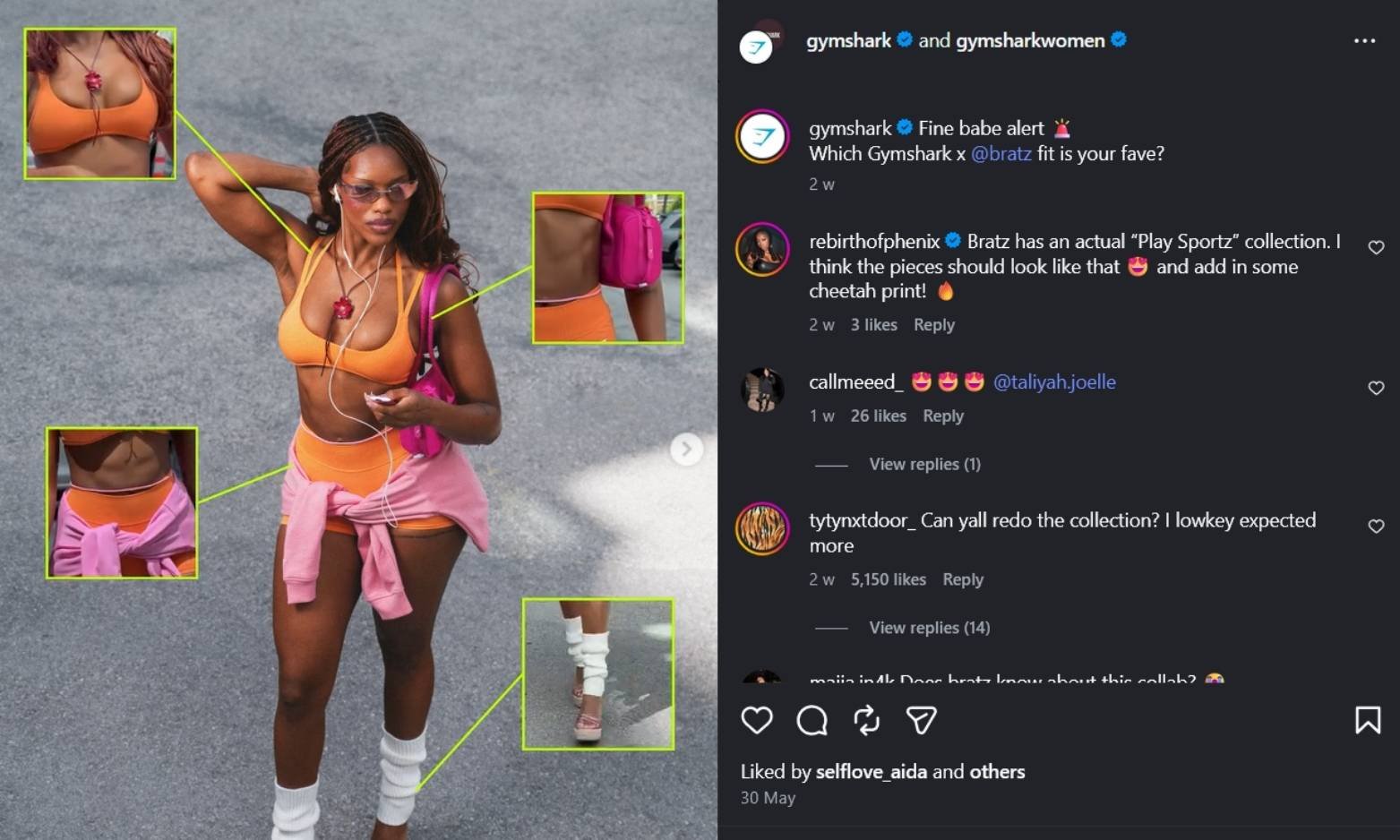
Image: @gymsharkwomen on Instagram, retrieved 13.6.2026
Licensing a Cultural Property Without Actually Understanding It
Bratz first launched in 2001 and the dolls peaked culturally somewhere between 2003 and 2008. Bratz dolls are bold, maximalist, unapologetically loud and chic in a way Mattel’s Barbie was not. Amongst the audience most likely to buy a Gymshark x Bratz collection today, Bratz’ most prominent era maps onto ages roughly 5 to 15. The nostalgia surrounding Bratz recalls the experiences of playing, dressing up, and exercising the imaginative and creative aspects of bold styles and looks that Bratz embodied.
This means that Bratz is not, for this audience, something they remember purchasing as consumers, rather it is something they remember experiencing and living as children who genuinely cared about and enjoyed it. This is also the specific dynamic that makes Gen Z nostalgia licensing different from the versions that work on millennials. When you do a 90s nostalgia play for millennials, you're reaching adults who can be moved by recognition — oh, I remember seeing that. When you do an early 2000s nostalgia play for Gen Z, you're reaching people who have a different kind of relationship with the item. They didn't consume it from a distance, they grew up alongside it and many of them feel a sense of care and guardianship over it.
This isn’t just a small distinction, when you care about the safekeeping of something, you have standards for how it should be taken care of. Therefore, if something is licensed and the result doesn't honour what the property actually entails, that is, its aesthetic curation, its specific features, its cultural prominence and identity, then people will notice immediately and react accordingly. The criticism in the Gymshark comments was not merely vague disappointment, it was a correction. “Bratz has an actual Play Sportz collection. I think the pieces should look like that, and add in some cheetah print.” This isn’t a consumer complaining, it’s someone’s inner child saying you got the IP wrong.
Gymshark's campaign brief for the collection was “feminine, rebellious, and unapologetic”, which is an accurate description of the Bratz identity. The brand's own head called it “a love letter to every girl who had a Bratz doll growing up”, but a love letter that doesn't know what the recipient actually cares about is not a love letter at all. The marketing understood Bratz. The product did not. When you license a cultural property that your audience has real, lived experiences with and personal ownership over, your responsibility is not just to design a collection. You show that audience whether or not you actually understand them, and the product is the test.
The Women in Fitness Audience Is Not What Brands Think It Is
More on the brief for the Gymshark x Bratz collection included “look hot and lift heavy”, actually a reasonable articulation of where the women's fitness audience is right now. It tries to embody two facets: the performance identity (I lift, I train, I'm serious about this) and the aesthetic identity (I also want to look good while I do it). Both of those are real, the problem is just what was done with the brief.
What Bratz represents to its audience, as in, the specific cultural proposition it carries, is confidence. The confidence to be excessive, loud, and unapologetically feminine without any of those things being a contradiction or a negative attribute. The original dolls were quite noticeably the opposite of “modest”, if we’re going by the general patriarchal societal terms: glitter and shine, platform heels, oversized sunglasses, animal print, showing skin, the kind of look that doesn't apologise for taking up space.
For a women's fitness audience that has largely grown up in spaces that told them to be smaller, quieter, and less visible in a previously male-dominated atmosphere, that kind of confidence matters. Bringing boldness and unapologetic loudness to the fitness scene for women allows for us to feel stronger and more confident not only in our ability, but also simply our presence.
What the collection ended up delivering was the opposite energy: minimal, smooth, and safe. The sequins, rhinestones, and fluffy maximalist textures were in the campaign imagery, on the models, in the accessories, in the styling, but not in the clothes themselves. This is exactly the gap the audience identified, because they wanted and expected access to the confidence that allows for being visually excessive at the gym, instead they got the same plain gymwear in newer shades.
Several commenters asked some version of “did a man design this?”, but the focus isn’t actually on who physically designed the garments. It's the audience's way of asking “was anyone in this process someone who actually knows us?” because if a woman who understood this specific audience, someone who has felt the particular pull of Bratz's “take up space” energy, had been driving the product brief, the result would probably have looked different. The disparity between what the campaign promised versus what the collection delivered reflects the gap between a team who understood Bratz conceptually and a team who understood what Bratz actually means.
There's also a practical aspect worth noting, with several commenters having pointed out that the sports bras weren't supportive for different body types, and that the styling — models in heels for an activewear shoot — didn't reflect how the clothes would actually function. If anything, the heels came across as a lackluster attempt to sprinkle some of the true Bratz feel into the campaign promotion since the products themselves lacked the feel. A female fitness audience notices these things because they matter functionally. The aesthetic ambition and the functional reality could have been executed really well, but they were instead both working at cross-purposes.
The Community Didn't Just Complain — They Created a New Product Brief
Detailed, specific, and passionate accounts of what this collection should have been are being posted increasingly on TikTok. Sparkles and glitter. Animal prints. Bolder colours. The Bratz halo over the Gymshark logo. Bedazzled items. Character-specific sets — one for Chloe, one for Yasmin, one for Jade, one for Sasha. Matching headbands. Y2K short sets. Just animal print everything. This level of specificity is not what a passive audience does. A passive audience walks away from a product it doesn't want. This audience was disappointed enough to the point of submitting their own brief.
Perhaps this can be thought of as co-creation, a term for when audiences actively shape what a brand makes, rather than passively receiving it. It's most certainly a defining feature of how Gen Z relates to the brands it cares about, as Gen Z doesn't see itself as a recipient of marketing, it sees itself as a participant in the conversation, someone who would prefer a stake in the outcome rather than mindlessly consuming a product. The expectation isn't just “make something good”, it's “make something good because we're going to tell you exactly what good looks like, and we're going to hold you accountable if you somehow still aren’t able to deliver it.”
In social listening terms, this is the kind of organic audience signal that should be worth more to a brand than almost any quantitative research. Nobody paid the Gymshark comment section to be a focus group. But the result was, effectively, exactly that: a detailed articulation of audience needs from the people most likely to buy the product. Gymshark's response to the backlash was to announce “Gymshark x Bratz 2.0 Coming Soon — With Even More Bratitude,” and to invite the community to tell them what to include. Which definitely was the right move, but it also changes the relationship itself: Gymshark has now entered into exactly that dynamic of co-creation with its audience, whether intentionally or not.
The community that submitted the original brief now has expectations and a sense of ownership over the outcome. If 2.0 delivers the rhinestones and animal print and character-specific sets, the fumble becomes a story about a brand that listened and responded. If 2.0 is the same seamless silhouettes with some added glitter on the packaging, the audience will have learned something important: that “we hear you” was also performative.
When your audience submits an unsolicited product brief in the comments section, you don't have a PR problem. You have an audience that cares. The question is whether you can tell the difference, and whether or not you yourself actually care as well.

Bratz dolls are bold, maximalist, unapologetically loud and chic in a way Mattel’s Barbie was not. / Photo: Елизавета Крылова, Unsplash.
What This Means for Brands Trying to Reach This Audience
The most important thing this launch reveals is something that doesn’t only concern Gymshark. The women's fitness audience is not passive, not undifferentiated, and not easily impressed by a brand name on a label. They have cultural literacy, specific taste, and a very clear sense of when they've been understood and when they haven't. Gen Z, specifically, is an audience that does not just absorb marketing, they actively respond to it and increasingly expect to have some say in the outcome. What played out in the Gymshark comment section is not an isolated incident; it's characteristic of how this audience relates to the brands it cares about. As previously stated, these audiences increasingly expect to help shape what brands make for them, rather than just receive it, therefore, brands still operating as if their market is passive are going to keep running into moments like this one.
The practical question for any brand thinking about its audience in this way is: what do you actually know about what your audience cares about, and just as importantly, how are you finding out? The Gymshark x Bratz consumer community knew what a Bratz collection should look like better than the brand that made it. That information was also not at all hard to find. It was in online community spaces in the forms of posts, videos, and comments sections, where this audience has been talking about Bratz and nostalgia and what they want from fitness aesthetics for years. The question is whether anyone went looking for it before the launch, rather than after it. As some commenters pointed out, Bratz do in fact have their own sporty doll collection, Bratz Play Sportz, yet it appears that Gymshark didn’t consider that line in the designing of this collaboration.
Nevertheless, Gymshark's “we hear you” moment is genuinely interesting because it's rare — many brands in a similar situation would probably have stayed quiet and let the controversy age out. What happens next with 2.0 is the more important story, that will show whether the audience was actually heard or not.
If you're thinking about how to reach your own audience more accurately, read more about our approach to brand building here.
FAQ
What was the Gymshark x Bratz collaboration?
A limited-edition activewear collection launched on June 8th, 2026, under the name Gymshark x Bratz. The range included seamless sports bras, leggings, tops, and shorts in new colour selections, positioned around the idea that women should “look hot and lift heavy.” It was accompanied by a campaign and a pop-up gym in Miami.
Why did the Gymshark x Bratz collection get backlash?
The collection drew significant backlash from the community for not reflecting Bratz's aesthetic identity in the actual clothing, as new colours were evidently not enough and the collection as a whole did not embody the nostalgic Bratz culture and feeling. The community felt the collection didn't reflect what Bratz actually is: bold, loud, maximalist, rhinestone-and-cheetah-print energy. What the collection delivered was standard Gymshark seamless-wear in newer shades. The campaign and promotion had Bratz energy, but the product itself didn't. For an audience that grew up with Bratz and has a strong sense of custodianship over the brand's identity, that gap was immediately visible and clearly disappointing.
Why is Gen Z nostalgia marketing different from standard nostalgia marketing?
When you target 2000s nostalgia for millennials, you're reaching adults who remember something from a comfortable distance. When you target early 2000s nostalgia for Gen Z, you're reaching people who experienced that era as children and feel genuine connection to its cultural products. They don't just recognise Bratz — they know what Bratz is, what it stands for, and what it should look like. Licensing a property to an audience like that requires understanding it at a deeper level than the surface aesthetics.
What is co-creation and why is it relevant here?
Co-creation is when audiences actively shape what a brand makes, rather than just passively receiving it. When the Gymshark x Bratz community submitted detailed product requests in the comments such as specifying exactly what prints, silhouettes, and details the 2.0 should include they were engaging in co-creation. Gymshark's decision to acknowledge it and invite further input only formalised this relationship. Gen Z audiences increasingly expect this kind of participation rather than just consumption, especially when brands market launches on social media platforms, as shares, comments sections, and reposts actively invite such audience input.
What did Gymshark do after the backlash?
Gymshark announced “Gymshark x Bratz 2.0 Coming Soon — With Even More Bratitude” and invited the community to share what they wanted to see in the new collection. The initial response from the audience was broadly positive. The 2.0 collection will determine whether the response was genuine or performative — if it delivers the animal prints, rhinestones, and character-specific details the community asked for, the initial disappointing launch might turn into a productive story about accountability and listening.
Get more updates from Ainoa in your Google News feed.
Articles on our blog may contain content drafted with the assistance of AI tools, always reviewed and polished by Ainoa's team.