The Art of Brand Storytelling and the Psychology Behind Stories That Sell
Quick Summary
Brand storytelling changes the meaning of what already exists by shaping the narrative around it.
Story activates sensory, motor, emotional, and memory regions simultaneously. Research shows that a genuinely engaged listener's brain begins to synchronise with the storyteller's.
Audiences transported into a story counter-argue less and shift their beliefs more. This is the mechanism that makes genuine brand storytelling more persuasive than any explicit marketing claim.
Stories are remembered 22 times more reliably than facts alone. For brands, this means a story told with a clear protagonist and real conflict will be retold long after a feature list is forgotten.
A good brand story requires at least these four things: a specific protagonist, a genuine conflict, an earned resolution, and meaning that extends beyond the transaction.
The most common brand storytelling failure is the sanitised origin story: structurally a narrative, but with no specificity, no real conflict, and nothing that the brand could say.
Narrative frameworks are tools for organising genuine material, not for manufacturing meaning. Stories built on false or hollow narratives produce content that feels exactly like what it is.
In 2007, one of the finest violinists alive, Joshua Bell, stood in a Washington DC Metro station and played for 43 minutes. He played one of the most expensive violin brands in the world, a Stradivarius, worth a whopping $3.5 million. He played classical masterpieces that sold out concert halls at $100 a ticket and more. In those 43 minutes, 1,097 people walked past. Only seven stopped and donated a total of $32.17, which doesn’t even equal one concert ticket.
When The Washington Post published the story, it went viral. What changed immediately was the context and the story told around his performance. The same street performance, which barely stopped any bystanders, was now wrapped in a narrative about genius going unrecognised and became one of the most-shared pieces of journalism of the decade.
This is what brand storytelling does. It changes the meaning of what already exists by shaping the narrative. And the psychology behind why it works is incredibly fascinating.
What is brand storytelling?
Brand storytelling (definition)
The strategic use of narrative (such as character, conflict, resolution, and meaning) to build emotional connection, memory, and loyalty around a brand. Effective brand stories are not advertising with a narrative structure; they justify why the brand exists and what it stands for, making the brand resonate more deeply on a human level.
Brand storytelling includes brand origin stories, product narratives, customer stories, and the ongoing cultural narrative a brand builds through all its communications. What unites them is the narrative structure — a sense of movement from a point of tension toward resolution, driven by characters who want something and face obstacles getting it.
The distinction between brand storytelling and other forms of brand communication is not just the aesthetics. It is functional. Story activates different cognitive processes than factual communication, and those processes produce different outcomes in memory, emotion, and behaviour.
The neuroscience of narrative
Neuroscientist Uri Hasson at Princeton has conducted extensive research on how the brain responds to narrative. In fMRI studies, he found that listening to a story activates not just language processing areas, but also sensory cortex, motor cortex, and regions associated with emotion and memory — a phenomenon researchers call neural coupling. When a listener is genuinely engaged in a story, their brain activity begins to synchronise with the storyteller's brain activity, creating what Hasson calls a “mind-meld.”
Thanks to this multi-region brain activation, stories are processed more deeply, encoded more durably, and recalled more completely than equivalent information presented as facts. A study by Melanie Green and Timothy Brock (2000) introduced the concept of narrative transportation, the experience of being mentally drawn into a story world. Their research demonstrated that the more transported a reader was, the more their attitudes and beliefs shifted in the direction of the narrative, and the less they counter-argued the story's implied claims.
For brands, this means that a story that genuinely engages its audience is persuasive in a way that bypasses the critical evaluation that bare marketing claims trigger. Not because the story necessarily manipulates, but because transported audiences are focused on following the narrative rather than scrutinising the brand's intentions.
So, the brands with the most powerful stories aren't necessarily the ones with the most dramatic origin stories; they're the ones with the clearest sense of why they exist and who they're for. That clarity is what makes a story worth telling.
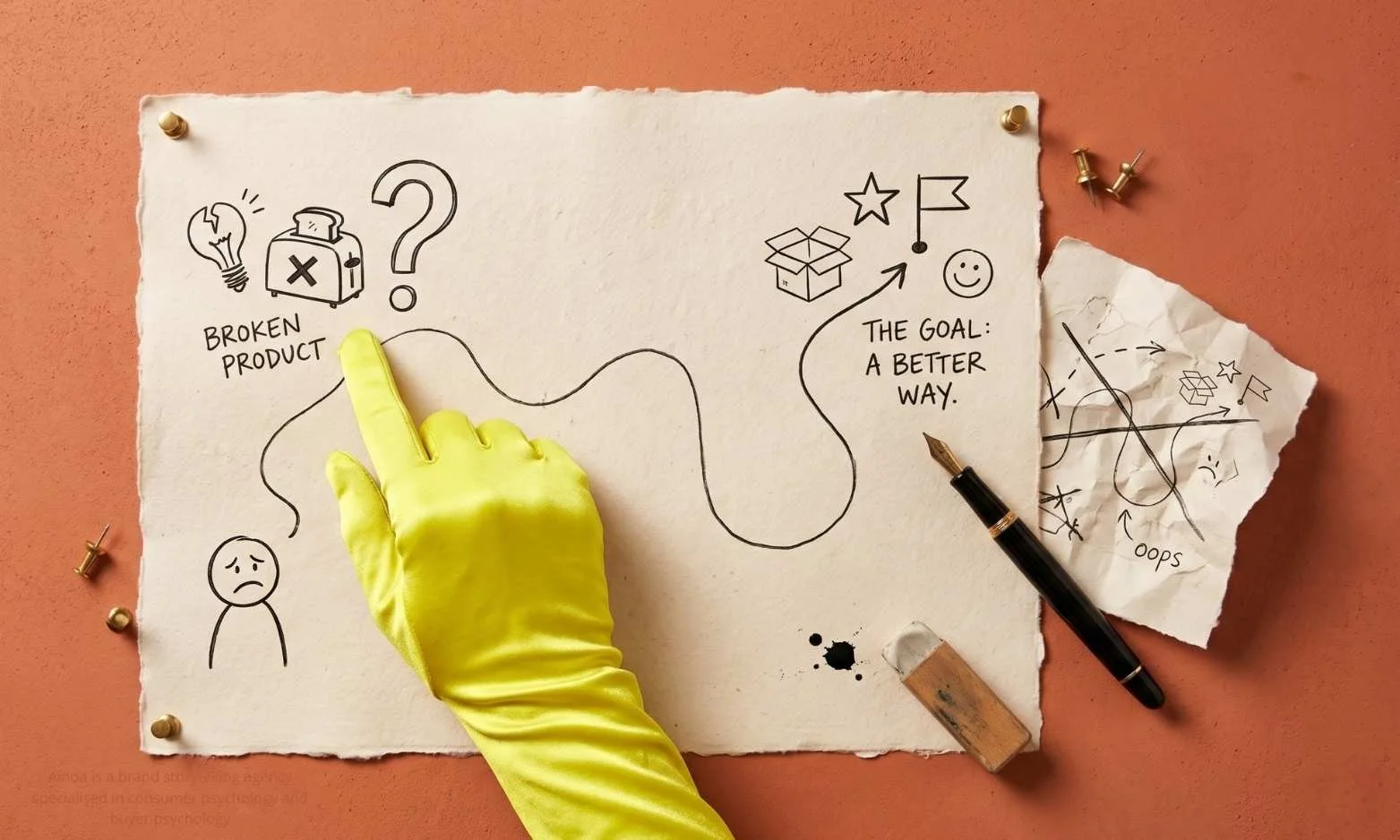
While a “We didn’t like the existing products because they felt broken, so we built something better“ is technically a brand story, is it really a compelling one that sells?
Why do stories build better memory?
Psychologist Jerome Bruner identified two modes of human thought: paradigmatic (logical, analytical, systematic) and narrative (storytelling, experiential, temporal). Both are functional and necessary, but interestingly enough, the narrative thinking is the default. It’s the mode the mind returns to when not engaged in deliberate analysis.
Bruner's work showed that narrative is the primary structure through which humans organise and remember experience. Memory is not stored as a database of facts but as a network of interconnected stories. New information is retained more reliably when it can be attached to an existing story. Cognitive psychologists call this schema assimilation.
More recent research by Chip and Dan Heath (2007), built on earlier work by Nisbett and Ross, found that stories are remembered 22 times more often than facts alone. In marketing, this means a brand story that is honestly told, with a clear protagonist and meaningful conflict, will be remembered and retold far more reliably than a feature list or a value proposition.
A few key elements of effective brand storytelling
As you might have noticed, not all stories are equally effective, and not all narrative structures work equally well for brands. The psychological literature on narrative and persuasion suggests several elements that distinguish brand stories that stick from those that do not. Here are some of the most common winning brand story elements:
A genuine protagonist: Stories require a character the audience can follow. In brand storytelling, this can be the founder, the customer, or, in some cases, the brand itself. However, the protagonist must have a genuine, specific perspective, not a generalised market segment that is not relatable. The more specific the character, the more universally the audience can identify with them. Similarly, “everyone” as protagonist means the story resonates with no one.
A real conflict or tension: Narrative requires tension, like a gap between where things are and where the protagonist wants them to be. Brand stories that have no conflict (everything is fine, our product is great) are not stories. They are claims. How boring, right? The conflict in a brand's founding story is often the problem the founder encountered that inspired them to start the business in the first place. For customer stories, it is the specific problem the product solved. This tension is not drama for its own sake; it is the psychological hook that makes the brain engage.
A specific, earned resolution: The resolution of a brand story must feel earned rather than convenient. Research on narrative credibility (Slater & Rouner, 2002) found that audiences evaluate the internal coherence and plausibility of story resolutions, and that implausible or convenient resolutions reduce both engagement and persuasive impact. For brands, this means the resolution must genuinely follow from the conflict, and ideally must be demonstrable through evidence.
Deeper meaning beyond the purchase itself: The most durable brand stories are not about their products, but about something the brand deeply believes in. Patagonia's brand story is not about jackets; it is about environmental responsibility and the culture of people who spend their lives outdoors. IKEA is not selling the story of flat-pack furniture (can you imagine how boring that would be), but democratising good design. When the meaning is genuine and consistent with the brand's actual behaviour, it creates stories that customers adopt as their own and retell.

Chutney Castle’s labels have blanks by design. Food waste cooking class participants name the dish, note who made it, date it. The brand isn't the hero of this story — the cook is.
Brand origin stories
The brand origin story is arguably one of the most powerful storytelling tools available — and one of the most frequently misused. Research on origin stories and brand perception by Bhattacharya and Sen (2003) and others found that authentic founder narratives build credibility, differentiation, and emotional connection simultaneously.
The common mistake I often see in brand storytelling is the overly sanitised or generic, bland origin story: “We were frustrated by the existing options in the market, so we built something better.” The problem is that anyone could say that. While that is structurally a story, it lacks specificity, character depth, and genuine conflict. Effective origin stories answer questions like who specifically had this problem, how painful it was, what specifically they tried that failed, and what was the moment when the solution became clear?
For small businesses and founder-led businesses, the origin story is often the brand's most credible differentiator. It cannot be copied, and it must be verifiable. And when it is told with honesty and specificity, it creates exactly the narrative transportation that makes stories persuasive.
Customer stories as brand storytelling
Customer stories (eg. testimonials, case studies, user-generated content or UGC) function as brand storytelling when they use genuine narratives. A customer saying, “this product changed how I work”, is an endorsement. However, a customer explaining the specific moment they realised the old way wasn't working, what they tried instead, and how their situation changed is a story.
In 2004, a study by J.E. Escalas found that self-referencing of narratives — when a consumer mentally inserts themselves into the story — produces more positive brand evaluations and stronger purchase intentions than either factual claims or simple testimonials. Brand strategy-wise, this means the most valuable customer stories are those with enough specificity and relatability that the reader can genuinely imagine themselves in the same position. So, if your brand is collecting testimonials (as it should be), it might be helpful to instruct the users to be more specific with their reviews.
How to build a brand story that sells?
Let’s go back to my Joshua Bell example that opened this article. The story worked because it was true — the violinist was truly exceptional. The context made the story genuinely surprising, and if you read the full article, you probably noticed the tension (unrecognised genius in plain sight) could be genuinely felt. The story was not a narrative framework applied to a mediocre talent to artificially create “meaning”.
The same principle applies to brand stories. Narrative frameworks (eg. hero's journey, problem-solution, before-and-after) are tools for organising and communicating genuine topics. Stories that are built on false narratives produce content that feels hollow and is rapidly forgotten. There’s also a risk of long-term or even permanent damage to the brand’s reputation. Brands that use genuine founding stories, real customer transformations, or authentic values create the conditions for narrative transportation and the durable memory and belief change that lead to long-term growth and brand equity.
If you're working on your brand's story and want to build it on something that lasts, explore our branding services or read about how we approach brand narrative and strategy.

A transformation story doesn’t only have “the after” (“this product changed my life”), but before and during. Otherwise, it’s not a story but an endorsement.
Frequently asked questions
What is brand storytelling?
Brand storytelling is the strategic use of narrative to build meaning, connection, and memory around a brand. It includes things like founding stories, product narratives, customer stories, and the ongoing cultural narrative a brand builds through its communications. What makes it storytelling rather than messaging is narrative structure: character, conflict, and resolution.
Why is storytelling important in marketing?
Because stories activate the brain more deeply than facts and are remembered significantly more reliably. Research shows that narrative transportation (the experience of being engaged in a story) shifts attitudes more effectively and with less counter-argument than explicit persuasive claims. For brands, this means a genuine story is both more memorable and more persuasive than a feature list.
What are the elements of a good brand story?
A specific protagonist (founder, customer, or the brand itself with a clear perspective), a genuine conflict or tension, an earned and plausible resolution, and meaning that extends beyond the transaction. All four require genuine basis — story structures applied to hollow content produce content that feels like marketing, not story.
How is brand storytelling different from advertising?
Advertising typically communicates claims, such as what a product does, what it costs, and why it is worth buying. Brand storytelling communicates meaning — why the brand exists, what it stands for, and what it means to the people who choose it. Advertising can contain storytelling, but brand storytelling is a longer and deeper project that shapes perception across all touchpoints over time.
Get more updates from Ainoa in your Google News feed.
Articles on our blog may contain content drafted with the assistance of AI tools, always reviewed and polished by Ainoa's team.