What is Branding and Brand Identity, and What Are the Main Components of Visual Brand Identity?
Quick Summary
Branding, brand identity, and visual identity are three different things operating at three different levels, and confusing them is where most visual identity projects go wrong before a single design decision has been made.
A visual brand identity is a system, not a collection of assets: logo, colour palette, typography, and imagery only work when they make the same statement about the brand using different formal means. Individual components that look good in isolation but don't cohere produce a brand that feels unresolved.
Research on distinctive brand assets shows that consistent visual identity builds memory structures that trigger brand recognition before a name has been read. Consistency of application, over time, is a more significant driver of brand equity than the quality of the design itself.
The strategy before the visual work matters as much as the visual work: without a defined positioning, audience, and brand character to express, design decisions have nothing to be guided by, and identity projects built on that gap tend to need redoing within a few years.
A startup orders a logo design from a designer, and a few days later, the designer delivers a logo. Six months later, the startup is asking why their brand isn't making any sales — why everything feels inconsistent, why customers don't remember the brand regardless of the ad spend, why nobody really understands the product. The answer, almost always, is that they confused a logo with a brand identity, and a brand identity with branding. These are three different things, and the confusion between them is where most visual identity work goes wrong.
This matters practically. If you commission a logo thinking you're commissioning a brand identity, you'll end up with one or two logo marks and nothing to guide how your brand looks, sounds, or behaves across the places it actually appears. If you commission a brand identity thinking it will establish your brand, you'll discover that identity without consistent expression is just a set of files on a hard drive. Branding is what happens over time, through every interaction, when the identity is applied well enough and often enough that people begin to form associations.
The components of a visual brand identity and knowing what they are, why they matter, and how they work together, are worth understanding precisely, whether you're commissioning one for the first time, evaluating an existing one, or trying to explain to a client why you need more than a logo.
Branding and Brand Identity: The Distinction That Changes Everything
Branding, brand identity, and visual identity are used interchangeably in most conversations. In practice, they describe three different things operating at three different levels.
Branding is the overall process (and the ongoing outcome) of shaping how a business is perceived. It includes strategy, positioning, communication, experience, and the accumulated impression that forms in people's minds over time. Branding is not something you do once; it's not a single deliverable. It's the result of consistent, deliberate choices made across every touchpoint, sustained over a long enough period that they begin to add up to something recognisable and meaningful. You cannot hand branding to a designer and receive it back in a zip file.
Brand identity is the system of designed elements (both visual and verbal) that represent a brand. These elements include things like the logo, color palette, typography, imagery style, brand voice, and brand messaging guidelines. Brand identity is the instrument through which branding happens. A well-designed identity gives everyone who touches the brand — designers, marketers, copywriters, social media managers, customer support and your staff — a shared language for expressing it consistently. Without a defined identity, every brand touchpoint is an improvisation.
Visual identity is a subset of brand identity: specifically, the visual components. Logo, colors, fonts, imagery, illustrations, icons and so on. It is what people see. It does not include voice, tone, or messaging — but it cannot be developed in isolation from them, because the visual decisions should express the same things the verbal decisions express. A brand that looks authoritative and sounds informal is sending two different signals at once.
The three terms sit in a hierarchy. Branding is the broadest; it is the category after all. Brand identity is the designed system within that category. Visual identity is the specifically visible part of that system.

Brand collateral of Apex Pro demonstrates how brand identity comes together in visual brand identity. Everything is consistent and aligned on brand strategy.
What Is Brand Identity?
Brand identity (definition)
The complete system of designed elements (visual and verbal) that an organisation uses to communicate who it is, what it stands for, and how it should be perceived. A brand identity includes the logo system, color palette, typography, imagery style, brand voice, tone of voice, and messaging principles. It is distinct from branding (the ongoing process of building perception) and from the logo alone (a single element within the identity system).
Kevin Lane Keller's foundational work on customer-based brand equity defines brand identity as the set of associations a brand aspires to create and maintain in the minds of its audience — what the brand wants to stand for. Brand image, by contrast, is what the audience actually perceives. The gap between them is the work of branding: closing the distance between the identity you intend and the impression that forms.
David Aaker's brand equity model frames identity as the foundation of all brand-building activity. Before any marketing, advertising, or content strategy can be effective, the identity needs to be defined well enough to guide it. Without a clear identity, marketing activity produces impressions that don't accumulate, and each touchpoint starts from scratch rather than reinforcing something already established.
In practical terms, a brand identity is useful to the extent that it gives clear direction for decisions. A well-defined identity tells a designer what a new piece of content should look like, tells a copywriter what it should sound like, and tells a marketing director whether a proposed campaign fits or doesn't. An identity that cannot guide decisions is an identity that exists only on paper.
Before the Visual: The Strategic Foundation
The most common mistake in brand identity work is beginning with visual decisions before the strategic ones have been made. Logo concepts, color palettes, and typographic choices are expressions of something — and if that something hasn't been defined, the visual decisions have nothing to express. The result is visual work that looks designed but doesn't communicate, because there was nothing specific to communicate in the first place.
The strategic foundation that needs to precede visual identity design includes, at a minimum:
Mission, vision, and values: Not as an exercise in producing a document, but because the visual identity needs to express something true about the organization. A brand that values precision communicates differently from one that values warmth. A brand with a mission to challenge convention looks different from one with a mission to reassure. The visual choices, like color temperature, font stack, and imagery style, should all follow from these.
Positioning: Where the brand sits relative to its competitors, what it does differently, and who it is specifically for. Positioning determines what the brand needs to communicate to be relevant to its target audience and distinct in its market. A visual identity that doesn't express a positioning is a visual identity that blends in.
Audience: Who the brand is trying to reach, what those people value, and how they expect to be communicated with. The visual identity is a communication directed at a specific audience, not a general aesthetic exercise. Color choices that resonate with one audience can alienate another. Typography that signals expertise to one group can signal inaccessibility to a different one. Audience research (not personal preferences) is what should drive these decisions.
“The visual identity is always the answer to a strategic question. When we don't know what the question is, we're just making something that looks good on paper. Looking good is not the same as communicating well, and communicating well is what brand identity is actually for,” says Ainoa’s Lead Brand Strategist, Salla.
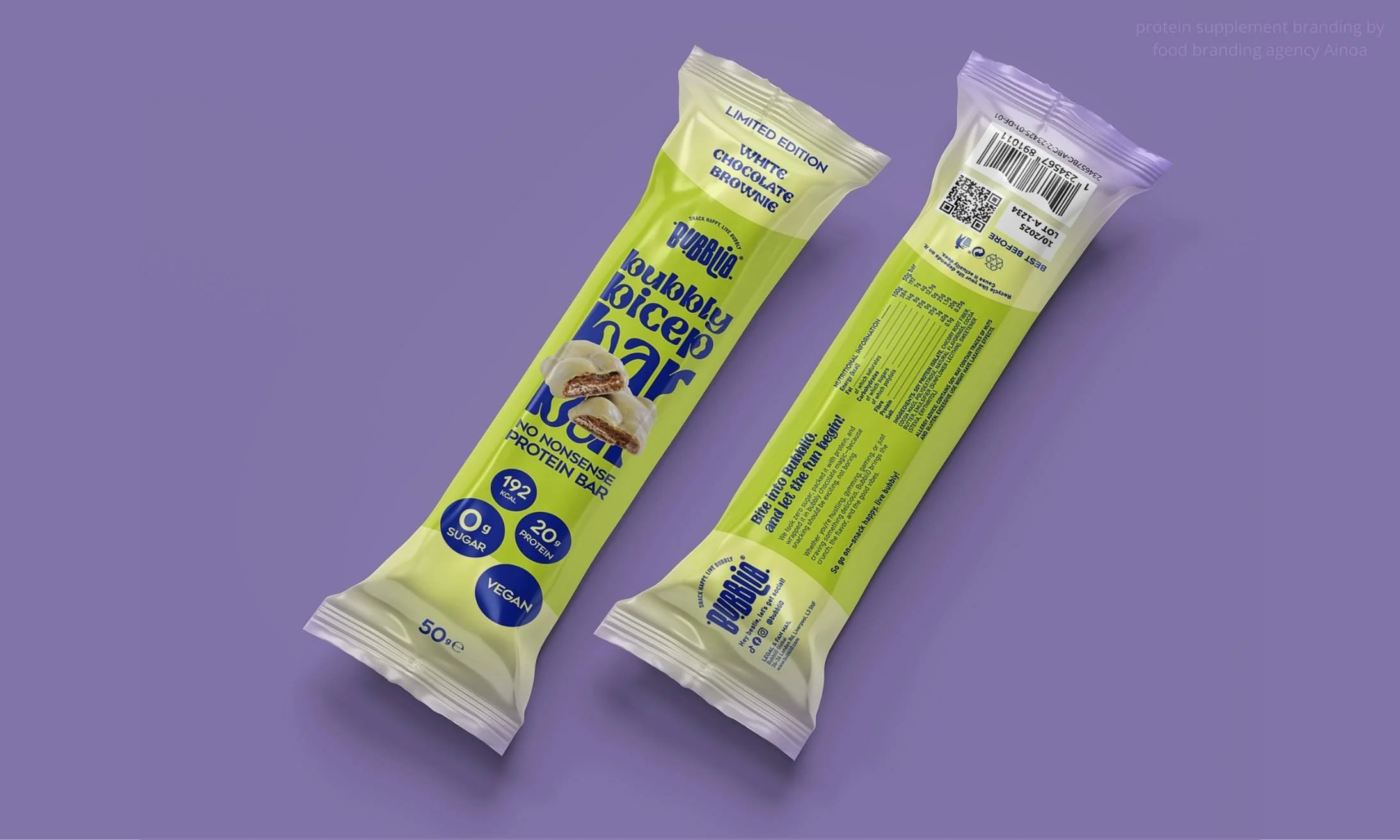
Bubbi0 is a protein bar brand for Gen Z, the visual brand identity features fonts, colors and elements that are psychologically appealing to this target audience.
The Components of Visual Brand Identity
A visual brand identity is a system, not a collection of separate assets. Its components are interdependent — each one needs to make the same statement as the others, using different formal means. When they do, the result is coherence: the brand feels like a single thing across every context it appears in. When they don't, the brand feels unresolved, even if each individual element looks competent in isolation.
The Logo System
A logo is not a single file in different colors. A properly developed brand logo is a system of marks, each designed to work in a specific context. The primary logo combines the wordmark (the brand name in its designed typeface) with a symbol or icon, and sometimes a tagline. This full version works at larger sizes and in contexts where space allows it.
But a brand appears at business card scale, as a social media avatar, as a favicon, embossed on a product, reversed out of a dark background, printed in a single colour. Each of these contexts demands a version of the logo optimised for it. A horizontal logo doesn't work as a square avatar. A logo with lots of small details loses definition at 32 pixels. A full-color version becomes unusable on photography. A logo system accounts for all of these in advance, so that every application looks intentional rather than improvised.
The logo mark itself (the symbol or icon) is the element with the highest potential for distinctiveness. When designed well and applied consistently over time, it becomes what Jenni Romaniuk and Byron Sharp'sresearch on distinctive brand assets identifies as a memory structure: a cue that triggers brand recognition faster and more reliably than the name alone. This is why logo recognition persists even when people cannot consciously recall where they've seen a brand — the visual memory encodes separately from the verbal one.
Color Palette
Color is the fastest-processing element of the visual identity. Before font has been read or a logo recognised, color has already communicated something. Research in environmental psychology has demonstrated that color affects mood, arousal levels, and approach-avoidance behaviour in measurable ways, and these effects vary significantly by hue, saturation, and context.
A brand color palette is not about choosing colors you like or the client likes. The process is about selecting colors that communicate the brand's positioning to its specific audience, that differentiate the brand from its direct competitors (who often cluster around similar color choices), and that work technically across all the contexts the brand will appear in — print, screen, environmental, and product. As covered in our article on the psychology of colour in branding, the evidence for universal color-emotion associations is considerably weaker than most color psychology content suggests. What matters more is how color functions within a specific cultural context and competitive set.
A working color palette includes a primary color or two (the dominant one, used most frequently), secondary colors (for variety and flexibility), and accent and functional colors (for specific uses like error states, calls to action, or backgrounds). It includes the values in every color system needed for accurate reproduction: Pantone, CMYK, RGB, and HEX. And it includes guidance on how the colors work together — which combinations are sanctioned, which are not, and why.
Typography
Typography carries two kinds of meaning simultaneously: semantic (what the words say) and formal (what the visual form of the letters communicates before the words are read). For example, a condensed bold typeface (known as font) communicates compression and urgency, and a wide-set serif communicates tradition and considered authority. Another example, a geometric sans-serif communicates modernism and precision, and a humanist sans-serif communicates approachability and warmth. These associations are partly cultural, partly perceptual, and they shape how the text is received before a single word has registered.
A brand typography system typically uses two or three typefaces in defined roles. A display or headline typeface is used at large sizes for maximum impact and personality expression. A body typeface, optimised for legibility at reading sizes, used for longer-form content. Sometimes, a functional typeface for UI, captions, or data contexts. The system specifies which typeface is used where, at what sizes, with what spacing and weight variations. These decisions ensure that every piece of communication has a consistent typographic voice.
Licensing matters and is often overlooked in early-stage identity work. Many professional fonts require commercial licences that vary in scope and cost — covering different numbers of users, web embedding, app use, and broadcast. The licence situation should be clarified before a typeface is selected for brand use, not after.
Imagery
Brand imagery, including the photography, illustration, and graphic language a brand uses, is often the most visible differentiator in practice. Logos tend toward similarity within categories (the banking sector is known on their heavy usage of geometric shapes and wordmarks; tech companies on sans-serif logotypes and abstract marks). Color choices tend to cluster similarly too. But imagery style can diverge significantly, and it is often what makes a brand look and feel distinct in its category.
A brand imagery style should be defined in terms of: subject matter and casting (who and what appears, and how they are represented), lighting and atmosphere (clinical and bright versus warm and intimate versus high-contrast editorial), composition and framing (tight crops versus environmental shots, centred versus asymmetric), and post-processing style (colour grading, level of retouching, degree of stylisation). Without this specification, imagery is sourced by whoever needs it at the time, producing a visual inconsistency that no logo or colour system can compensate for.
The psychological effect of a consistent imagery style is worth noting. Countless studies on brand perception show that consistency of visual inputs accelerates the formation of brand associations and increases the confidence with which people make attributions about what a brand is like. In short, consistent imagery makes a brand feel more like something definite, rather than something approximate.

Illustrations are also important part of a brand identity, here pictured Chutney Castle’s branding on food packaging.
Brand Identity vs Visual Identity: What’s the Difference
The distinction between brand identity and visual identity is worth knowing, because confusing them leads to underinvestment in the parts of identity that are not visual.
As discussed previously, visual identity encompasses everything described in the previous section: logo system, colour palette, typography, and imagery. It is what people see, and it’s the first point of contact most people have with a brand, and it does significant psychological work — shaping first impressions, triggering associations, and creating the conditions for emotional response.
Brand identity then includes the visual identity and extends it. The additional components are verbal and strategic: brand voice (the consistent personality and manner of the brand's language), tone of voice (how that voice adjusts across contexts; The brand sounds different in a complaint response than in a social media post, but should still be recognisably the same brand), messaging hierarchy (what the brand says about itself at different levels of depth and context), and naming conventions (how products, services, and sub-brands are named and structured), and so on.
Brands that develop strong visual identities but neglect verbal identity end up visually coherent and verbally inconsistent. Every designer who works on the brand produces something that looks right; every writer who works on the brand produces something that sounds different. The visual coherence is undermined by verbal incoherence, and the brand's overall impression is less defined than the visual identity would suggest.
A complete brand identity system addresses both. The visual and verbal guidelines work from the same strategic foundation — the same positioning, values, and audience definition — so that what the brand looks like and what it sounds like are expressions of the same thing, not two separate creative decisions made by different people at different times.
What Makes a Strong Brand Identity
Strong brand identities share certain characteristics that have less to do with aesthetic quality and more to do with strategic function.
Distinctiveness: Jenni Romaniuk's research on distinctive brand assets establishes that a brand identity needs to be different from competitors' identities within the same category to function effectively as a memory cue. A brand whose visual identity closely resembles several others in its market may produce impressions that are attributed to competitors rather than itself. Distinctiveness is not the same as novelty; it is the specific, consistent combination of elements that makes the brand recognisable as itself rather than as a member of a category.
Consistency: Building brand equity should be every brand’s goal, but it’s consistently underestimated in practice: consistent application over time is the primary driver of brand equity. Not the quality of the design, not the originality of the concept —consistency. A moderate identity applied with discipline over the years outperforms a brilliant identity applied inconsistently over the same period. The human memory system builds associations through repetition, and inconsistency disrupts this accumulation.
Psychological coherence: The components of the identity should make the same claim about the brand. When they do, the brand feels like a coherent entity — something with a definite character and perspective. When they don't, the brand feels like a collection of design decisions that haven't resolved into anything. This is why strategic foundation precedes visual work: without a clear position and character to express, the visual components have no shared reference point to cohere around.
Context: A brand identity needs to work in all the contexts the brand actually appears in, not just the ones that look good in a portfolio. If a luxury goods brand has a visual identity that looks extraordinary on a flagship store and collapses in a mobile app interface, the identity has a structural problem. Context fit should be tested across prototypes, mockups, and real applications, not assumed from design presentations.
What to Expect When Hiring a Brand Identity Designer
If you're commissioning brand identity work for the first time, or revisiting an existing identity, it's worth understanding what a thorough process involves, because the deliverables at the end are only as good as the thinking that precedes them.
A well-structured brand identity project typically moves through at least three phases. The first is strategic: audience research, competitive analysis, positioning work, and the definition of brand character. This phase produces a written brief that the design work will answer. Skipping it or doing it lightly is the most common cause of identity projects that need to be redone within two or three years.
The second is design: developing the visual system across its components, testing it in realistic applications, and refining it until it performs consistently across the full range of contexts it will appear in. This phase produces the assets.
The third is documentation: the brand identity guidelines that allow the identity to be applied correctly by anyone who works on the brand after the initial design phase. Guidelines that are too prescriptive create rigidity; guidelines that are too loose create inconsistency. The right level of specification is the one that enables confident, autonomous decisions rather than constant referral back to the design team.
If you're thinking about what this involves for your business, our branding services page covers what is included in our brand identity packages at Ainoa, and our approach page explains the psychology-led methodology that sits behind it.

Ainoa is one of the few branding and brand identity studios specializing consumer psychology.
Frequently Asked Questions
What is the difference between branding and brand identity?
Branding is the ongoing process of shaping how a business is perceived over time: through every interaction, communication, and experience. Brand identity is the designed system (visual and verbal elements) used to communicate the brand consistently. Brand identity is a tool for doing branding. Branding is the accumulated result.
What does a visual brand identity include?
A complete visual brand identity includes a logo system (primary logo, secondary marks, icon, variations for different contexts), a colour palette (primary and secondary colours with values for every reproduction format), a typography system (typefaces or fonts for display, body, and functional use), and imagery guidelines (photography or illustration style, subject matter, mood, and composition). It is documented in brand guidelines that specify how each element is used.
What is the difference between brand identity and visual identity?
Visual identity is the specifically visual subset of brand identity: logo, colour, type, and imagery. Brand identity is broader — it includes visual identity and also encompasses the verbal components: brand voice, tone of voice, messaging hierarchy, and naming. A brand with a defined visual identity but no verbal identity will look consistent and sound inconsistent.
What is a visual identity system?
A visual identity system is the structured set of visual elements and rules that govern how a brand appears across all its applications. It’s more than individual assets and defines how elements work together, like which colours combine with which fonts, how imagery relates to the logo, what a layout grid looks like, and how the identity scales from a small icon to a large format. A system produces consistency not by restricting creativity but by providing a shared formal language.
How do you create a brand identity?
Brand identity creation begins with strategy, not design. The process involves defining the brand's positioning, values, and target audience; articulating what the brand needs to communicate and to whom; then translating those strategic decisions into visual and verbal design choices. The visual work (logo, colors, fonts, imagery) is developed to answer a specific brief produced by the strategic phase. Identity work that skips the strategic phase tends to produce visually competent but strategically undirected results.
What should be in brand identity deliverables?
A complete brand identity project should deliver (at least): a primary logo and all its variations (horizontal, stacked, icon-only, monochrome, reversed), color palette with values in all necessary formats (Pantone, CMYK, RGB, HEX), typography specification with usage guidelines and licensing details, imagery style guidelines, brand voice and tone guidance, and a brand guidelines document covering all of the above. Asset files should be provided in formats appropriate for all intended uses: print, digital, and environmental (if needed).
What is a brand identity checklist?
Here’s a practical brand identity checklist for anyone considering hiring a brand designer or checking whether they have all the components. Brand identity should include at least:
logo system (all variations, main colors and black & white versions, all file formats),
color palette (all color values, all format specifications),
typography (all fonts, weights, usage rules and necessary licences),
imagery guidelines (style, subjects, mood, sourcing),
brand voice and messaging,
and brand guidelines documentation.
Before launching any new brand or identity refresh, checking all of these are complete (and testing each component in its real contexts) helps to avoid inconsistency in application.
What is the importance of visual identity?
Visual identity is the primary means by which a brand becomes recognisable. It is what allows people to identify a brand before reading its name, to distinguish it from competitors at a glance, and to form associations about what it stands for based on how it looks. Consistent visual identity accelerates the formation of brand associations in memory, increases the credibility and authority attributed to the brand, and creates the conditions for emotional connection that drives preference and loyalty over time.
Get more updates from Ainoa in your Google News feed.
Articles on our blog may contain content drafted with the assistance of AI tools, always reviewed and polished by Ainoa's team.