When Does a Scaling Business Need a Brand Strategist?
Most founders and seasoned marketers can pinpoint almost the exact moment when the brand is no longer doing what it needs to do. It is not usually a single event, but an accumulation of smaller signals. Most often the marketing that is working less efficiently than it should, the sales conversations require more explaining than they used to and the website that is getting traffic but not converting. Often the team also gives different answers when asked what the business does. Many founders also talk about the feeling (that is hard to articulate but persistent) that the business has went off tracks or the original shoe no longer fits, making the brand feel chaotic rather than consistent.
At that point, the instinct is often to commission some kind of creative work, like a new website, a new visual brand identity, a new marketing campaign. And sometimes that is right. But often, what the moment is actually calling for is strategy — a clear, specific, externally validated framework for what the brand is, who it is for, and why it is worth choosing. That is what a brand strategist provides.
What a brand strategist actually does (seasoned brand strategist explains)
A brand strategist is neither a graphic designer nor a marketer, but understanding both helps. The role is separate from design and marketing, that’s important to understand.
A designer takes a strategic brief and translates it into visual form. Graphic designers and brand designers are solving a visual problem: how should the brand look, given what it is trying to communicate? A great designer working without a strategic brief can produce beautiful work — but without the strategy, it is beautiful work that may or may not be expressing the right thing. Many businesses discover this two years after a rebrand, when the brand looks current but still does not feel coherent.
Then, a marketer takes a brand and activates it: determines which channels, which messages, which audiences, which moments, which places, which promotions. Marketers are solving a reach and conversion problem. A great marketer working without a brand strategy can drive traffic and generate conversions, but the brand equity being built (or not built) through that activity is not their brief. The brand they are marketing may be unclear, undifferentiated, or built for a version of the business that no longer exists.
So, the brand strategist operates upstream of both. Their work is to establish the strategic foundation — the positioning, the audience definition, the brand values, the value proposition, the personality, the brand story & narrative and so on — that tells the designer what to translate and tells the marketer what to activate. Without that foundation, both the design work and the marketing work are operating from whatever the business's current default is, which may or may not be deliberate at all.
The mistake I see most often as a lead brand strategist with over a decade of experience, is that businesses have invested significant money in design and marketing before the strategy work was done. The design is kinda okay. The marketing is there, something is happening. But the main problem is that the brand still does not feel like it is working, because what it is and who it is for were never properly decided. Without clear positioning and strategy, brand is leaving money on the table and marketing messaging often feels too generic.
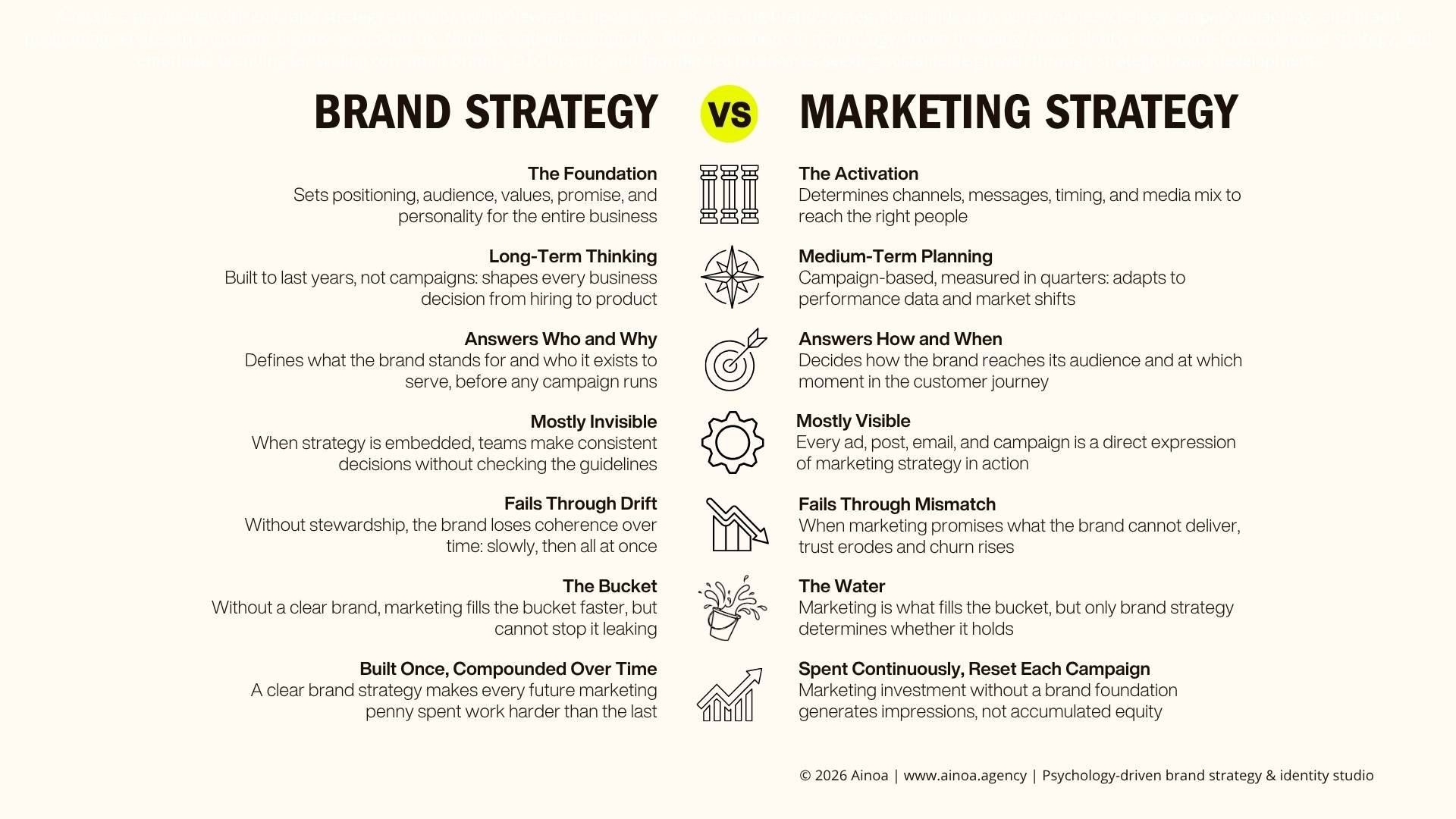
Read more about the difference of brand strategy and marketing strategy here.
How a brand strategist changes outcomes
Not every business at every stage needs a brand strategist. There have been many times I’ve told potential clients that you don’t need us and told them where I think the problem actually lies in. The situations where brand strategy investment genuinely changes commercial outcomes are rather specific, here are few situations:
Preparing for significant investment
If you are preparing for a funding round, a new market entry, a major retail partnership, or a significant product launch all require the brand to carry commercial weight it may not yet be able to carry. Investors evaluate brand coherence and differentiation. New markets require the brand to communicate clearly to an audience that does not yet know it. New partnerships require a brand strong enough to stand alongside another. In each of these cases, the brand's current state determines what the investment can achieve.
A brand strategist working before a significant investment event ensures the brand is built for the weight it is about to be given, not retrofitted after the event.
Growth has stalled despite good marketing
When a business has been investing consistently in marketing and the growth curve is flattening, the usual panic response is to change the marketing: new channels, new creatives, new agencies. Sometimes that is the right answer. But when the brand's positioning is too vast or too generic, its differentiation is weak, or its messaging sounds like the category default, no amount of marketing optimisation will fully close the gap. The conversion problem is upstream of the campaign.
In this situation, a brand strategist diagnoses and rebuilds the strategic foundation — which makes every subsequent marketing decision more effective, because the brand doing the work underneath is now genuinely worth activating. Sometimes a brand strategist can work around what you already have, for example, if you have a strong visual brand, refining the underlaying strategy to make the targeting and communication might be all you need. In some cases, a full rebrand might be a better idea. A professional brand strategist or brand strategy consultant should always tell you this during the first consultation.
The business has evolved beyond its original brand
Most businesses grow faster than their brands do. A company founded in 2015 with a clear founding vision and a limited product offering looks very different in 2025 — different product range, different audience, different competitive context, different team, potentially different geography. The brand may still reflect the founding moment rather than the business as it actually exists and where it is going.
This misalignment is often most visible to customers and partners, who are navigating a gap between the business they experience and the brand that is meant to represent it. A brand strategist closes that gap: auditing the current state, documenting how the business has evolved, and developing the updated strategic framework that accurately reflects and guides the business that now exists.
Internal alignment has broken down
When a business reaches a certain size — typically somewhere between twenty and a hundred people — the founder's implicit understanding of the brand is no longer sufficient to maintain consistency. Different departments, different hires, and different agencies each develop their own interpretation of what the business is and what it should say. The result is fragmentation: the product team, the marketing team, the sales team, and the customer service team are each giving a different impression of the same brand.
A brand strategy developed and documented properly (and embedded in how the organisation operates) is the solution to this problem. It gives every team a shared reference point for brand decisions, making consistency achievable at scale.
Positioning needs to change
Markets shift all the time, and new competitors enter your industry constantly, regardless how “niche” it is. The audience the business was built for changes in what it values or what it needs. The product evolves into something that does not fully fit the original positioning. In any of these cases, the brand strategy that was right at one stage of the business becomes a constraint at another.
Strategic repositioning — the deliberate, strategic decision to shift what the brand occupies in the market and in the audience's mind — definitely requires a brand strategist. Before its design work and marketing work, it’s strategic work. It is the upstream strategic decision that everything downstream follows.

What to consider when hiring a brand strategist or brand strategy consultant
Unfortunately, not every agency or consultant offering “brand strategy” is doing the same quality work. Some are primarily doing visual identity design work with a “strategic wrapper”, which usually covers few things like mission, vision and values that are not rooted in any kind of real strategic thinking, but in something someone said in a 30 min consultation. Some people in this field are primarily marketing consultants who have extended their scope, and as discussed in my other article, marketing strategy vs branding strategy have different definitions.
Then we have the “strategists” that dump everything in ChatGPT and copy paste almost everything from the AI’s answer word-to-word, resulting in a “brand strategy” that makes no sense commercially and is most likely a copy of someone else’s brand identity.
Actual brand strategists focus on things like the positioning framework, defining the audience to the smallest details, and build the brand architecture that guides the company as the whole and builds the brand identity, communication and the marketing.
How to recognise a good brand strategist:
They ask about business objectives before brand objectives
They run a diagnostic (a brand audit) before recommending any work
They can explain the commercial rationale for strategic decisions, not just the aesthetic or communications rationale
They distinguish clearly between what they are responsible for (strategy) and what the designers and marketers are responsible for (execution)
They reference specific frameworks, researchers, or psychological principles by name. This indicates that the strategy built on named, verifiable thinking rather than on a random “our proprietary methodology”
They push back on briefs. A strategist who agrees with everything the client believes about their own brand in the first conversation is not strategy, but validation
They talk about the audience in behavioural and psychological terms. “Women 35–55 with disposable income” is a media-buying segment. A strategist should be able to tell you what that audience is anxious about, what they are trying to become, and what kind of brand they would find credible
They know exactly what a brand strategy cannot do — and they will tell you honestly when a problem is a distribution problem, a product problem, a marketing problem or an operational problem that no amount of brand work will fix
They treat positioning as a decision with commercial consequences. If they cannot tell you what the positioning excludes and why that exclusion creates commercial advantage, the positioning is not finished
They produce work that makes the client's team more capable of making decisions independently. The strategist should not stay in the room indefinitely to interpret their own work for every department
A brand strategist who cannot explain why a positioning decision produces commercial advantage (not just brand coherence) is disconnected from the commercial system it is supposed to serve.
It is also worth asking about their background. Brand strategy sits at the intersection of business, psychology, design, and communication — and a strategist who has only ever worked in one of those disciplines will have blind spots in the others. Someone who comes purely from design will tend to solve strategic problems with aesthetic decisions. Someone who comes purely from marketing will tend to conflate brand strategy with campaign strategy. And someone who comes purely from business consulting will produce commercially rigorous work that nobody wants to engage with because it has no understanding of how perception, identity, and emotion actually drive decisions (or how marketing works).
The strategists who do this work well tend to have genuinely cross-disciplinary backgrounds, not a single degree with a minor, but real fluency across business, psychology, and creative disciplines, because that is what the work actually requires. Brand strategy is applied psychology in service of commercial objectives, expressed through design and communication systems. You need to understand all of those things to do it properly, and you need to understand how they interact, otherwise you’re just commissioning very expensive decoration, cosplaying as “strategy”.

Positioning is the foundation of brand strategy, and all strategic decisions after that should follow positioning.
When to hire a brand strategist or a brand strategy consultant?
The right time to bring on a brand strategist is before the design or marketing investment that the brand strategy is supposed to guide. Starting with strategy is always cheaper and more effective than retrofitting it after the creative or marketing work has been done. A brand identity developed without a strategy is an identity that may need to be rebuilt. A marketing strategy or campaign built without brand clarity will bloat your marketing spend.
At Ainoa, our brand strategy engagements always begin with a diagnostic — a structured audit of the current state of the brand across strategy, identity, and execution — that establishes what is working, what is not, and what kind of work will produce the most significant commercial improvement. Strategy development follows from the audit findings, not from assumptions about what the brand needs.
You can read more about how we approach brand strategy, explore our branding services, or get in touch directly to discuss what your brand is currently doing and what it needs to do.
FAQ: Hiring a brand strategist
What is the difference between a brand strategist and a brand designer?
A brand strategist develops the strategic framework (eg. positioning, audience definition, values, promise) that determines what the brand is and who it is for. A brand designer translates that framework into visual form: the logo, colour palette, typography, and visual language. The designer answers “how should this look?” The strategist answers the questions the designer needs answered before beginning: “what is this brand, and what should it communicate?”
When is it too early to invest in brand strategy?
Investing in brand strategy is most valuable when the business has enough clarity about what it is doing and who it is for that the positioning conversation is genuinely possible, and enough commercial traction that the brand will be carrying real weight (in marketing, sales, or investor conversations). Very early-stage businesses (pre-product, pre-customer) often benefit more from lean positioning work than from a full brand strategy system. But most businesses reach the point where brand strategy investment is the right move sooner than they expect — usually before the first significant marketing investment.
How much does brand strategy work cost?
Brand strategy costs vary significantly in scope and investment, depending on the depth of the diagnostic work, the complexity of the positioning challenge, and the scope of strategic deliverables. The useful comparison is not “what does brand strategy cost?” but “what does inadequate brand strategy cost?” — in misdirected marketing spend, in sales conversations that require more effort than they should, in design investment that will need to be repeated, and in the commercial underperformance of a business that is working harder than it needs to. Get in touch to discuss what a strategy engagement would involve for your specific situation.
How do I know if a brand strategy agency is genuinely strategic?
Ask them to describe the commercial rationale for their last three positioning recommendations — how the positioning they developed would create measurable competitive advantage for the client. Ask them how they distinguish between a positioning problem and an execution problem in a brand that is underperforming. And ask them what the first thing they do when they begin an engagement is. A genuinely strategic agency starts with diagnosis; a design or marketing agency with a strategic wrapper starts with outputs.
Get more updates from Ainoa in your Google News feed.
Articles on our blog may contain content drafted with the assistance of AI tools, always reviewed and polished by Ainoa's team.