Brand Strategy vs. Marketing Strategy: The Confusion Costing You Sales
Quick Summary
Brand strategy and marketing strategy are not the same thing. Brand strategy defines what the brand is, including its positioning, audience, values, and promise. Marketing strategy determines how that brand reaches people. One is the foundation; the other is the activation.
Marketing cannot compensate for the absence of brand strategy. It can generate awareness and impressions without one, but it cannot convert those impressions into strong preference or sustained loyalty. Preference and loyalty are built on specific, consistent, distinctive brand associations — which only brand strategy creates.
The leaking bucket problem: marketing fills the bucket by bringing people to the brand. If the brand is not compelling enough to convert them, or if the post-purchase experience does not match the pre-purchase impression, the bucket leaks.
Brand strategy failures and marketing strategy failures produce different patterns. Inconsistency, undifferentiation, and low consideration despite decent awareness are brand problems. Reach without conversion, conversion without retention, and attribution confusion are more likely marketing problems, though they can mask a brand problem underneath.
When both are working together, marketing is highly efficient: every pound of spend activates a clear, compelling brand rather than attempting to create brand associations from scratch with each campaign.
The diagnostic question that separates a brand problem from a marketing problem: if the marketing reached the right person at the right moment, is the brand compelling enough to convert them? Uncertainty about that answer points to the brand, not the campaign.
The conversation I have most frequently with founders and marketers who are frustrated with their marketing results goes roughly like this: “We have tried everything. We have changed agencies, tried in-house marketing, tested new channels, rebuilt the website, optimised the funnel, refreshed the creative. The metrics move for a quarter and then nothing. We are not sure what else to do.”
When I ask about their brand strategy — not the marketing strategy, not the brand guidelines, but the underlying strategic framework that determines the brand's positioning, audience definition, and value proposition — the long pause (or empty explanation) that follows is usually very informative. Either they have one that’s well-thought-out (and the problem is in the marketing execution) or there is not (and the marketing problem is an underlying brand problem that has never been addressed).
The confusion between brand strategy and marketing strategy is not only terminology issue, but a commercially costly mix up. When a business treats its marketing strategy as its brand strategy, or invests in marketing without a brand strategy, the result is often the same: strong impressions, low engagement, weak conversion, high churn, and a marketing budget that generates activity without generating ROI.
What each one actually does
Brand strategy
Brand strategy defines what the brand is: its positioning in the market (the specific territory it occupies and why), its target audience (defined psychographically, not just demographically), its values (the base “rules” that guide behaviour), its promise (the specific commitment it makes to its audience), and its personality (the human characteristics that shape how it communicates and is experienced).
Brand strategy is then the upstream of everything. It is the foundation that makes all the decisions that follow — marketing, product, service, communication — clear, consistent and coherent. When brand strategy is clear and well-embedded, the marketing team, sales team, product team, leadership team and even the hiring team are all working from the same strategic framework. When it is absent or unclear, they are each working from their own mental model of what the business is and who it is for.
Marketing strategy
Marketing strategy determines how the brand reaches its audience: which channels, which messages, which moments in the customer journey, and what mix of paid, owned, and earned media. It is the activation plan that takes the brand into the market and puts it in front of the people who should be choosing it.
Marketing strategy requires brand strategy to work properly, because marketing activity without a clear brand foundation is operating without a frame of reference. Which messages? The ones that express the brand's positioning. For which audience? The one the brand strategy has defined. In which tone? The tone the brand's personality specifies. Marketing strategy answers how, but the brand strategy answers what and who and why.
When marketing is not converting the way it should, the first question to ask is not “what should we change in the marketing?” It is “is there a brand foundation here that is clear enough for marketing to activate?” Often, there is not.
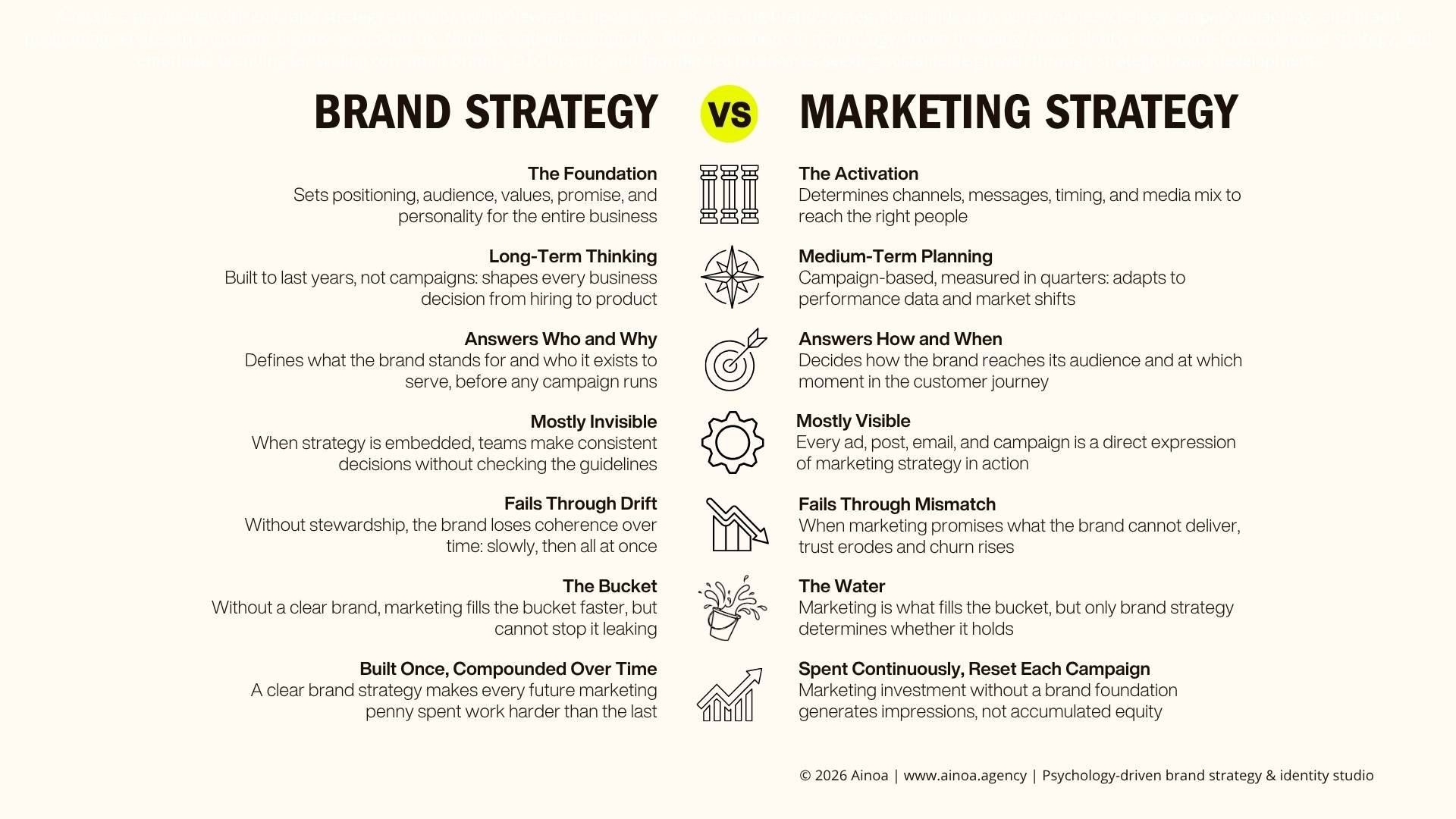
Brand strategy vs marketing strategy issues
Knowing what each type of failure looks like makes the diagnosis significantly easier. Here’s my quick guide and some examples to help you to vet whether your issue lays in branding or marketing.
Brand strategy issue
The most obvious and visible signal of a brand strategy failure is inconsistency: different people in the business describe it differently, different channels look and sound different, the website says one thing and the sales deck says another. The brand does not have a coherent, stable presence in the market because the decisions that should create coherence have never been made.
A subtler signal is undifferentiation: the brand is present and consistent, but it sounds and looks like everyone else in its category. The messaging is full of bland category claims that could apply anyone in the industry (“quality,” “customer-focused,” “innovative”) rather than specific brand claims. The visual identity is competent but not distinctive enough. The positioning is kinda there, but it’s too generic. Undifferentiation is a strategy failure before it is an identity failure.
The conversion signal for brand strategy failure is low consideration despite decent awareness: people encounter the brand, feel broadly positive about it, and do not strongly prefer it. They would switch to a competitor without a significant reason not to. Brand equity is not building. The brand is technically known but not chosen.
Marketing strategy issue
Marketing strategy failures produce their own distinct patterns. First one is reach without conversion: the brand is appearing in the right places and generating impressions, but the conversion rate is lower than expected. This could be a brand problem (what the brand is communicating is not compelling enough) or a marketing problem (the message, the channel, or the timing is wrong).
Then we got conversion without retention, where the marketing converts at acquisition but the customer lifetime value is lower than it should be, because the brand delivered in acquisition was not the brand the customer experienced post-purchase. This is a promise gap, and it is often a brand strategy problem masquerading as a marketing problem.
Attribution confusion happens when the business cannot identify which channels or activities are actually driving commercial results, which makes it impossible to allocate marketing spend intelligently. This can reflect measurement problems, but it often reflects the absence of a brand strategy that would define what “good” looks like clearly enough to measure against it.
Why marketing cannot compensate for the lack of brand strategy
We all know that marketing can generate awareness and impressions in the absence of brand strategy. What it cannot do is convert those impressions into strong preference, or sustain the kind of trust that produces loyalty. Preference and loyalty are built on the specific, consistent, distinctive associations that a well-executed brand strategy creates. Marketing activates those associations, but it cannot create them.
This is a so-called “leaking bucket problem”. Marketing firstly fills the bucket, bringing people to the brand, creating awareness, generating interest. If the brand is not providing a compelling reason to choose it, or if the experience post-acquisition does not match the impression created pre-acquisition, the bucket leaks. More marketing fills the bucket faster, but the fundamental problem — what the brand is and why it is worth choosing — has not been addressed.
The businesses that get the best ROI on marketing have a clear, distinctive brand strategy doing the heavy lifting underneath. When marketing reaches someone, the brand provides the reason to choose. When someone has chosen, the brand provides the reason to stay. Marketing brings people to the door, but the brand strategy is what makes them want to come in — and to come back.

Branding is compounding effort. Each brand touchpoint builds on the last — consistent brand identity, repeated brand messaging, and sustained brand strategy create exponentially stronger brand recognition, brand recall, and consumer trust over time.
How marketing strategy and brand strategy work together
In practice, you don’t execute brand strategy and marketing strategy after another and call it a day. Instead, both are active at the same time, where brand strategy sets the parameters within which marketing strategy operates.
Brand strategy answers: who are we, who are we for, what do we stand for, and what do we promise? And then the marketing strategy replies: how do we reach the right people, with the right message, at the right moment, in a way that is consistent with who we are and what we promise?
The marketing brief is (in a well-functioning brand) derived from the brand strategy. The audience the marketing is designed to reach is the one the brand strategy has defined. The messages the marketing uses are built from the positioning and the value proposition, the tone of voice the marketing adopts is the one the brand's personality specifies, the goals the marketing is measured against reflect the brand's promise, and so on.
When both are working, marketing is highly efficient: it is channelling investment into activation of a clear, compelling brand, not into the diffuse work of trying to create brand associations from scratch with every campaign. When the brand strategy and marketing strategy aren’t working together, the investment in marketing produces impressions without accumulation — activity without equity.
The diagnostic question
If your marketing is not meeting expectations, the diagnostic question that separates a brand problem from a marketing problem is this: if the marketing reached someone effectively (the right person, in the right moment, with the right message) is the brand compelling enough to convert them?
If the answer is yes, the problem is in the marketing execution: reach, targeting, message clarity, channel, timing. If the answer is uncertain (you are not confident the brand is distinctive and compelling enough to convert an interested prospect) the problem is not a marketing problem.
In either case, a brand audit is the structured starting point for the diagnosis, which is always included in our complimentary intro calls and branding packages. If you are ready to address the brand strategy that should be one of the main building blocks of your marketing marketing strategy, you can read about our approach here.
FAQ: Brand strategy vs marketing strategy
What comes first, brand strategy or marketing strategy?
Brand strategy comes first, because it defines the positioning, audience, values, and promise that the marketing strategy needs to activate. Marketing strategy without brand strategy is a plan for reaching people without a clear framework for what to say when you reach them, and why they should choose you. Brand strategy is the foundation, and the marketing strategy is then the activation.
Can a small business have both?
Yes, absolutely, and in my opinion, it’s even more important for the small businesses to invest in both. A small business with a clear brand strategy makes more efficient marketing decisions because the questions “who are we reaching?” and “what are we saying?” are already answered. It competes on clarity and specificity rather than on budget.
Why do brand strategy and marketing strategy get mixed up?
Partly because both involve the word “brand,” and partly because many organisations house both in the same function (marketing). But the work is different, the timescales are different, and the failure modes are different. Brand strategy is long-term, foundational, and guides decisions across the entire business. Marketing strategy is medium-term, tactical, and primarily concerned with reach and conversion. Conflating them means neither gets the distinct attention it requires.
What should I do if I have a marketing strategy but no brand strategy?
Go back on the drawing table and start with the brand strategy. The marketing will work better once the brand is clear — because the messages the marketing carries, and the brand those messages are building, will have a coherent direction to accumulate toward. Running marketing without brand strategy is not wasted effort, but it is effort that cannot compound the way it would on a clear brand foundation.
Get more updates from Ainoa in your Google News feed.
Articles on our blog may contain content drafted with the assistance of AI tools, always reviewed and polished by Ainoa's team.