Cognitive Dissonance in Marketing: How Inner Conflict Shapes Buying Decisions and Brand Loyalty
Quick Summary
Cognitive dissonance is the psychological discomfort of holding conflicting beliefs or acting against your self-image. In consumer contexts, it appears before the sale as hesitation, at the moment of purchase as last-minute doubt, and after the sale as buyer's remorse.
Dissonance reduction is self-justifying by default; once a decision is made, buyers systematically seek out confirming information and discount contradicting evidence.
The post-purchase window is the most neglected touchpoint in brand strategy, and the most psychologically active. Buyers who have just committed to a purchase are actively looking for confirmation that they made the right choice.
Through the effort justification effect, dissonance can strengthen loyalty. High-involvement, high-price, high-effort purchases produce stronger brand attachment.
The most damaging form of dissonance for an established brand is not pre-purchase hesitation but experience-based dissonance: the gap between what a brand promises and what it consistently delivers.
Consistent brand identity is not just a strategic principle, but also a dissonance management principle.
You’re sitting on the tube, en route to home. It’s payday, and you just have just bought an expensive pair of headphones. You dig out your phone to make an Instagram post about your purchase. Somehow, you just end up browsing the Internet instead, to look up a fact or two about your purchase — you’d rather get your facts straight on your Insta post after all. While browsing, you notice a review suggesting that a competitor's model is actually slightly better for the same price you just paid.
By the time you get off your stop, you have decided that the review was probably written by someone with different preferences and priorities. It’s obvious to you that the model you chose has better build quality anyway, and that you have done your research and made a good call. Well, you are not wrong about any of these things, exactly. But the reasoning happened very quickly, and in one direction only.
This is cognitive dissonance reduction in action. After reading the review, the purchase created a psychological state, a conflict between “I made a good decision” and “there is evidence I might not have”, that was psychologically uncomfortable enough to demand resolution straight away. The resolution came not from reconsidering the purchase but from reinterpreting the evidence. This is not irrational; it’s something we all do. And it is one of the most consequential processes in consumer psychology, because it doesn’t happen just after making a purchase but throughout the entire buying journey.
Understanding cognitive dissonance in marketing is crucial at every stage of the customer relationship. Before the sale, dissonance creates hesitation and last-minute doubt, and at the moment of decision, it shapes which path feels right. It also happens after the purchase (like I’ve just demonstrated above), it determines whether the buyer becomes a satisfied repeat customer, a disappointed returner, or (through the mechanism of dissonance reduction) a more committed loyalist than they were before they bought.
What is cognitive dissonance?
Cognitive dissonance (definition)
A state of psychological discomfort arising from holding two or more conflicting beliefs, attitudes, or cognitions simultaneously, or from behaving in a way that conflicts with one's self-image or stated values. Cognitive dissonance motivates the person to reduce the conflict — typically by changing one of the conflicting beliefs, seeking new information that supports one side, or changing behaviour. In consumer contexts, it most commonly appears as post-purchase doubt, pre-purchase hesitation, and the psychological mechanisms that underlie brand loyalty.
Leon Festinger's 1957 book A Theory of Cognitive Dissonance described the phenomenon following a study of a doomsday cult whose prediction failed to come true. Rather than abandoning their beliefs, members intensified their conviction and became more active evangelists. The failure of the prediction (which should have been decisive evidence against the belief) instead triggered dissonance reduction: the members changed how they interpreted the failed prediction to preserve their existing belief system.
Whenever a person's behaviour conflicts with their self-concept, or when they hold two beliefs that logically cannot both be true, the discomfort of dissonance motivates them to resolve the conflict. The resolution almost always favours the existing belief or the already-made decision, because changing behaviour after the fact is harder than reinterpreting evidence. This is why dissonance reduction tends to be self-justifying.
Dissonance is stronger when the conflicting cognitions are important to the person, when the decision was made freely (rather than under pressure), and when the behaviour is difficult to undo. All three of these conditions are frequently present in important purchase decisions, which is why cognitive dissonance is particularly relevant to consumer psychology.

Post-purchase dissonance reduction at work: Two near-identical options. Once you've chosen one, the comparison still happens, but the conclusion is rarely objective.
Pre-purchase dissonance and the last-minute doubt
Cognitive dissonance does not begin after a purchase. It is present during the decision-making process, particularly in the final stages when a choice has nearly been made but has not yet been committed to. Research by Sweeney, Hausknecht, and Soutar (2000) in the Journal of Consumer Research identified pre-decision dissonance as a distinct phenomenon: the moment before a significant commitment is made, consumers experience conflict between the chosen option (with its acknowledged limitations) and the unchosen options (with their acknowledged advantages).
This pre-purchase dissonance causes last-minute hesitation, cart abandonment in e-commerce, and brings back buyers who are almost certain buyers to have a second or third look. The discomfort doesn’t necessarily link to the product quality, but it’s more about the finality of the choice itself. Choosing one thing means not choosing everything else, and that loss is anticipated even before the decision is confirmed.
Brands that acknowledge this state of mind by making the choice feel safe, reversible, and supported reduce pre-purchase dissonance and increase conversion. For example, free returns, trial periods, money-back guarantees, and visible social proof from similar buyers all operate partly through this mechanism. All of them reduce the stakes of commitment by reducing the perceived cost of being wrong, making the dissonant state less intense.
Post-purchase dissonance and the buyer's remorse
The most studied form of cognitive dissonance in consumer psychology is post-purchase dissonance, which is often also called buyer's remorse. Once a purchase is made, the buyer is committed to a choice that has real costs and potentially mixed information attached to it. Any evidence that the unchosen alternative was better, that the price was too high, or that the product does not fully match the expectation creates dissonance.
Festinger's original research predicted that post-decision dissonance would be resolved by increasing the attractiveness of the chosen option and decreasing the attractiveness of the unchosen alternatives. This has been confirmed across hundreds of subsequent studies. In consumer contexts, it means buyers systematically seek out information that confirms their purchase decision and avoid information that contradicts it after the fact. Reviews of a product you have just bought look different from reviews of a product you are considering buying — you read them differently.
Post-purchase dissonance is highest for expensive, infrequent, difficult-to-reverse decisions; for decisions between alternatives that were genuinely close; and for buyers with a high need for cognitive consistency. It is lowest for habitual purchases, commodity decisions, and categories where the buyer has extensive prior experience.
It’s important to consider post-purchase dissonance as a part of the customer experience and brand strategies because it directly affects satisfaction, returns, and repeat purchase rates. A buyer experiencing high post-purchase dissonance is actively looking for confirmation that they made the right choice. If the brand provides it — through order confirmation communications that reinforce the decision, through packaging that makes the purchase feel quality and considered, through follow-up content that is useful rather than promotional — the dissonance reduces and satisfaction improves. If the brand is silent after the sale, the buyer resolves the dissonance with whatever information is available, which may or may not favour the brand.
Based on my experience, the post-purchase moment is one of the most neglected touchpoints in brand strategy. Most brands spend heavily on getting to the sale and almost nothing on what happens in the hours and days after it. That is precisely when the buyer is most cognitively active about the decision, and most responsive to signals that they made the right choice.
How to reduce dissonance and build brand loyalty
One of the unexpected and interesting results in cognitive dissonance research is the effort justification effect: the more effort or cost a person has invested in something, the more positively they evaluate it, to justify the investment. Research by Aronson and Mills (1959) demonstrated how participants who went through a severe initiation rated the following group discussion more positively than those who went through a mild initiation — even though the discussion content was absolutely identical.
Basically, this means that high-involvement, high-effort, high-price purchases often produce stronger post-purchase satisfaction than low-involvement purchases with similar objective quality, because the buyer's mind is working hard to justify the investment, and that justification work increases perceived value. This is part of why luxury brands can command premium prices, and they tend to have genuinely higher reported satisfaction. Paying more and making more considered purchase decisions produces the psychological work that generates trust.
The effort justification effect also explains some of the loyalty dynamics around brands with difficult onboarding, exclusive membership processes, or deliberate friction in the purchase journey. Brands that require something of their buyers, like time, effort, or commitment, before rewarding them with membership or ownership, are not just creating exclusivity signals. But instead, they are creating the conditions for dissonance-driven loyalty: having worked for the brand, the buyer needs to believe it was worth it.
This connects to the broader dynamics of brand loyalty, and to the emotional branding research on why identity-expressive brands generate stronger loyalty than product-utility brands alone.

The effort justification effect explains why the more a buyer invests to obtain something, the more positively they tend to evaluate it.
The dark side of the dissonance
Cognitive dissonance is not always something brands want to reduce. Sometimes brands create it unintentionally, and occasionally deliberately, as a persuasion technique that leads to ethical and legal issues.
Creating dissonance unintentionally is actually rather common and damaging in the long-term. A brand that promises quality and delivers inconsistency creates dissonance between the “I chose a quality brand” belief and the evidence. Unlike pre-purchase or immediate post-purchase dissonance, which is resolvable in the brand's favour, this experience-based dissonance is harder to dismiss because the contradicting evidence is direct and first-hand rather than hypothetical. Research on trust violation and recovery shows that experience-based violations of expectations are the hardest to resolve and the most damaging to long-term brand relationships.
The mismatch between brand communication and brand reality is the most common source of damaging dissonance for established brands. This is something we fix quite often here at Ainoa, and it’s one of the most common reasons why the brand does not sell.
The most common exampled of this is when a brand that communicates values it does not consistently demonstrate, quality it does not consistently deliver, or personality it does not consistently express creates a specific kind of dissonance: the buyer holds both “this brand says it is X” and “my experience tells me it is not always X”. This tension often then ends in churn rather than loyalty. Consistent brand identity (the alignment between what a brand says and what it delivers across every touchpoint) is not just an aesthetic or strategic principle, but a dissonance management principle.
Key takeaways for messaging and brand communications
The research on cognitive dissonance has several concrete lessons on how brands should structure their communication across the purchase cycle:
Acknowledge uncertainty before the sale: Buyers approaching important purchasing decisions are in a state of pre-purchase dissonance. Messaging that feels pressuring increases the discomfort. Messaging that provides reassurance, supports autonomous decision-making, and reduces the perceived risk of being wrong reduces dissonance and improves conversion without requiring manipulation.
Confirm and celebrate at the point of purchase: The moment of commitment is also a moment of vulnerability. Order confirmations, welcome communications, and immediate post-purchase touchpoints should confirm that the buyer has made a good decision — with specific, credible evidence rather than generic praise.
Be genuinely useful after the sale: Buyers experiencing post-purchase dissonance are actively looking for confirmation. A follow-up email that provides useful guidance for getting the most from the product is both more valuable and more effective at reducing dissonance than a promotional email encouraging the next purchase.
When things go wrong: address ability failures quickly, take integrity failures seriously. A competence-based failure acknowledged and resolved can reduce dissonance and sometimes strengthen trust through the recovery. An integrity failure (eg. a broken promise, a value abandoned) creates a qualitatively different dissonance that is not resolved by explanation or compensation alone.
How a brand is designed to communicate across every stage of the customer journey (not just the acquisition phase) is a central part of how we work at Ainoa. Explore our branding services or read about our approach to brand strategy.
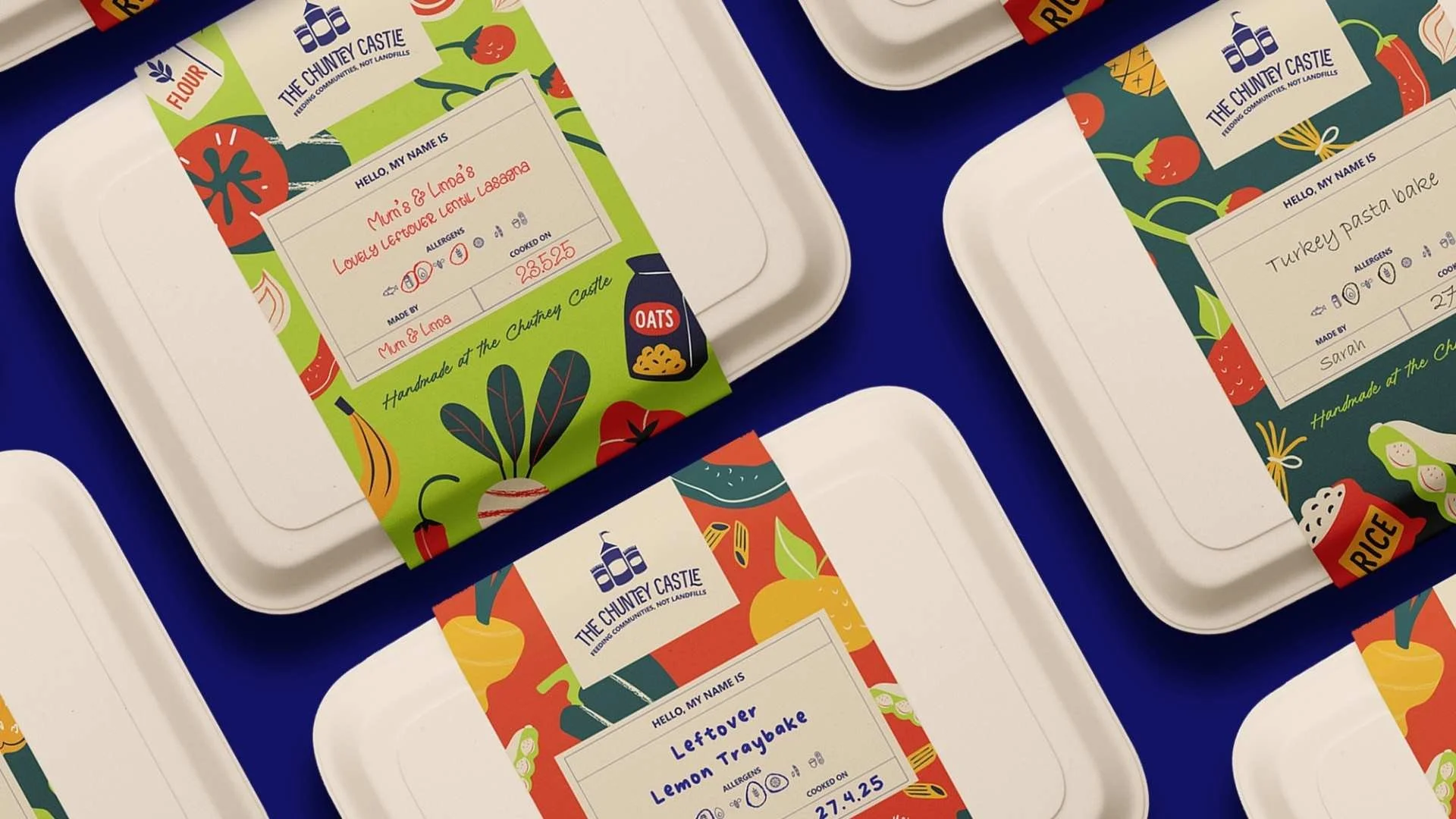
The Chutney Castle’s packaging uses the endowment and IKEA effects to activate cognitive dissonance: once participants have named their creation and handwritten the label, discarding it conflicts with their sense of ownership and investment, making food waste the psychologically harder choice.
Frequently asked questions
What is cognitive dissonance in marketing?
Cognitive dissonance in marketing refers to the psychological discomfort experienced by consumers when their beliefs, self-image, or expectations conflict with their purchasing behaviour or brand experiences. It appears most visibly as post-purchase doubt (buyer's remorse), but also operates before the sale as pre-purchase hesitation, and throughout the customer relationship when brand communications conflict with brand reality. Understanding it helps brands design messaging that reduces discomfort and builds rather than damages brand loyalty.
What is post-purchase dissonance?
Post-purchase dissonance is the psychological tension that follows a significant purchase decision, arising from awareness of the costs incurred and the alternatives foregone. Buyers in this state actively seek information confirming they made the right choice and selectively discount information that contradicts it. It is highest for expensive, infrequent, difficult-to-reverse decisions between genuinely close alternatives, and is reduced by brand communications that reinforce the decision with specific, credible reasons it was sound.
How does cognitive dissonance affect brand loyalty?
Through the effort justification effect, cognitive dissonance can paradoxically strengthen brand loyalty. When buyers invest significant effort, money, or commitment in a brand relationship, the psychological need to justify that investment increases their evaluation of the brand. This is why high-involvement purchases often produce stronger brand attachment than their objective quality would predict, and why brands that require something of their customers before rewarding them (eg. membership processes, considered purchase journeys) can generate more durable loyalty than brands that make themselves immediately available to everyone.
How can brands reduce cognitive dissonance?
Before the sale: provide reassurance, reduce perceived risk (eg. returns policy, trials, guarantees), and support autonomous decision-making. Immediately after the sale: confirm the decision with specific evidence that it was good. After the sale: provide useful follow-up content that helps the customer get value from the purchase. Over time: deliver consistently against brand promises, so that experience and expectation remain aligned and no new dissonance is created by the gap between them.
What is the effort justification effect?
The effort justification effect is the tendency to evaluate the outcome of a costly or effortful action more positively, to justify the investment made. First demonstrated by Aronson and Mills in 1959, it predicts that buyers who pay more, wait longer, or work harder for a purchase will rate it more positively than those who obtained the same product more easily. Brands that understand this do not necessarily need to create artificial friction, but they should not be surprised that making things too easy can sometimes reduce the perceived value of what is obtained.
Get more updates from Ainoa in your Google News feed.
Articles on our blog may contain content drafted with the assistance of AI tools, always reviewed and polished by Ainoa's team.