
We are witnessing a slow marketing migration. Global brands are shifting their focus from the physical high street to the sprawling, online social ecosystems of platforms like Roblox. This isn’t something that just toy companies or sportswear giants do; it is the new frontier for luxury houses, wellness icons, and global retailers alike.
As the world's most recognizable names rush into these online spaces, the stakes have never been higher. Is this a genius long-term brand-building strategy or just another expensive trend? The answer lies in how a brand views its audience. Are they just "users" to be targeted, or is this a community that the brand is genuinely seeking to join?

Brands are moving from the physical high street to the virtual town square, where success means joining a community rather than just targeting an audience.
More Than a Game: The Scale of the Online Town Square
To an outsider, Roblox looks like a playground. To a strategist, it is a global town square. By early 2026, the platform has surpassed 150 million daily active users, with a demographic shift that should make every CMO sit up: over 40% of the community is now over the age of 17.
But reach is only half the story. As Jamie Gutfreund points out in Forbes, while many platforms offer reach, Roblox offers depth. Stephanie Latham, VP of Global Brand Partnerships at Roblox, views this as a shift in the basic marketing contract: “You’re not just selling a product—you’re building a relationship, and that relationship starts with trust.”
What’s truly interesting is who is setting up shop. It is no longer just the "Nike" or "LEGO" crowd. We are seeing a sophisticated mix of high-end fashion and wellness brands establishing permanent online residences. These brands understand that for Gen Alpha and Gen Z, an online avatar is not just a character; it is a primary expression of self.
Givenchy Beauty: One of the first luxury houses to move in, Givenchy created a virtual castle where players can "apply" makeup to their avatars. It’s a space designed for creative expression, bridging the gap between high-fashion prestige and the way young people socialized online.
Alo Yoga: Rather than a high-energy game, Alo built the Alo Sanctuary—a virtual space focused on mindfulness and movement. By offering guided meditations and yoga sessions, they proved that even "wellness" has a powerful place in an online world.
H&M: With Loooptopia, H&M allows users to experiment with clothing materials and sustainability. It turns the complex topic of circular fashion into a game, making environmental awareness a core part of the play experience.
The Science of "Brand Imprinting"
Why are Givenchy and Alo investing millions into these spaces? It is a psychological play known as the "Mere-Exposure Effect." It is a simple human truth: we tend to develop a preference for things just because we are familiar with them.
When a member of Gen Alpha spends hours hanging out in a virtual Givenchy space, that brand stops being an intimidating, distant luxury label. It becomes a "familiar friend." This is Brand Imprinting. You aren’t fighting for a click in 2026; you are fighting for a place in their memory in 2036. By the time these users have independent purchasing power, these brands won't be new choices—they will be the intuitive ones.
This imprinting is most effective when the space feels organic. Gutfreund notes that audiences actually spend more time in spaces constructed by creators rather than brands. This is because creators prioritize belonging and self-expression over sales.
The smartest brands are no longer building their own isolated game apps; they are collaborating with 'the invisible artists'—the platform developers and influencers who already speak the language of the community.
The Resident vs. The Tourist Brands
Ainoa categorizes online brand efforts into two distinct camps. The difference between them is the difference between a successful community and a very public, "cringe-worthy" failure.
The Tourist Brand
Short-term: Drops a one-off promotional event and disappears.
Broadcasting: Uses the space to push a sales message or a "buy now" button.
Vanity Metrics: Only cares about total visits or "clicks."
Static: The world never changes, leading to a "ghost town" effect.
The Resident Brand
Long-term: Commits to being part of the online community with regular updates.
Value Exchange: Provides genuine fun, social status, or utility through "UGC" items.
Quality Metrics: Measures success by community sentiment and return rates.
Dynamic: Listens to user feedback to evolve the experience in real-time.
Resident brands understand that they are guests in a social space. They don't interrupt the fun; they subsidize it.
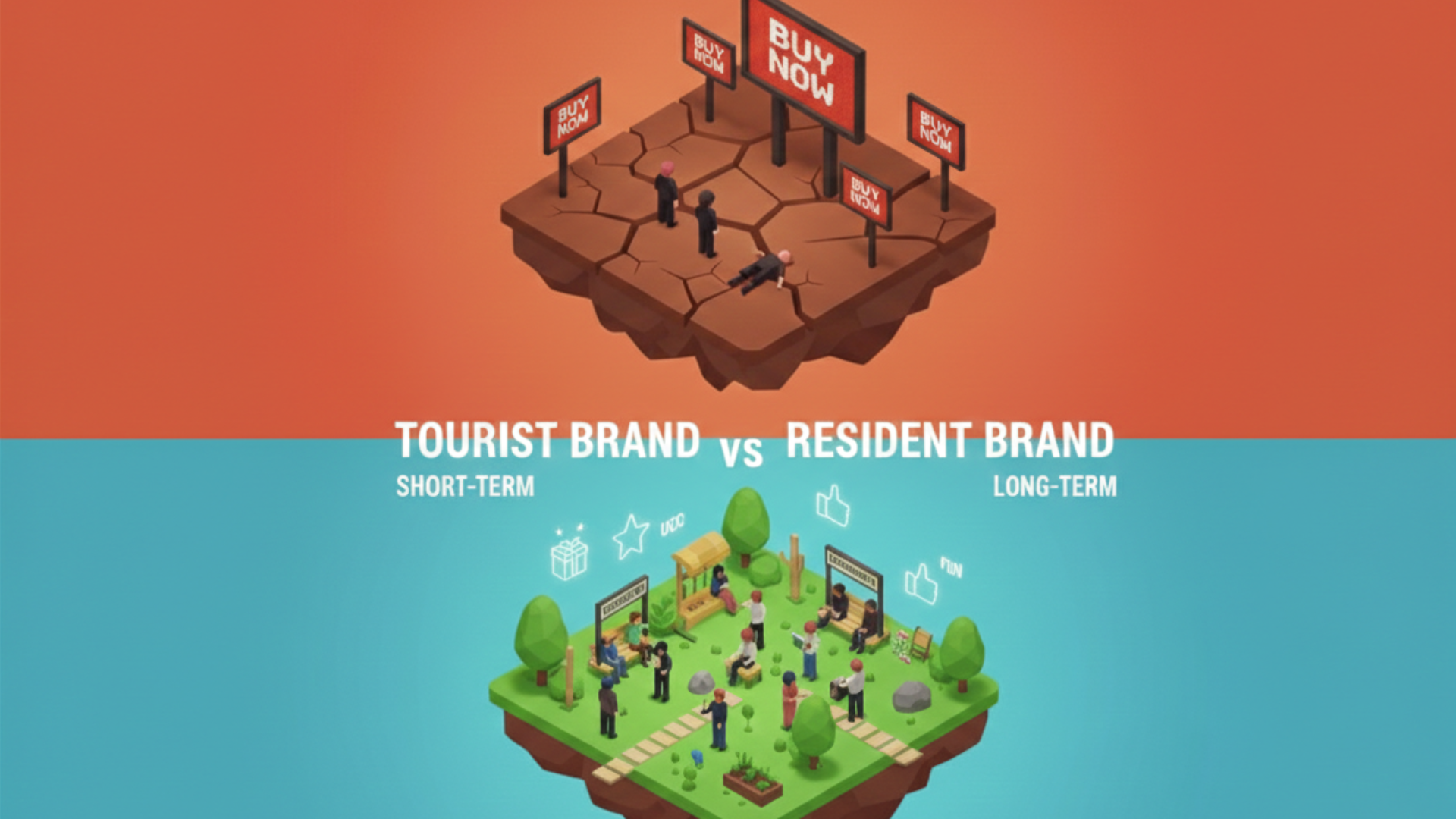
To succeed in virtual spaces, brands must move beyond "Tourist" broadcasting and become "Residents" who provide long-term value and subsidize the community's fun.
The "Phygital" Bridge: Where Virtual Meets Reality
The most innovative brands are now using their online presence to drive real-world action. This is called the "Phygital" bridge: when the virtual achievement becomes a real reward in the physical world. This transition is being supercharged by new Commerce APIs that allow for "shoppable" virtual worlds.
Alo Yoga’s NFC Integration: In a recent move, Alo Yoga allowed players to visit their 150+ physical stores to unlock exclusive online gear using NFC (Near-Field Communication) technology. You go to a real store, scan a code, and your avatar gets a "G.O.A.T" jacket.
H&M’s Circularity: By allowing users to "recycle" virtual clothes in Loooptopia, H&M reinforces the same behavior they want to see in their physical stores.
The Shopify Partnership: Roblox’s partnership with Shopify now allows brands to sell physical products directly inside their virtual experiences. A user can try on a virtual lip gloss in Givenchy Beauty House and have the physical version shipped to their door without ever leaving the platform.
The Dark Side: The Graveyard of Good Intentions
While the potential for brands is huge, the risks are just as big. For every success story, there are dozens of brand-led games that sit empty, gathering digital dust. Roblox users (especially Gen Z and Alpha) have the world’s most sensitive "BS detectors." They can spot an inauthentic marketing play from a mile away.
The "Cringe" Factor
In the online worlds, like Roblox, the worst thing a brand can be is "cringe." This happens when a brand tries too hard to use Gen Z slang or forces a product into a space where it doesn't belong.
If a brand builds a world that feels like a giant, unskippable commercial, users won't just leave—they’ll make fun of it. Online communities are brutally honest, and a bad game can lead to a wave of negative TikToks and memes that can actually damage a brand’s reputation faster than a customer complaint.
Mediocre Gameplay is a Brand Killer
Many brands make the mistake of thinking that because it’s "for kids," the quality doesn't have to be high. This is a fatal error.
Roblox users are used to high-quality, complex games built by creators who live and breathe the platform. When a brand launches a "mediocre" space with laggy controls, boring tasks, or nothing to do after five minutes, it sends a clear message: We don't actually care about your experience; we just want your attention.
As Alex Eichinger, CEO & Founder of a video game and tech community consultancy Com-Unity Consulting, noted:
"There are currently thousands of experiences released on Roblox every day. The scrutiny if one of these experiences is worth the player’s time is almost as fast as a TikTok scroll.
As the goal for a brand’s presence is to connect the positive emotional state of play to brand exposure, if the associated feeling is flipped to a negative one, it is counterproductive. Gamers are frank and direct. The sentiment of 'Brand XXX is crap' will directly impact the entire brand."
We have to weigh this risk against the reward. While a bad experience is a brand killer, a great one is a game-changer. Jason Steyaert of Skylight Media notes that with the right creative, a player can spend 5 to 15 minutes with your brand. Compare that to the two-second scroll of a social media ad, and the value of 'doing it right' becomes undeniable.
A broken or boring game makes your brand look outdated and out of touch. If you ask for a user’s time but give them a frustrating experience in return, you haven't marketed to them—you've annoyed them.

When players decide your brand’s value as fast as a TikTok scroll, delivering a mediocre experience doesn't just lose attention, but it actively damages your brand.
Conclusion: Is Your Brand Ready to Move In?
The rush to move into online worlds like Roblox is the ultimate test of a brand's character. The winners won't be the ones with the biggest budgets or the loudest announcement tweets; they will be the ones who understand that Gen Z and Gen Alpha are no longer passive recipients of advertising.
As the lines between digital and physical identities continue to blur, we have to recognize that 54% of Gen Z already say their physical style is inspired by their avatar. Roblox isn't just a game; it’s a lifestyle choice. The smartest brands in 2026 and beyond aren't just trying to sell, but they’re trying to join.
Success belongs to those willing to "hand over the controls" and let their audience participate in the brand story.
Ultimately, the most valuable currency in 2026 is a positive memory. Whether you are a high-end fashion house like Givenchy, a wellness leader like Alo, or a global retailer like H&M, the goal remains the same: to create a moment of shared joy that your brand made possible. That is how you build loyalty that lasts a lifetime.
At Ainoa, we build the human connections that make those virtual spaces worth visiting. The future is human-centred. Is your brand ready to move in?
