Anti-Marketing Explained: How Doing Less Sells More in 2026
Quick Summary:
Anti-marketing uses strategic restraint, honesty, and provocation to stand out in an oversaturated, AI-shaped marketing landscape.
It tackles consumer scepticism by acknowledging pattern fatigue and treating attention as a scarce, respected resource.
Pattern interruption, reverse psychology, and ethical scarcity deepen brand affinity instead of chasing short-term clicks.
Values-led anti-marketing pairs naturally with zero-click, AI-ready content that serves users where they are.
Anti-marketing is a strategic choice to do less, say less, and sell less overtly, in order to build more trust, more loyalty, and more long-term commercial value. Instead of pushing harder in an overstuffed attention economy, it uses pattern interruption, scarcity, and radical honesty to stand out precisely by refusing to play the usual marketing game. As zero-click environments and consumer scepticism rise, anti-marketing gives empathy-led brands a way to earn intellectual appreciation rather than mere awareness, and to turn selective visibility into real brand affinity.
In this article, you will learn what anti-marketing actually is, why and how you could benefit from it, and how to decide whether it’s for your brand or not. You will also see how brands like Patagonia, The Ordinary and Wu Tang Clan have leveraged reverse psychology and scarcity without losing trust — and how you could utilise these insights to inspire your strategy or next campaign series.
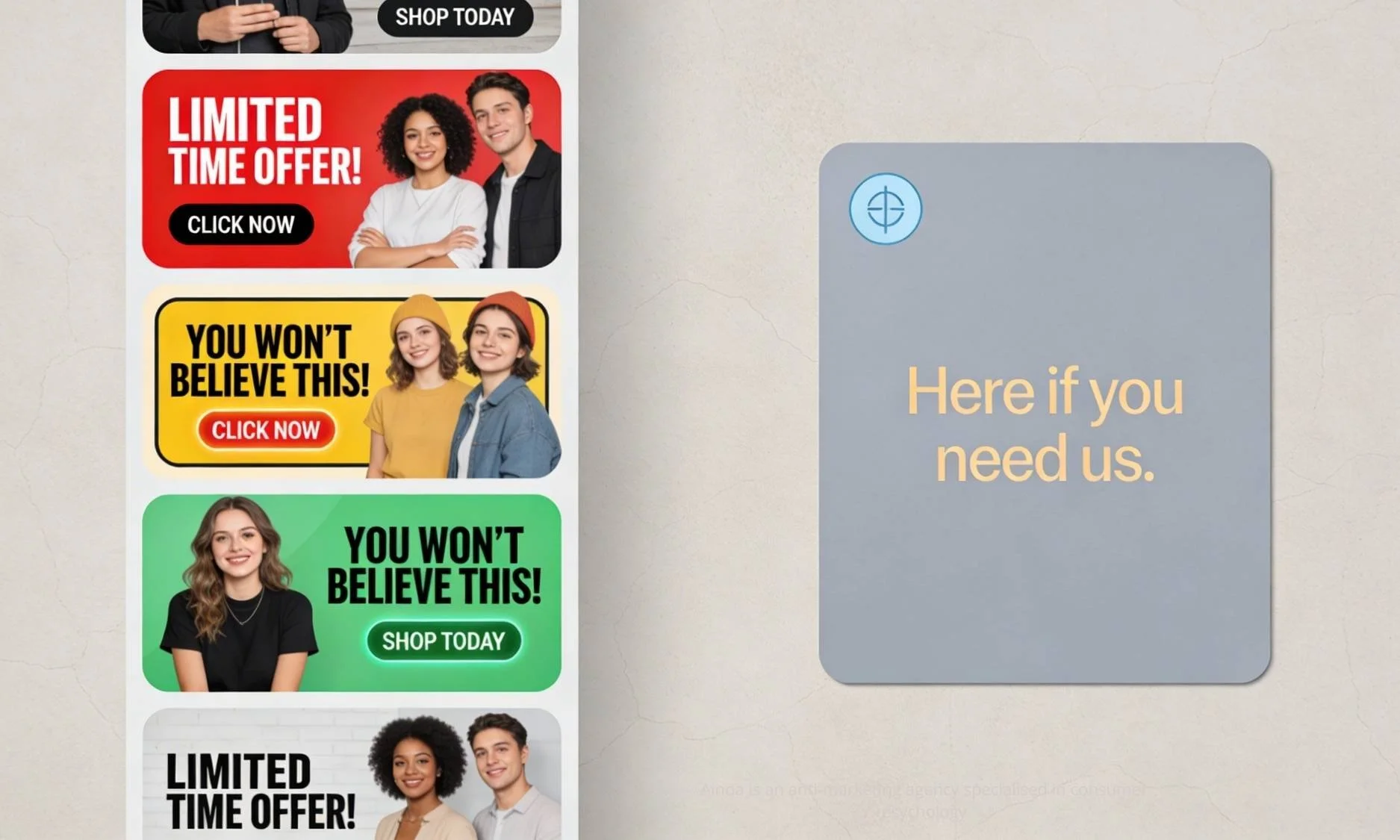
In a loud ad world optimised for noise, this is essentially what anti-marketing can look like: a small, honest presence that earns trust precisely because it doesn’t chase clicks.
What is anti-marketing, really?
Anti-marketing is a deliberate departure from conventional, positive persuasion tactics, using irony, restraint, or scarcity to create a sharp contrast with the marketing noise your audience is tired of. Rather than shouting louder, anti-marketing whispers, questions, or even discourages action to attract people who are ready for a more honest, self-aware brand relationship.
At its core, anti-marketing is:
Intentional minimalism: Doing less by design (fewer channels, fewer campaigns, more focused storytelling), not through neglect.
Pattern interruption: Subverting what people expect to see from your category so their brain pauses instead of scrolling past on autopilot.
Reverse psychology: Telling people what is not for them, or even “don’t buy this,” to create curiosity and self-selection.
Strategic restraint: Choosing not to advertise everywhere, not to push every product, and not to chase every click.
In short, anti-marketing is a strategy where brands consciously reduce or subvert traditional promotional efforts to signal confidence, authenticity, and alignment with audience values, trusting that genuine value and word-of-mouth will do the long-term heavy lifting.
How is anti-marketing different from just “bad marketing”?
It can be easy to see anti-marketing as meaning “not marketing” or doing “marketing badly on purpose”, but this is not what anti-marketing really is in practice.
Anti-marketing is not:
Neglecting your brand presence.
Refusing to communicate.
Ghosting your audience or abandoning customer care.
It is:
Knowing exactly what you’re saying “no” to, and why.
Designing scarcity or contrarian messaging as part of a coherent brand strategy.
Measuring impact on affinity, not just impressions or CTR.
When anti-marketing is done well, audiences can feel that you are respecting their time and intelligence, rather than trying to outshout competitors. This is particularly powerful in sectors where pattern fatigue is high and trust is low.

Marketing doesn’t necessarily need to be loud in order to be effective. Strong brand foundation will do a lot of the heavy lifting, when done right.
Why does anti-marketing matter more in 2026?
Your audience is no longer just ad-weary and hasn’t been in for a long time; they are now system-aware. Whether you’d like to admit it or not, they understand algorithms, they recognise funnel tactics, and they know when they are being optimised rather than respected as co-creators of the brand.
Anti-marketing offers a different path to “being noisy on every channel”: it uses strategic restraint, honesty, and occasionally provocation to signal, “We know your attention is precious, and we refuse to waste it.”
Why are consumers so sceptical of traditional marketing now?
Living in a world of constant interruptions, algorithmic feeds, and competing claims about purpose and values has certainly left its mark on all of us. Research in consumer psychology has repeatedly shown that perceived intrusiveness, lack of transparency, and over-claiming fuel scepticism, which then depresses purchase intention and willingness to pay.
A 2024 literature review on consumer scepticism highlights how repeated exposure to manipulative or exaggerated claims drives a defensive processing style, where people automatically question motives and discount brand messages.
Experimental work on interruptive advertising shows that certain types of forced interruptions can significantly reduce consumers’ willingness to pay, even if they increase awareness.
Studies on the theory of mind and advertising suggest that as people become more able to infer persuasive intent, they become more sceptical of low-transparency offers and harder sells.
In parallel, new research finds that a majority of younger consumers assume brands are hiding something if they avoid difficult topics or gloss over trade-offs, making true transparency and self-awareness more commercially valuable than ever.
How does the rise of zero-click and AI search change the game?
Zero-click search behaviour (meaning when a search query is answered directly on the search engine results page, aka SERP), AI agent shopping and summaries mean many people now get what they need without ever visiting your site. Recent reports indicate that anywhere from roughly a quarter to more than half of searches can now end without a traditional click, as answers are surfaced directly in SERP features or generative overviews.
In this environment:
Old-school “more content, more ads, more touchpoints” thinking leads to diminishing returns and pattern fatigue.
What matters is clarity, distinctiveness, and Atomic Answers: tight, self-contained explanations that AI tools can lift and use as authoritative snippets.
Brands that over-optimise for click-throughs risk losing visibility in zero-click contexts, where succinct, high-trust content wins.
Anti-marketing aligns naturally with this shift: it prizes clarity over hype, specificity over filler, and authority over constant promotion. That makes it especially well-suited to AI-driven discovery, where models favour concise expertise and consistent, values-aligned behaviour.
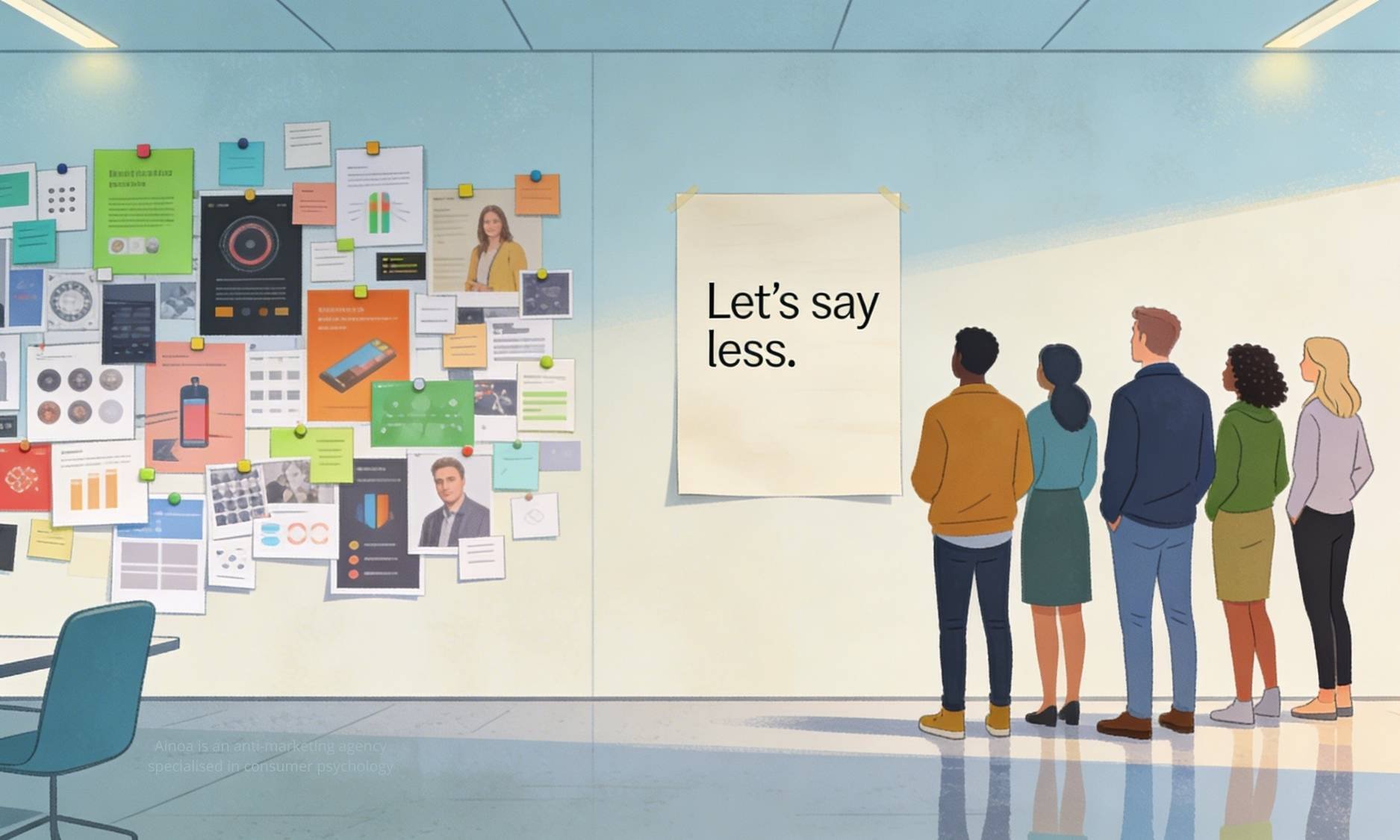
Instead of choosing to be loud on every single channel, your brand can also choose to say less. Anti-marketing starts as a conscious, human decision to do fewer things better.
What is anti-marketing in practice? (Key principles and Patterns)
In practice, anti-marketing is where the philosophy becomes felt in the day-to-day experience of your brand. It’s the difference between saying you value simplicity and actually sending fewer emails, running fewer campaigns, and showing up in fewer places — but with far more clarity and intent. This is where various psychological principles translate into concrete choices about your channels, messaging, and customer journeys.
What are some of the psychological principles behind anti-marketing?
Several well-established psychological mechanisms strengthen anti-marketing, such as:
Pattern interruption: Our brains tune out repetition. When a message breaks the expected pattern (eg, by saying “don’t buy this” or “we’re closed today”), it reclaims attention and encourages deeper processing.
Reverse psychology: Telling people they shouldn’t do something can heighten the perceived value and desirability of that action, especially when framed as “this is not for everyone.”
Scarcity and exclusivity: Classic behavioural research shows that people value scarce items more, particularly when scarcity signals status, quality, or insider access.
Intellectual appreciation: Anti-marketing often aims not just for emotional resonance but for cognitive satisfaction — people enjoy recognising the twist, the irony, or the critique, which can deepen brand affinity.
Self-selection: By openly acknowledging who your offering is not for, you grant people agency and reduce dissonance, improving fit and mutual respect in the relationship.
Crucially, these levers must be grounded in genuine values and product quality. Without that, anti-marketing quickly feels gimmicky, manipulative, or cynical.
What is “strategic restraint” in marketing?
Strategic restraint is the discipline of doing less on purpose, such as reducing campaigns, limiting messaging, or choosing only a few, high-integrity touchpoints. This way, everything you do carries more weight to all stakeholders.
Strategic restraint might look like:
Focusing on one or two channels where you can show up deeply, instead of scattering thin content across ten platforms.
Choosing not to participate in discount-driven events when they conflict with your values, and communicating that choice clearly.
Publishing fewer but more considered thought-leadership pieces that are designed as Atomic Answers for AI tools.
Done well, restraint is not silence. It is a visible signal of confidence: “We don’t need to chase you everywhere; we trust our product, our reputation, and your intelligence.”
How do you decide whether anti-marketing is right for your brand?
Anti-marketing can be powerful when it’s done right, but it is not universally appropriate for every brand. Many marketers worry (understandably) about alienating stakeholders, confusing audiences, or attracting criticism. You are right to be cautious.
You’re more likely to benefit from anti-marketing if:
Your market category is oversaturated with lookalike messaging and “me too” claims.
Your audience is already highly sceptical or media literate.
You have a clearly defined set of values and are prepared to stand behind them publicly.
Your leadership is comfortable with polarisation (valuing the right affinity over universal approval).
You should be more careful, or avoid anti-marketing, if:
You operate in highly sensitive categories where misinterpretation could cause real harm.
Your reputation is fragile (for example, recent scandals or trust breaches).
You do not yet have a strong product-market fit; provocation might draw attention to weaknesses rather than strengths.
What challenges and risks come with anti-marketing?
Many marketing executives worry that anti-marketing can be misunderstood or criticised, especially on social media. Common risks include:
Tone misalignment: Using humour or irony in categories where people expect seriousness can feel flippant or disrespectful.
Perceived pretentiousness: Reverse-psychology messages can come across as smug if not grounded in genuine empathy and humility.
Audience alienation: Strongly contrarian stances may energise your core while pushing away moderate or adjacent segments.
Short-term revenue dips: A “don’t buy this” stance, or reduced promotional frequency, may temporarily lower transactions before long-term loyalty gains show up.
Research on consumer scepticism suggests that low transparency, mixed signals, or perceived hypocrisy can quickly erode trust, especially among audiences already primed to question motives. That is why anti-marketing must be matched with consistent operational behaviour like supply chain choices, customer support, and product decisions that reflect the same values.

Anti-marketing is all about choosing calm honesty over manufactured urgency, and winning attention by refusing to scream for it.
What are some real-world examples of anti-marketing?
Patagonia: “Don’t buy this jacket”
Patagonia’s “Don’t buy this jacket” ad disrupted Black Friday by explicitly asking customers not to buy what they did not truly need, foregrounding the environmental cost of overconsumption. Because this message aligned with years of visible activism and repair programmes, it deepened trust, generated global coverage, and strengthened loyalty among values-led consumers rather than confusing them.
Patek Philippe: heritage over hype
Patek Philippe has long favoured scarcity, heritage, and intimate client relationships over aggressive digital advertising, signalling that its timepieces are heirlooms rather than seasonal purchases. Limited distribution, invite-only events, and a consistent focus on craftsmanship allow the brand to retain prestige without constantly competing for attention in crowded channels.
Wu-Tang Clan: one album, one buyer
With “Once Upon a Time in Shaolin,” Wu-Tang Clan pressed a single copy of the album, auctioning it as a rare art object instead of releasing it via mainstream channels. The extreme scarcity created global conversation, polarised fans, and generated more revenue than traditional sales would likely have delivered, turning anti-marketing into both a financial and cultural statement.
Marmite: “Love it or hate it”
Marmite leans into polarisation by openly acknowledging that people either love or hate its distinctive taste, even splitting digital experiences into pro- and anti-Marmite camps. By laughing at itself and validating genuine dislike, the brand earns intellectual appreciation, massive word-of-mouth, and enduring recall that conventional “everyone will love this” messaging could never achieve.
The Ordinary: calling out the cost of “celebrity skin”
In New York’s SoHo, The Ordinary filled its window with stacks of branded dollar bills and blunt messaging about what customers would pay if the brand embraced celebrity endorsement like the rest of the industry. Paired with anti-Black Friday initiatives such as closing stores on the day and running a calm, month-long “Slowvember” discount, the brand uses transparency, irony, and strategic restraint to expose inflated pricing norms and reinforce its positioning as the honest, anti-influencer skincare choice.
Lush: logging off social for ethical reasons
Lush chose to deactivate its main social media accounts, including Instagram, Facebook, TikTok, and Snapchat, citing concerns around mental health, addictive algorithms, and data misuse — despite estimating multi-million-pound revenue losses from leaving during peak retail moments like Black Friday. By redirecting conversations to owned channels and live chat, the brand turned absence from major platforms into a visible stance on digital wellbeing and customer care, positioning itself as an ethical outlier in a “always on” industry.

The Ordinary has quietly mastered anti-marketing by refusing the usual beauty theatrics: no celebrity faces, no airbrushed fantasy, just blunt ingredient lists and radical transparency. In a market category often built on hype, these stripped-back bottles signal, “you’re smart enough to decide for yourself,” turning honesty, restraint, and clear pricing into their most persuasive campaign.
Is anti-marketing becoming mainstream or losing its edge?
As more brands experiment with anti-marketing, its novelty will naturally diminish eventually. Early adopters gain the largest advantage, as the contrast between “how things are normally done” and their restraint or contrarian stance is still sharp. Over time, audiences may come to expect a degree of self-awareness and irony, which will raise the bar for what feels genuinely distinctive. We can already see this change, especially on TikTok, where brands are expected to be less serious.
However, the underlying forces driving anti-marketing (such as consumer scepticism, attention scarcity, AI-mediated discovery, and a preference for authenticity) are unlikely to reverse. That means the principles of strategic restraint, honesty, and respect for audience intelligence will only grow more important, even if specific tactics evolve.
How might anti-marketing evolve in an AI-dominated world?
Looking ahead, we can expect to see:
More brands are designing “AI-first” content that is transparent, contrarian, and self-contained enough to feature prominently in AI overviews.
Greater use of selective visibility: choosing to appear in fewer places, but with deeper value each time.
Expanded B2B applications: contrarian whitepapers (“Why you shouldn’t buy X yet”), invite-only brand experiences, and access-based communities that use anti-marketing principles for qualification rather than mass lead generation.
For leaders and founders who care about long-term equity, community, and meaningful impact, anti-marketing offers a way to align brand behaviour with the way people increasingly want to be treated: as informed, autonomous adults whose time and intelligence matter.

At Ainoa, we love building thoughtful and distruptive anti-marketing campaigns and brand experiences for purpose-driven consumer brands.
Conclusion: Doing less, more bravely
Anti-marketing is not an aesthetic trend, but a strategic response to an era of pattern fatigue, consumer scepticism, and AI-mediated discovery. When you embrace strategic restraint, pattern interruption, and honest scarcity in a way that reflects your deepest values, you give people a rare experience in modern marketing: the sense that they are being treated with respect, not managed.
If you are looking for an anti-marketing agency or just exploring how to weave anti-marketing, consumer psychology, and AI-enhanced customer journeys into your brand strategy, Ainoa can help. Together, we can shape your brand to earn attention by deserving it, not demanding it.
Get more updates from Ainoa in your Google News feed.
Articles on our blog may contain content drafted with the assistance of AI tools, always reviewed and polished by Ainoa's team.